
Carnet Application in Singapore
Declarators offer the lowest cost for complicated and tedious Carnet applications. Why go through unnecessary hassles when you can expect to save time and money by engaging Declarators as your broker? We are one of the few specialist in Singapore for carnet applications. Call us now or email us at group@declarators.com.sg for any enquiries.
What is a ATA or TDB/BOFT Carnet?
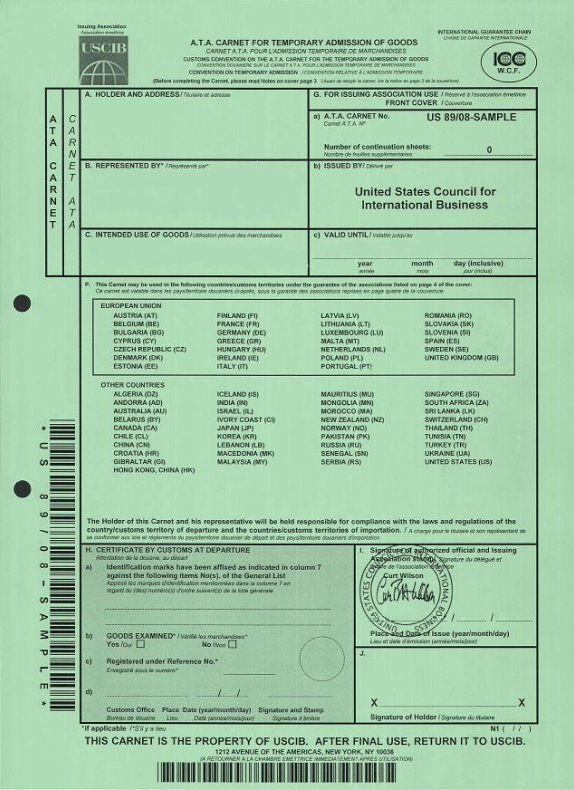
The ATA Carnet is an international customs document that permits the tax-free and duty-free temporary export and import of goods for up to one year. The Carnet eliminates the need to purchase temporary import bonds. So long as the goods are re-exported within the allotted time frame, no duties or taxes are due. Failure to re-export all or some of the goods listed on the Carnet results in the payment of applicable duties and taxes. Failure to remit those duties results in a claim from the foreign customs service to the importer’s home country.
The ATA Carnet is jointly administered by the World Customs Organization (WCO) and the International Chamber of Commerce through its World Chambers Federation.
Which Item Categories can be used for Carnet?
Carnets apply to three broad categories of merchandise
- Commercial Samples
- Professional Equipment
- Goods for use at exhibitions and fairs
Advantages of Engaging Declarators for Carnet Application
Carnets apply to three broad categories of merchandise
- Reduce time taken for time-consuming coordinations, tedious carnet alignments
- Save costs on multiple courier/despatch trips (Each Application requires approx 7 to 10 trips)
- All-in one stop service provider
- No more worrying of rejection/amendments, we ensure an approved Carnet!
Real Life Case Study
Challenge: A Singapore-based engineering company needed to temporarily bring specialised equipment to Germany for an exhibition and subsequently return the equipment to Singapore.
Solution: Declarators reviewed the equipment list, checked the identification details and assisted with the Carnet application and supporting documentation.
Outcome: The customer was able to use the Carnet for the temporary movement of the equipment, reducing the need to arrange separate temporary import procedures for the shipment.
FAQs About ATA Carnet Application
Q: What is an ATA Carnet?
An ATA Carnet is an international customs document that facilitates the temporary movement of eligible goods across international borders without the payment of import duties and taxes at each destination, provided the goods are subsequently re-exported or re-imported within the prescribed period.
Often referred to as a “passport for goods,” an ATA Carnet can generally facilitate duty-free and tax-free temporary importation for up to one year. It is commonly used for commercial samples, professional equipment, exhibition and trade fair goods, tools, and other eligible items intended for temporary use overseas.
Declarators assists businesses with the ATA Carnet process, including coordinating the Carnet application, preparing and reviewing item lists, arranging supporting documentation, addressing security requirements, processing amendments where required, and coordinating dispatch arrangements where applicable.
An ATA Carnet does not eliminate customs or regulatory compliance requirements. The goods must remain identifiable, must generally be re-exported in the required condition and within the permitted period, and must be properly presented to customs authorities for endorsement at the relevant points of departure and entry.
With proper preparation and documentation, an ATA Carnet can simplify international temporary exports and imports while helping businesses avoid the need to pay import duties and taxes at each destination.
Q: Who should use an ATA Carnet?
An ATA Carnet is suitable for companies, businesses and professionals who need to temporarily move eligible goods overseas for exhibitions, trade fairs, demonstrations, customer presentations, business development activities, filming, repairs, technical work or professional assignments.
Common users of ATA Carnets include exhibitors, technicians, travelling sales representatives, engineers, entertainers, film crews and other specialist teams travelling on behalf of or under contract with Singapore-registered companies. An ATA Carnet is particularly useful when goods are being transported to one or more countries temporarily and are intended to return to Singapore rather than being sold, processed or consumed overseas.
By using an ATA Carnet, eligible goods may be temporarily imported into participating countries without the need to arrange separate temporary import procedures and payment of import duties and taxes at each destination, subject to the customs requirements of the countries involved.
However, not every shipment or item is automatically eligible for an ATA Carnet. Suitability may depend on factors such as the destination country, type and classification of goods, declared value, serial-number or other identification requirements, intended use, duration of stay and planned re-export arrangements.
Declarators can assist businesses in assessing whether an ATA Carnet is appropriate for their shipment and intended itinerary before the application process begins. This preliminary assessment can help identify potential documentation, eligibility and customs requirements early, reducing the risk of delays or complications during international travel.
Q: What types of goods can usually be covered by an ATA Carnet?
ATA Carnets generally cover three main categories of goods: commercial samples, professional equipment, and goods intended for exhibitions or trade fairs.
Examples of goods that may be covered include advertising and promotional materials, exhibition goods, cinematographic and musical equipment, costumes and stage props, educational equipment, press and broadcasting equipment, professional tools, and surgical or medical equipment, subject to the applicable customs requirements and the acceptance of the destination country.
In practical terms, goods covered by an ATA Carnet should be clearly identifiable and capable of being re-exported in the required condition. Items with serial numbers, model numbers, equipment references, detailed descriptions, photographs and properly prepared item lists are generally easier to identify and document than loose consumables or generic goods that may be difficult to trace.
Declarators assists clients with preparing and reviewing the Carnet item schedule, including item descriptions, quantities, values, identification details, destination countries and supporting documentation. Where appropriate, additional evidence such as photographs, serial-number records or detailed equipment lists may also be required.
If the goods are controlled, sensitive, high-value, dutiable or difficult to identify, additional eligibility and customs checks may be necessary before proceeding with an ATA Carnet. Declarators can help assess the goods and intended movement in advance to determine whether a Carnet arrangement is suitable.
Q: What goods are not suitable for an ATA Carnet?
An ATA Carnet is generally not suitable for goods that are intended to be sold, disposed of, processed, consumed, given away or permanently imported into the destination country. It may also be unsuitable where the goods cannot be adequately identified and matched when they are re-exported or returned.
For temporary imports into Singapore, Singapore Customs allows foreign entities to use ATA Carnets for eligible goods temporarily imported for display or use at exhibitions, fairs and similar events, subject to the applicable requirements. Certain goods, including intoxicating liquors and tobacco, are excluded from this facilitation.
Where goods are subject to import controls, the Carnet holder may need to obtain an assessment or approval from the relevant Competent Authority before the goods can be imported into Singapore.
Particular care should be taken with goods that may be consumed, used up, altered, processed, permanently installed or transferred to another party. Such goods may not satisfy the requirements of a temporary import arrangement and could potentially result in duties, GST, customs claims, penalties or other compliance issues if the Carnet conditions are not properly fulfilled.
Declarators can help businesses identify potential eligibility and compliance risks before an ATA Carnet application is submitted, including reviewing the nature of the goods, intended use, destination, identification requirements and planned re-export arrangements.
Q: Who issues ATA Carnets in Singapore?
For Singapore exporters, ATA Carnets are issued through the Singapore International Chamber of Commerce (SICC). Singapore Customs states that Singapore exporters may apply to SICC for an ATA Carnet when temporarily exporting eligible goods for approved purposes. In such circumstances, the ATA Carnet may be used in place of a Singapore Customs export permit, subject to the applicable requirements.
Declarators does not act as the issuing authority or replace the role of Singapore Customs or SICC. Instead, Declarators provides operational support throughout the Carnet preparation process. This may include collecting and reviewing item details, checking supporting documents, preparing and organising the Carnet item schedule, coordinating the countries and travel dates, monitoring clarification requests, and arranging document dispatch where applicable.
This coordination is important because an ATA Carnet involves more than simply completing paperwork. The Carnet document, goods, itinerary and intended temporary-use purpose must remain consistent throughout the movement. Proper preparation can help reduce documentation discrepancies and avoid unnecessary delays at customs checkpoints.
Final issuance of an ATA Carnet remains subject to SICC’s applicable requirements, fees, security arrangements and approval procedures. Declarators can assist with the preparation and coordination process while the final issuance decision remains with the relevant issuing and customs authorities.
Q: How long can goods stay overseas under an ATA Carnet?
Internationally, an ATA Carnet is generally valid for up to one year, allowing eligible goods to be temporarily imported without the payment of customs duties and taxes, subject to the requirements of the countries involved. However, the actual period available for temporary admission may be shorter depending on the Carnet’s validity period and any specific deadline imposed by the customs authorities at the destination.
For Singapore procedures, Singapore Customs states that goods temporarily exported from Singapore under a local ATA Carnet must generally be re-imported into Singapore within six months from the date of export, provided this period remains within the validity of the Carnet.
Similarly, goods entering Singapore under a foreign ATA Carnet for temporary admission may be subject to a six-month temporary import period or the remaining validity of the Carnet, depending on the applicable requirements.
This distinction is important because the one-year Carnet validity does not necessarily mean that goods can remain in a country for the full one-year period. The applicable customs deadline may be shorter.
Declarators can assist customers in planning their ATA Carnet movements around the applicable customs deadlines, including the Carnet validity date, temporary admission period, planned travel itinerary and required re-export or re-import date. This helps businesses manage the operational deadline rather than relying solely on the headline one-year Carnet validity.
Q: What information is needed for an ATA Carnet application?
A well-prepared ATA Carnet application requires complete and accurate information about the goods, their intended use and the planned international movement. Depending on the shipment and destination, this may include the item list, declared values, serial numbers, model numbers, quantities, detailed descriptions, countries of travel, travel dates, temporary-use purpose, planned re-export or re-import arrangements, Carnet holder details and supporting commercial documents.
For professional equipment, each item should be clearly identified so that customs authorities can match the physical goods against the Carnet documentation during the export, import, re-export and re-import stages. Accurate identification details such as serial numbers, model numbers, photographs and equipment references can be particularly useful.
For exhibition and trade fair goods, information such as the event name, venue, destination, exhibition dates and planned movement dates may be relevant. For commercial samples, the descriptions should clearly identify the goods as samples and indicate that they are being temporarily imported rather than intended for sale or consumption.
Declarators assists customers in organising and reviewing the required information so that the Carnet application, item schedule and supporting documents remain consistent. Incomplete values, vague descriptions, missing identification details, incomplete serial numbers or changes to the planned itinerary can potentially result in clarification requests or processing delays.
Where the destination country imposes additional restrictions or requirements, supplementary documents, approvals or customs checks may be necessary. Reviewing these requirements before submission can help businesses prepare a more complete and accurate ATA Carnet application.
Q: Why are serial numbers and item descriptions important?
Serial numbers and detailed item descriptions are important when using an ATA Carnet because customs authorities need to be able to identify and verify the goods at each stage of their international movement. This can include departure from Singapore, arrival in the destination country, re-export from that country and eventual re-import into Singapore.
An ATA Carnet works most effectively when each item can be clearly matched to the corresponding entry in the Carnet documentation. For professional equipment, useful identification details may include the brand, model, serial number, quantity, declared value, dimensions and other distinguishing characteristics, where applicable.
For sets, kits or multiple-piece equipment, the item schedule should provide sufficient detail rather than relying on broad descriptions such as “tools,” “samples” or “equipment.” Where appropriate, individual components or items should be separately identified so customs officers can verify the goods accurately.
Incomplete or overly vague descriptions may increase the risk of customs queries, processing delays, identification issues or potential claims if authorities are unable to establish that the goods being re-exported or re-imported correspond to those listed on the Carnet.
Declarators assists customers in preparing and reviewing clearer ATA Carnet item schedules and can flag incomplete or weak descriptions before submission. Detailed documentation is particularly important for high-value professional equipment, exhibition and trade-show goods, filming equipment, medical equipment, technical demonstration kits and specialised tools.
Q: What happens at Singapore checkpoints when using an ATA Carnet?
The ATA Carnet and the corresponding goods must be presented to customs officers for verification and endorsement at the relevant stages of the international movement. This allows customs authorities to confirm that the goods match the Carnet documentation and that the temporary import or export requirements are being properly fulfilled.
According to Singapore Customs, for foreign ATA Carnets, the Carnet and goods must generally be presented upon arrival in Singapore and again when the goods are re-exported. For local ATA Carnets, the Carnet and goods must be presented during the temporary export from Singapore and subsequent re-import into Singapore.
The endorsement process is an important part of ATA Carnet compliance. The stamped vouchers and counterfoils provide documentary evidence of the goods’ movements and help demonstrate that the required customs procedures have been completed.
If the appropriate customs endorsements are missed, the Carnet holder may subsequently face difficulties proving that the goods were properly exported, re-exported, re-imported or otherwise accounted for within the applicable timeframe. This may potentially lead to customs queries, claims or other compliance issues.
Declarators can assist with coordinating document dispatch and providing practical instructions regarding the required customs checkpoints. However, responsibility for ensuring that the ATA Carnet physically travels with the goods and is presented to the relevant customs authorities ultimately rests with the Carnet holder, traveller or appointed logistics party.
Q: Is Customs supervision required for containerised Carnet goods?
Customs supervision may be required when goods covered by an ATA Carnet are transported in containers. The supervision requirements depend on whether the goods are being temporarily imported into or re-exported from Singapore under a foreign Carnet, or temporarily exported from and subsequently re-imported into Singapore under a local Carnet.
According to Singapore Customs, where goods covered by a foreign ATA Carnet are temporarily imported or re-exported in containers, the foreign entity or its appointed freight forwarder must generally apply for Customs supervision of the unstuffing or stuffing operation at least one working day before the intended operation.
For goods moving under a local ATA Carnet, Singapore exporters may similarly be required to arrange Customs supervision for packing or stuffing before temporary export, as well as supervision of unstuffing following re-import where the goods are transported in containers.
These requirements are important operational considerations and can easily be overlooked if an ATA Carnet is treated simply as a travel document. Failure to arrange the necessary supervision in advance could potentially result in operational delays, missed cargo handling windows or customs compliance issues.
Declarators can help identify whether Customs supervision is required and coordinate the relevant operational arrangements, including warehouse coordination, stuffing and unstuffing schedules, cargo handling dates and communication with the appointed freight forwarder before the goods are moved.
Q: What happens if goods are sold, lost or not re-exported?
Goods covered by an ATA Carnet must generally remain under the temporary admission or temporary export arrangement and be properly accounted for within the applicable period. If Carnet goods are sold, lost, disposed of, consumed, transferred to another party or otherwise not re-exported or re-imported as required, customs duties, GST, taxes or other claims may arise.
According to Singapore Customs, where goods temporarily imported into Singapore under an ATA Carnet are subsequently sold, GST may become payable based on the selling price at the point ownership is transferred.
Where goods cannot be accounted for before re-export, Singapore Customs may also seek recovery of applicable duty and/or GST from the Carnet holder, subject to the relevant requirements.
Internationally, an ATA Carnet also serves as part of a customs guarantee system for potential duties and taxes. Failure to comply with the conditions of temporary admission or export may therefore result in a customs claim being pursued through the applicable guaranteeing chain.
Declarators can assist customers with planning the required re-export or re-import arrangements, movement dates and documentation. However, the Carnet holder remains responsible for ensuring that all goods listed on the Carnet are properly accounted for and that the applicable customs requirements are fulfilled.
If there is any anticipated sale, disposal, transfer, consumption or change in the intended use of the goods, this should be raised and reviewed before the goods are moved. Addressing such changes in advance can help avoid unexpected customs duties, GST, claims or compliance issues after the shipment has already taken place
Q: Can one ATA Carnet cover multiple countries or trips?
Yes. One ATA Carnet can generally be used for multiple destinations and trips during its validity period, provided the countries involved participate in the ATA Carnet system, the goods are eligible and the planned movements are properly reflected in the Carnet documentation.
The International Chamber of Commerce (ICC) notes that an ATA Carnet can be used for multiple destinations and trips throughout its validity period. Similarly, the Singapore International Chamber of Commerce (SICC) explains that an ATA Carnet can facilitate the movement of goods through multiple customs checkpoints during a single international journey.
However, using one Carnet across several countries does not mean that every destination will automatically have identical requirements. Individual countries may impose specific acceptance conditions, eligible-goods restrictions, documentary requirements or limitations on the purposes for which Carnets can be used. Certain destinations may, for example, accept Carnets only for specific categories such as exhibitions, professional equipment or commercial samples.
Before applying, Declarators can help customers map out the proposed countries, destinations, travel dates, goods, intended purpose and movement sequence. This helps identify potential issues such as omitted destinations, insufficient Carnet sheets, unclear transit arrangements or destination-specific restrictions before the Carnet is issued.
Proper itinerary planning is particularly important for multi-country movements, as changes to the planned route may require additional coordination or amendments depending on the circumstances.
Q: Can an ATA Carnet deadline be extended?
The re-exportation or re-importation deadline under an ATA Carnet may, in certain circumstances, be extended, but any extension request should be addressed before the applicable deadline. Importantly, an extension of the movement deadline does not necessarily extend the overall validity of the ATA Carnet itself.
According to Singapore Customs, ATA Carnet holders seeking an extension of the re-exportation or re-importation due date should write to Customs Carnet at least two weeks before the applicable due date. Singapore Customs also states that the validity period of an ATA Carnet cannot be extended.
This distinction is important. A holder may potentially obtain additional time to complete a required re-export or re-import movement, but an expired ATA Carnet cannot simply be treated as though it remains valid. Any request for additional time is subject to the applicable customs procedures and the circumstances of the case.
Declarators can assist with monitoring important Carnet deadlines, identifying potential timing issues, preparing clarification points and coordinating extension requests where appropriate. However, any extension remains subject to approval by the relevant customs authorities, and submitting a request close to or after the deadline may increase the risk of customs claims or other compliance complications.
Businesses planning to keep Carnet goods overseas beyond the original timeframe should therefore raise the matter well before the due date rather than waiting until the Carnet deadline has passed.
Q: What if the ATA Carnet is lost, stolen, destroyed or expiring?
If an ATA Carnet is lost, stolen, damaged or destroyed, or is approaching expiry while the goods are still under temporary movement, prompt action is important. The Carnet is a key customs document, and any issue affecting its validity or availability should be addressed before the goods reach the next customs checkpoint.
According to Singapore Customs, a replacement ATA Carnet may be used in certain circumstances where the original Carnet has been lost, stolen, destroyed or is approaching expiry. Where an ATA Carnet has been lost or stolen, Singapore Customs requires a police report from the country where the loss or theft occurred before approval for a replacement can be considered.
The Carnet holder should therefore avoid waiting until the goods arrive at a border or customs checkpoint before reporting the problem. Early action provides more time to obtain the required supporting documents, coordinate with the relevant parties and address any outstanding customs requirements.
Declarators can assist with coordinating the replacement process where applicable, including identifying the required supporting documentation, organising relevant information and liaising with the appropriate parties within the scope of the service.
The priority is to preserve supporting evidence, notify the relevant authorities and stakeholders promptly, maintain a clear record of the goods and avoid missing any applicable re-export or re-import deadlines.
Q: How is ATA Carnet application pricing calculated?
The cost of obtaining and managing an ATA Carnet depends on several factors, including the number of items, countries involved, required Carnet sheets, processing urgency, quality of supporting documentation, security requirements, amendments, document dispatch and whether additional services such as customs declarations, courier or freight coordination are required.
The Singapore International Chamber of Commerce (SICC) publishes its own ATA Carnet fees, which may include application charges, additional-country fees, urgent-processing fees and charges for additional product-listing sheets. Applicable fees are subject to GST at the prevailing rate.
Declarators’ professional service fee is separate from SICC, government, carrier, courier, freight forwarder and other third-party charges, unless these costs are specifically included in a written quotation. The total cost may therefore vary depending on the complexity and operational requirements of the shipment.
Additional coordination may be required where goods are high-value, controlled, containerised, travelling through multiple countries or subject to amendments, customs supervision or close-out monitoring. These factors may affect the overall service cost and processing requirements.
For customers with multiple Carnet applications or recurring shipment volumes, volume-based pricing may be considered. Like-for-like competitor price matching may also be reviewed where the scope of services, inclusions and assumptions are genuinely comparable.
Any quotation provided by Declarators should be considered binding only once the scope, inclusions, assumptions, applicable third-party charges and commercial terms have been confirmed in writing by both parties.
Q: How long does an ATA Carnet application take in Singapore?
The processing time depends on the completeness of the documents, the number and complexity of items, the required security or guarantee, and the issuing authority’s processing requirements. For straightforward applications with complete information, we can assist with preparing and coordinating the application promptly. We recommend applying early, especially for urgent shipments, exhibitions, overseas events or large equipment lists.
Q: How do I apply for an ATA Carnet in Singapore?
The process generally involves providing details of the goods, including descriptions, quantities, values and identification or serial numbers where applicable. We will review the information, assist with preparing the required documentation and coordinate the application with the relevant issuing authority. Once the Carnet is issued, it can be used for the temporary movement of eligible goods in accordance with the customs procedures of the countries involved.
Q: Can I use an ATA Carnet for laptops, cameras and other electronic equipment?
Yes. Laptops, cameras, audiovisual equipment, computers, testing equipment and other professional or commercial equipment may generally be suitable for an ATA Carnet when they are being temporarily exported and subsequently re-imported. The goods must meet the applicable Carnet conditions, and sufficient identifying details should be provided to enable customs authorities to identify the items.
Q: Can I use an ATA Carnet for filming, events or exhibitions?
Yes. ATA Carnets are commonly used for professional equipment brought overseas temporarily for exhibitions, trade shows, conferences, filming, broadcasting, events and other professional activities. Examples may include cameras, lighting equipment, audiovisual equipment, production equipment, display materials and other eligible professional equipment. The specific eligibility depends on the nature and intended use of the goods.
Q: Can I apply for an ATA Carnet if I have many items?
Yes. An ATA Carnet can cover multiple items, subject to the applicable requirements. For larger or more complex inventories, it is particularly important that the item descriptions, quantities, values and identification details are accurate and sufficiently detailed. We can assist in reviewing and organising larger item lists to reduce the risk of amendments, delays or difficulties during customs verification.
Q: Can I change my travel itinerary after my ATA Carnet is issued?
Changes to an itinerary may be possible, but they should be reviewed before the goods move. The customs procedures and required Carnet endorsements can vary depending on the countries involved and the nature of the change. If your flight, route, destination or customs entry point changes after issuance, contact us as soon as possible so we can advise on the appropriate next steps.
Q: Can Declarators help with urgent ATA Carnet applications?
Yes. We can assist with urgent or time-sensitive Carnet applications, subject to the completeness of the information provided and the processing requirements of the relevant issuing authority. For urgent applications, providing the complete item list, values, supporting documents and travel details as early as possible helps us identify potential issues and minimise unnecessary delays.