
Certificate of Origin Application
Declarators offer the lowest cost for complicated COO applications. Why go through unnecessary hassles when you can expect to save time and money by engaging Declarators as your broker? We are one of the few specialist in Singapore for COO applications. Call us now or email us at group@declarators.com.sg for any enquiries.
What is Certificate of Origin?
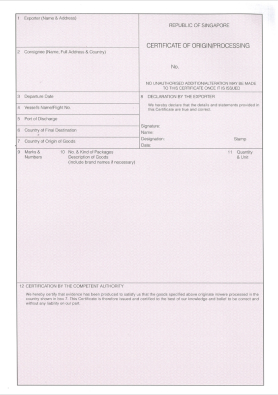
A Certificate of Origin (CO) is an important international trade document confirming that the goods in a particular shipment have been wholly obtained, produced, manufactured or processed in a particular country.
For more information on CO, please visit Certificates of Origin.
Types of Certificate of Origin (CO)
Preferential Certificate of Origin
- Issued to cover eligible exports for preferential tariff exemption or reduction under free trade agreements (FTA).
- Can be applied through Tradenet Frontend platforms.
Non-Preferential Certificate of Origin
- Issued to cover eligible exports for preferential tariff exemption or reduction under free trade agreements (FTA).
- Can be applied through Tradenet Frontend platforms.
Why Certificates of Origin are Necessary for Trade in Singapore?
Certificates of Origin (COs) are crucial for international trade, serving as a declaration by the exporter that goods in a particular export shipment are wholly obtained, produced, manufactured, or processed in a specific country. Singapore, being a global hub for trade, requires COs for various reasons:
Customs Clearance
COs are often required by the importing country’s customs authority to determine whether the goods can be legally imported and if they are subject to duties.
Preferential Treatment
Preferential COs allow exporters to benefit from reduced tariffs under FTAs, making their products more competitive in foreign markets.
Trade Compliance
They ensure compliance with trade agreements and international regulations, preventing illegal transhipment and fraud.
Best Practices for Certificate of Origin Application
When applying for a Certificate of Origin (CO) or a Preferential CO in Singapore, following best practices is essential for a smooth and successful process:
Accurate Information
Ensure that all information provided on the CO application is accurate and truthful. This includes the producer’s details, quantity of goods, and the HS code.
Timely Application
Submit the CO application well in advance to avoid any shipment delays. Most COs can be applied for electronically via Singapore’s TradeNet system.
Understanding FTAs
For Preferential COs, thoroughly understand the rules of origin criteria under the relevant FTA to ensure that your goods qualify for the benefits.
Regular Updates
Stay updated with any changes in the trade agreements or regulations by regularly checking with Singapore Customs or the respective FTA authorities.
Documentation
Keep all supporting documents readily available, such as the bill of lading, invoice, and production records, to prove the origin of goods if required.
Real-World Certificate of Origin Application Case Studies
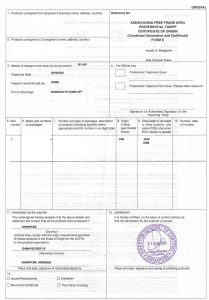
Case Study 1 — ACFTA Form E for Export to China
Shipment: Singapore → Shanghai, China
Certificate: ASEAN-China Free Trade Area (ACFTA) Form E
Type: Preferential Certificate of Origin
Transport: Air freight
Destination: Shanghai Pudong Airport
Origin Criterion: Product Specific Rules (PSR)
Shipment Weight: 19.50 KG
What we handled:
Declarators assisted with the preparation and application of the preferential Certificate of Origin for a Singapore export to China under the ASEAN-China Free Trade Area.
The shipment required a Form E Certificate of Origin to support the importer’s claim for preferential tariff treatment in China. We coordinated the required shipment and origin information, prepared the application documentation and ensured that the Certificate of Origin was properly certified by Singapore Customs.
The completed Form E was issued for the shipment travelling by air to Shanghai Pudong Airport.
Result:
The exporter obtained the required preferential Certificate of Origin for the shipment, allowing the importer to use the applicable ACFTA preferential tariff treatment, subject to China’s customs requirements.
FAQs about Certificate of Origin Application Support
Q: What is a Certificate of Origin
A Certificate of Origin (CO or COO) is an international trade document that certifies the country in which goods were wholly obtained, produced, manufactured or substantially transformed. It helps the importing country determine the applicable origin, customs treatment, eligibility for preferential tariff rates and other trade compliance requirements.
For exporters, a Certificate of Origin can be an important part of the export documentation process. Overseas buyers, banks, customs authorities, freight forwarders and import agents may request a CO before goods can be cleared or preferential tariff treatment can be claimed.
Singapore Customs generally distinguishes between Ordinary Certificates of Origin and Preferential Certificates of Origin, with the applicable application process depending on the goods, their origin and the purpose of the certificate.
Declarators assists exporters with the Certificate of Origin application process by reviewing supporting documents, checking application readiness, coordinating submission requirements and identifying potential gaps in origin documentation before the application proceeds.
Final issuance is subject to the requirements of the relevant issuing authority or chamber, the supporting documentation provided and the actual facts and circumstances of the shipment.
Q: What is the difference between a Preferential CO and a Non-Preferential CO?
A Preferential Certificate of Origin (PCO) is used when an exporter wants the overseas importer to claim reduced or zero customs duties under a Free Trade Agreement (FTA), provided the goods satisfy the applicable rules of origin.
A Non-Preferential Certificate of Origin (CO), also commonly referred to as an Ordinary Certificate of Origin, is generally used when no preferential tariff concession is being claimed, but the importing country, overseas buyer, bank or tender requirement still requires documentary proof of the goods’ origin.
The distinction is important because preferential tariff treatment is not granted simply because goods are exported from Singapore. The goods must meet the specific origin criteria established under the relevant FTA.
Singapore Customs states that preferential origin is determined according to the specific rules and criteria under the applicable trade agreement, while non-preferential Singapore origin may be established based on criteria such as wholly obtained status or substantial transformation. Singapore Customs – Rules of Origin Overview
Declarators helps exporters identify the appropriate Certificate of Origin route based on the intended use and destination requirements, and assists with preparing the supporting documentation and application before submission.
Q: When should a business apply for a Certificate of Origin?
A business should consider applying for a Certificate of Origin (CO) when the overseas importer, customs authority, bank, letter of credit, distributor, tender requirement, government buyer or shipping process requires documentary proof of the goods’ origin.
A CO may also be required when goods could qualify for preferential tariff treatment under a Free Trade Agreement (FTA), allowing the overseas importer to potentially benefit from reduced or zero customs duties and lower landed costs in the destination country.
Where possible, the Certificate of Origin application should be planned before shipment. The information stated on the CO should be consistent with the commercial invoice, packing list, export permit, transport documentation and supporting evidence of origin. Last-minute applications may face delays if documents such as manufacturer registration details, cost statements, origin declarations or other supporting records are incomplete.
Declarators can review the shipment documentation at an early stage, help determine whether a Preferential or Non-Preferential Certificate of Origin is required, and identify potential documentation gaps before the application proceeds.
The safest approach is to verify the Certificate of Origin requirements before the cargo departs, rather than waiting until the overseas buyer encounters a customs clearance issue.
Q: What information is needed for a COO application?
A Certificate of Origin (COO) application typically requires key shipment and exporter information, including exporter details, consignee details, invoice number and date, goods description, HS code, quantity, unit of measurement, package details, country of origin, destination country, transport information and relevant commercial supporting documents.
For manufactured goods, additional evidence of origin may be required. Depending on the circumstances, this may include production information, bills of materials, manufacturing cost statements, local content details, supplier invoices, production process flow, factory information and declarations from the exporter or manufacturer.
For Preferential Certificate of Origin applications, the applicable Free Trade Agreement (FTA) rules of origin must be carefully reviewed, as different agreements may apply different origin criteria and documentary requirements.
Singapore Customs indicates that certain locally manufactured goods may require manufacturer registration, a manufacturing cost statement and submission of the Certificate of Origin application through TradeNet. Singapore Customs – How to Apply for an Ordinary or Preferential Certificate of Origin
Declarators assists exporters in organising and reviewing the required documentation before submission, helping to identify inconsistent product descriptions, missing origin evidence, incomplete production information or other potential issues that could delay the application process.
Q: How does Singapore origin get determined?
Singapore origin is not determined simply by where goods are packed, stored or shipped. For non-preferential origin purposes, Singapore Customs explains that goods may qualify as Singapore-originating if they are wholly obtained in Singapore or have undergone substantial transformation in Singapore.
Depending on the goods and applicable HS classification, substantial transformation may be assessed using criteria such as minimum local content, a change in tariff classification or a specific chemical reaction. The applicable test depends on the nature of the product and the relevant rules of origin. Singapore Customs – Rules of Origin Overview
Minimal processing or activities such as simple packing, relabelling, sorting, washing or basic assembly may not, by themselves, be sufficient to confer Singapore origin.
This distinction is important because goods can be exported from Singapore without necessarily being considered Singapore-originating goods.
Declarators can assist in reviewing the available production, manufacturing and commercial documentation and identifying the relevant origin considerations. However, origin eligibility ultimately depends on the actual circumstances of the goods and the applicable rules of origin. For more complex products or situations where the origin position is uncertain, a formal ruling or specialist review may be appropriate before making an origin claim.
Q: Why are Rules of Origin important for COO applications?
Rules of Origin are the criteria used to determine the country of origin of goods. They are an important part of the Certificate of Origin process because a CO is only effective when the stated origin is accurate and supported by appropriate evidence.
For Preferential Certificates of Origin, Rules of Origin determine whether goods qualify for reduced or zero customs duties under the relevant Free Trade Agreement (FTA). For Non-Preferential Certificates of Origin, they help establish whether the declared origin can be accepted for customs clearance, banking, tender requirements, import controls or other commercial purposes.
Singapore Customs describes Rules of Origin as the provisions used by a country to determine the origin of goods, based on national legislation or international agreements. Singapore Customs – Rules of Origin Overview
An incorrect origin claim can result in customs clearance delays, tariff disputes, rejected documentation, customer claims or potential compliance issues. The origin determination should therefore be supported by appropriate production and commercial records.
Declarators assists exporters by helping to organise relevant supporting evidence, review documentation for consistency and identify situations where additional confirmation or specialist advice may be required before the Certificate of Origin application is submitted.
Q: Can Declarators help with Preferential CO applications under FTAs?
Yes. Declarators can assist with Preferential Certificate of Origin applications by reviewing shipment documentation, identifying the relevant Free Trade Agreement (FTA) route, checking whether the necessary origin evidence is available and coordinating the application process.
Preferential Certificates of Origin can provide significant benefits because they may allow the overseas importer to claim reduced or zero customs duties in the destination country, potentially making the exporter’s products more competitive.
However, goods must satisfy the specific Rules of Origin under the applicable FTA. An exporter should not assume that goods qualify simply because the company is registered in Singapore or because the shipment is exported from Singapore.
Depending on the product and applicable agreement, supporting documentation may include production information, manufacturing cost statements, supplier invoices, bills of materials, HS code details and other evidence of origin.
Declarators can help organise and review these inputs, identify missing or inconsistent information and coordinate the application process. Final eligibility for preferential treatment depends on the applicable trade agreement, the product’s actual production process, supporting evidence and the requirements of the relevant authority.
Q: Can Declarators help with Non-Preferential or Ordinary CO applications?
Yes. Declarators can assist with Non-Preferential or Ordinary Certificate of Origin applications when a customer requires formal origin certification but is not seeking preferential tariff benefits under a Free Trade Agreement (FTA).
This may apply when the importing country requires origin documentation for customs clearance, when a bank requests a Certificate of Origin under a letter of credit, when an overseas distributor requires it for resale or commercial documentation, or when a tender requires proof of origin.
Non-Preferential Certificates of Origin remain important because the declared origin must be accurate, truthful and supported by appropriate records. Singapore Customs provides guidance on origin documentation and the requirements applicable to both preferential and non-preferential origin documentation. Singapore Customs – Origin Documentation
Declarators can assist by reviewing the invoice, packing list, goods description, origin statement and relevant supporting evidence to identify inconsistencies or missing information before submission.
Where goods have only been transhipped, stored or handled in Singapore without undergoing the necessary processing or transformation, they should not automatically be treated as Singapore-originating goods. The actual origin of the goods and the applicable Rules of Origin should be established before an origin claim is made.
Q: What is a Manufacturing Cost Statement and when is it needed?
A Manufacturing Cost Statement (MCS) is a document used to support the origin assessment of locally manufactured goods. It may contain details such as production costs, raw materials, local content, manufacturing processes and other information required to determine whether the goods satisfy the applicable origin criteria under a relevant Free Trade Agreement (FTA) or trade scheme.
Singapore Customs states that, following manufacturer registration, a Manufacturing Cost Statement may be submitted for verification to establish whether the goods meet the applicable origin criteria. The cost statement is generally valid for one year from its date, subject to the applicable requirements. Singapore Customs – How to Apply for an Ordinary or Preferential Certificate of Origin
The Manufacturing Cost Statement should be prepared carefully, as incomplete, inaccurate or inconsistent production and cost information may delay the Certificate of Origin application.
Declarators can assist with coordinating document readiness and reviewing the required supporting information. However, the exporter or manufacturer remains responsible for providing accurate production, material and cost information.
Where there are significant changes to the manufacturing process, materials, suppliers or production costs, the origin position should be reviewed to determine whether the existing origin assessment remains applicable.
Q: Does the manufacturer need to be registered before applying for a CO?
For locally manufactured goods, manufacturer registration may be required before certain Certificate of Origin applications can proceed. Singapore Customs states that applications for Ordinary or Preferential Certificates of Origin for locally manufactured goods generally begin with the registration of the manufacturing premises or a new product line, unless the manufacturer is already registered for the specific goods. Singapore Customs – How to Apply for an Ordinary or Preferential Certificate of Origin
This registration process enables the relevant authorities to assess the manufacturing process and the basis on which Singapore origin is claimed. Supporting documentation must be provided, and Singapore Customs may conduct visits to verify manufacturing processes and inspect relevant records where necessary.
Declarators can assist exporters in understanding the documentation and information required and coordinate the application workflow. Where goods are purchased from another local manufacturer, the exporter may also need the manufacturer’s cooperation to obtain relevant production, manufacturing and origin evidence required to support the Certificate of Origin application.
Q: How long does a COO application take?
The processing time for a Certificate of Origin (COO) depends on several factors, including the type of certificate, nature of the goods, origin evidence, manufacturer registration status, Manufacturing Cost Statement readiness, TradeNet submission and the processing requirements of the relevant authority or chamber. Additional clarifications or supporting documents may also affect the overall timeline.
Singapore Customs states that manufacturer registration for locally manufactured goods generally takes about one month from receipt of a complete and accurate submission, while a Manufacturing Cost Statement generally takes seven working days upon receipt of a complete submission. Singapore Customs – How to Apply for an Ordinary or Preferential Certificate of Origin
Once all prerequisites are in place, the subsequent Certificate of Origin application may be processed more quickly. However, incomplete documentation, discrepancies or questions regarding the origin of the goods can result in additional processing time.
Declarators can review the specific circumstances of each application and provide an indicative timeline based on the certificate type, documentation and applicable requirements.
Where possible, exporters should begin the Certificate of Origin process before shipment and ahead of the buyer’s document deadline, particularly when the CO is required for customs clearance, bank presentation or preferential tariff treatment.
Q: Can a CO application be rejected or delayed?
Yes. A Certificate of Origin (CO) application can be delayed, rejected or require clarification if the information provided is incomplete, inconsistent or insufficiently supported.
Common issues include vague or inconsistent goods descriptions, incorrect HS codes, discrepancies between the commercial invoice and packing list, unclear manufacturer details, missing production records, outdated Manufacturing Cost Statements, unsupported Singapore-origin claims, incorrect FTA selection, missing exporter declarations or insufficient evidence that the goods satisfy the applicable Rules of Origin.
Preferential Certificate of Origin applications may require additional scrutiny because eligibility for reduced or zero tariffs depends on meeting the specific origin criteria under the relevant Free Trade Agreement.
Non-Preferential or Ordinary Certificate of Origin applications can also encounter issues where goods appear to have only been packed, relabelled, sorted, stored or transhipped through Singapore without undergoing the processing or substantial transformation required to establish Singapore origin.
Declarators helps reduce the risk of delays by reviewing documentation readiness, checking for inconsistencies and identifying potential issues or missing supporting evidence before submission. Where necessary, we can also highlight areas that may require further clarification from the exporter or manufacturer.
However, no service provider can guarantee approval or issuance of a Certificate of Origin. The final outcome depends on the applicable rules, the relevant issuing authority and the factual evidence provided by the exporter or manufacturer.
Q: Can a Certificate of Origin be amended or cancelled?
A Certificate of Origin (CO) may be amended or cancelled depending on the requirements of the issuing authority, the type of certificate, the nature of the error, the shipment status and whether the original certificate has already been used in the destination country.
Singapore Customs provides separate guidance on the amendment and cancellation of Certificates of Origin issued by Customs as part of its origin documentation resources. Singapore Customs – Origin Documentation
If an error is identified in the consignee name, invoice number, quantity, goods description, HS code, origin criterion or transport details, the exporter should notify Declarators as soon as possible. Depending on the circumstances, a correction may be relatively straightforward, while other cases may require replacement documentation, further authority review or a new application.
Additional charges may apply for work already completed, urgent amendments, replacement documents, courier arrangements, third-party costs or applicable chamber and authority fees.
To minimise the risk of delays or additional costs, exporters should carefully verify all Certificate of Origin details before signing, dispatching the certificate to the overseas buyer or presenting it for customs clearance.
Q: How is COO application pricing calculated? "
Certificate of Origin (COO) application pricing depends on several factors, including the type of certificate, urgency, shipment complexity, origin evidence, number of product lines, applicable Free Trade Agreement (FTA), supporting document quality, authority or chamber requirements and whether manufacturer registration or Manufacturing Cost Statement work is involved.
A straightforward Non-Preferential or Ordinary Certificate of Origin with complete supporting documentation may have a different fee from a Preferential Certificate of Origin that requires detailed Rules of Origin assessment, Manufacturing Cost Statement coordination or applications covering multiple product lines.
Any published prices should generally be regarded as starting prices, unless otherwise stated. Government or chamber fees, courier and collection charges, amendments, cancellations, after-hours services and other third-party costs may be charged separately or at cost, depending on the agreed scope.
Bulk or recurring application rates may be available for clients with regular Certificate of Origin requirements involving consistent products, documentation and origin criteria.
Where appropriate, like-for-like competitor quotations may be reviewed for potential price matching, provided the competing quotation covers a comparable Singapore Certificate of Origin application scope and service level.
Declarators will confirm the applicable commercial terms in writing, based on the agreed scope of work, documentation provided and any relevant assumptions or exclusions.
Q: What makes a COO application successful?
A successful Certificate of Origin (COO) application depends on accurate information, complete supporting documentation, sufficient origin evidence and realistic processing timelines.
Before submission, exporters should prepare the relevant commercial invoice, packing list, transport records, product descriptions, HS codes, origin declarations, manufacturer details, production records and any FTA-specific documentation required for the application.
For Preferential Certificates of Origin, the applicable Rules of Origin should be reviewed carefully because preferential tariff benefits depend on the goods satisfying the specific requirements of the relevant Free Trade Agreement (FTA). Goods do not qualify simply because they are exported from Singapore.
For Non-Preferential or Ordinary Certificates of Origin, the declared origin must also be supported by appropriate evidence, including documentation demonstrating that the goods were wholly obtained or underwent the required processing or substantial transformation.
Declarators assists exporters by reviewing documentation readiness, identifying missing or inconsistent information, coordinating the application process and clearly setting out the applicable scope, requirements and assumptions.
The strongest applications are those where the commercial documents, production records, origin evidence and transport information are consistent and support the same origin position.
Final issuance, processing time and acceptance of the Certificate of Origin overseas remain subject to the requirements of the relevant issuing authority and the rules of the importing country.
Q: Is electronic Certificate of Origin (eCO) submission mandatory from 1 August 2026?
From 1 August 2026, Singapore Customs is transitioning to the full electronic submission of Ordinary Certificate of Origin (OCO) applications. Exporters and their authorised agents should therefore ensure that their OCO application processes are ready for electronic submission through the applicable systems.
Declarators can assist exporters with the transition by reviewing application requirements, supporting documents and submission readiness.
Q: What changes for Ordinary Certificate of Origin applications from 1 August 2026?
The key change is the move towards full electronic submission of OCO applications. Businesses that previously relied on paper-based or manual application processes should review their internal procedures and ensure that the necessary information and supporting documents can be submitted electronically.
The underlying origin requirements do not change simply because the application is submitted electronically. Exporters must still ensure that the declared origin is accurate and supported by appropriate documentation.
Q: Does the 1 August 2026 eCO requirement apply to Preferential Certificates of Origin?
The 1 August 2026 announcement identified by Singapore Customs relates specifically to the full electronic submission of Ordinary Certificate of Origin (OCO) applications. Preferential Certificates of Origin (PCOs) are subject to the procedures applicable to the relevant Free Trade Agreement and origin scheme.
Some FTAs already use electronic transmission or self-certification arrangements. For example, Singapore has electronic exchange arrangements for certain preferential origin documents and self-certification regimes under selected FTAs.
Q: Do I still need supporting documents for an electronic Certificate of Origin?
Yes. Moving to electronic submission does not remove the need for accurate supporting documentation. Depending on the goods and application, information may include the commercial invoice, packing list, product details, HS code, manufacturer information and evidence supporting the claimed origin.
For locally manufactured goods, additional requirements such as manufacturer registration and a Manufacturing Cost Statement may apply.
Q: Can Declarators help with the transition to electronic COO applications?
Yes. Declarators can assist exporters with the transition to electronic Certificate of Origin applications by reviewing the required information, checking supporting documents, identifying inconsistencies and coordinating the application process.
This can be particularly useful for businesses that regularly apply for Certificates of Origin and need to adapt their existing manual workflow to the electronic submission process.
Q: Will electronic submission make Certificate of Origin applications faster?
Electronic submission can streamline the application process, but it does not guarantee faster approval. Processing time can still depend on the completeness and accuracy of the application, manufacturer registration, origin evidence, Manufacturing Cost Statement requirements and whether Singapore Customs or the relevant issuing organisation requires clarification.
Providing complete and consistent information from the outset can help minimise avoidable delays