
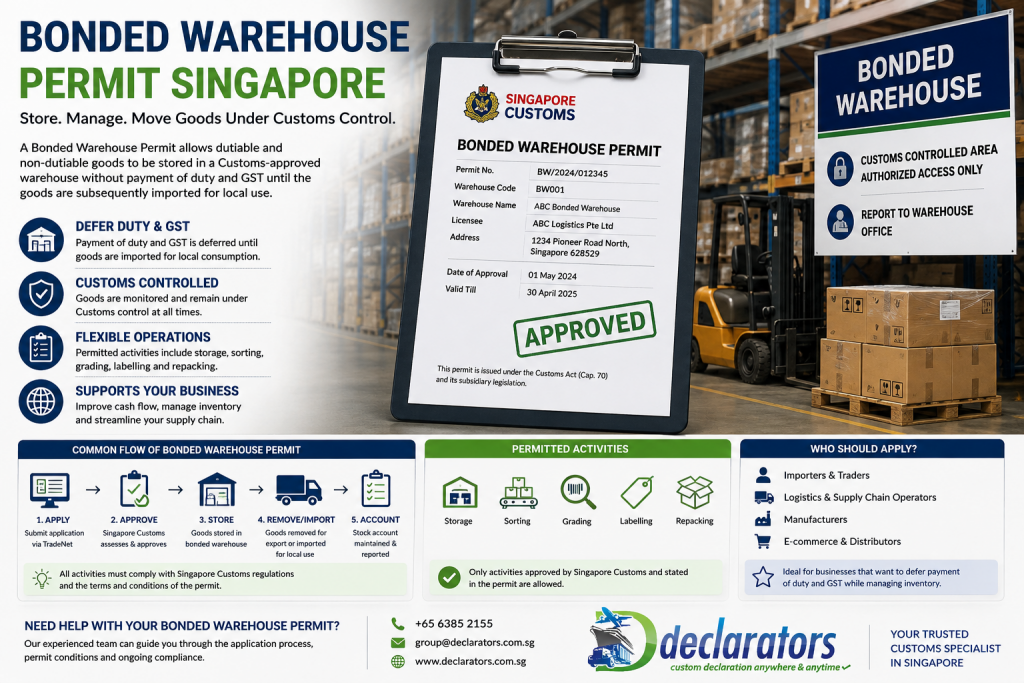
If your imported goods are going into a bonded, Licensed or Zero-GST Warehouse in Singapore, the Customs declaration is not the same as simply importing goods for local consumption.
The permit used depends on what the goods are, where they are coming from, where they are going and whether duty or GST should remain suspended. Getting this wrong can create unnecessary tax payments, warehouse discrepancies or delays in cargo movement.
At Declarators Pte Ltd, our team handles Customs permit declarations for air, sea and road shipments, including movements involving approved and licensed premises. Here is what businesses should understand before moving their next shipment.
Quick Answer: What Is a Bonded Warehouse Permit in Singapore?
A bonded warehouse permit generally refers to the Customs permit required when goods are moved into, between or out of a Singapore Customs-licensed warehouse while duty and/or GST remains suspended. Depending on the movement and type of goods, the appropriate TradeNet declaration must be submitted before the cargo is moved.
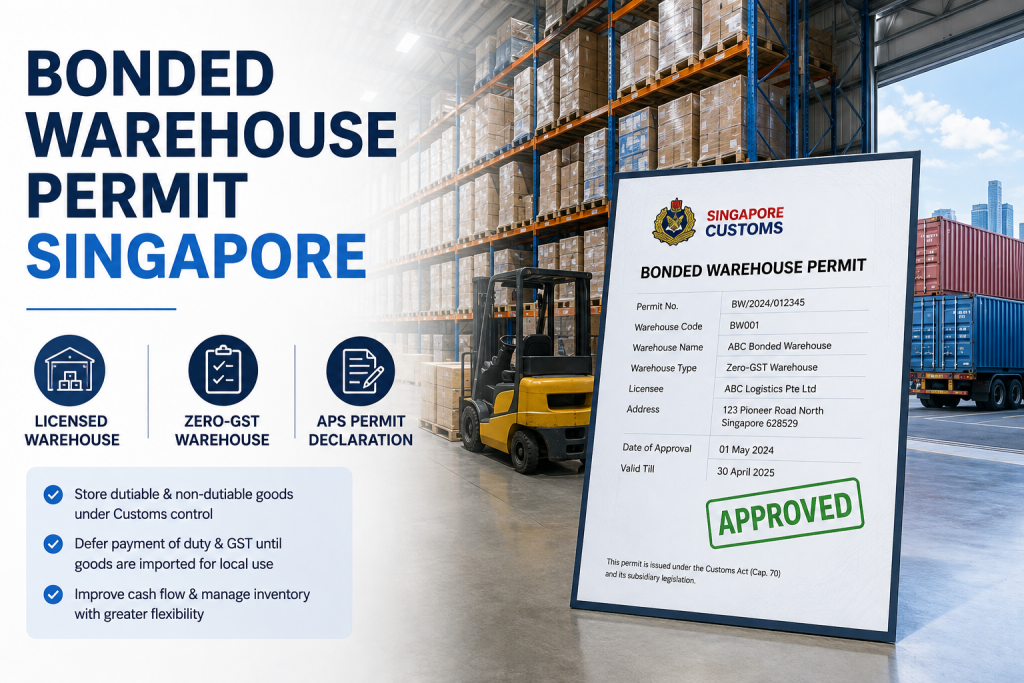
Singapore Customs operates different warehousing schemes. Two important ones are:
Licensed Warehouse (LW)
Used primarily for imported dutiable goods, with duty and GST suspended while the goods remain in the licensed premises.
Zero-GST Warehouse (ZGS)
Used for imported non-dutiable goods, allowing GST to remain suspended while the goods are stored in the licensed premises.
The permit declaration therefore needs to match the actual warehouse arrangement and cargo movement.
First: What Does “Bonded Warehouse” Mean in Singapore?
“Bonded warehouse” is a commonly used logistics term, but Singapore Customs officially operates specific warehouse schemes.
For dutiable goods, businesses may use the Licensed Warehouse Scheme. For non-dutiable imported goods, businesses may use the Zero-GST Warehouse Scheme. The important concept is simple:
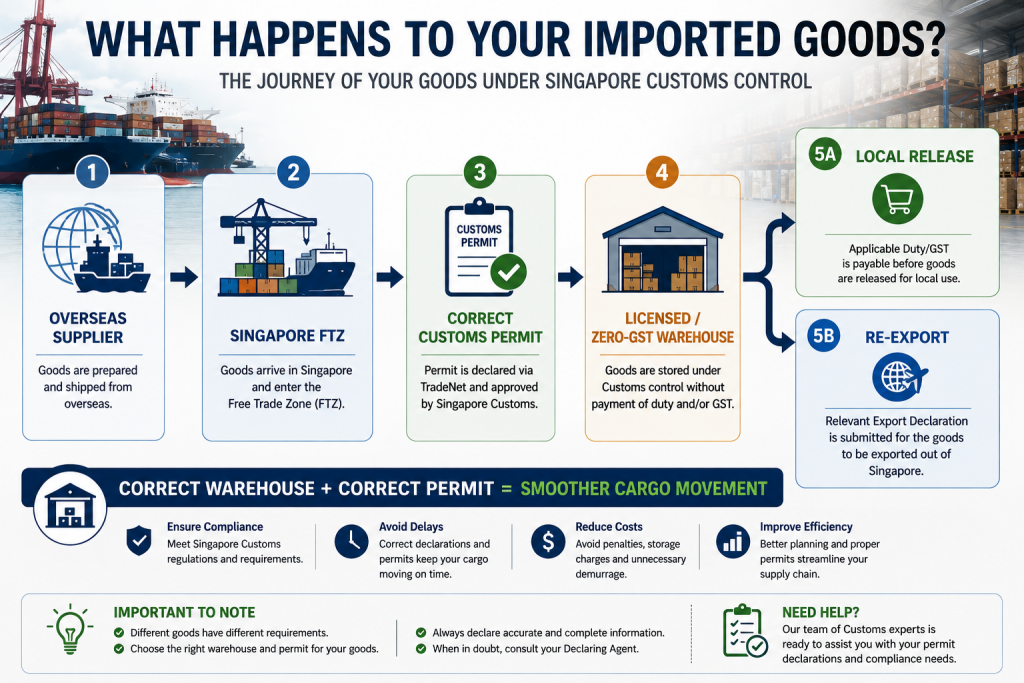
Goods enter Singapore → Goods enter approved warehouse → Duty/GST remains suspended → Tax becomes payable when applicable goods are released locally
This can provide an important cash-flow advantage to businesses that import goods but do not immediately release everything into the Singapore market.
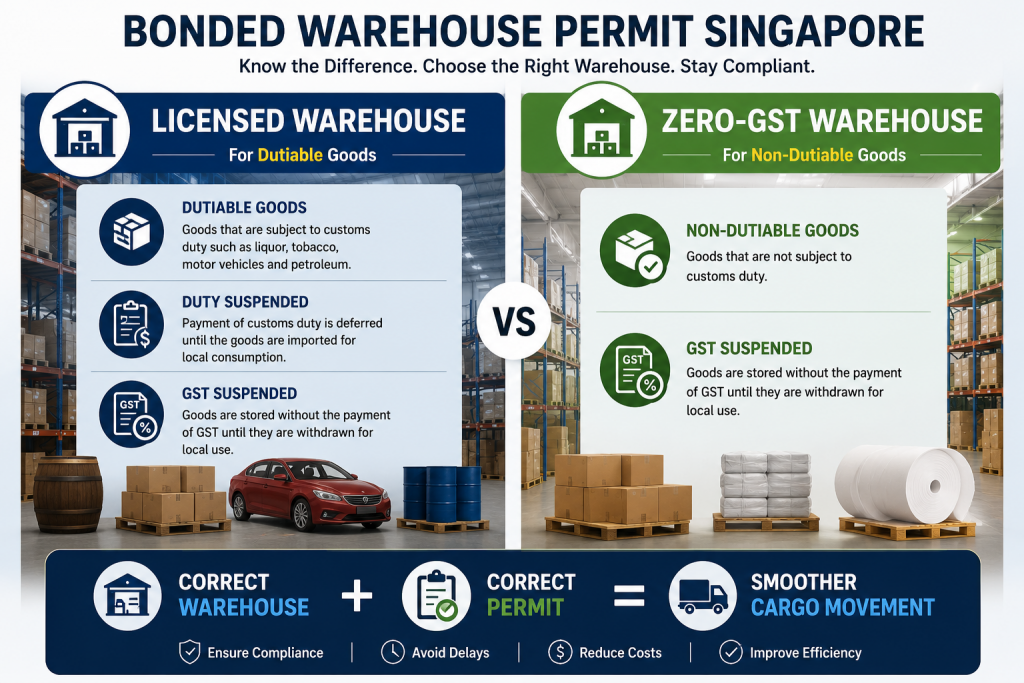
Licensed Warehouse vs Zero-GST Warehouse
Licensed Warehouse | Zero-GST Warehouse | |
Mainly used for | Dutiable goods | Non-dutiable goods |
Duty treatment | Duty suspended | Generally not applicable to non-dutiable goods |
GST treatment | GST suspended | GST suspended |
Local release | Duty/GST may become payable | GST may become payable |
Export from warehouse | Relevant Customs declaration required | Relevant Customs declaration required |
Permit declarations required for movements | Yes | Yes |
Singapore Customs states that the Licensed Warehouse Scheme covers imported dutiable goods such as liquor, tobacco, motor vehicles, petroleum and biodiesel blends. Duty and GST remain suspended while those goods are stored in the licensed warehouse. The Zero-GST Warehouse Scheme, meanwhile, allows imported non-dutiable goods to be stored with GST suspended.
What Is an APS Permit?
One term importers and logistics companies may encounter is APS.
APS refers to Approved Premises/Schemes, an In-Non-Payment declaration type. It can be used for relevant movements such as bringing:
- dutiable goods from a Free Trade Zone or overseas into a Licensed Warehouse for storage;
- non-dutiable goods from an FTZ into a Zero-GST Warehouse; and
- goods under certain approved GST suspension schemes.
This is where warehouse declarations can become confusing. The commercial invoice may look like an ordinary import invoice, but the Customs treatment can be completely different depending on where the cargo is being moved.
Do not select a permit type simply because the shipment is an “import”. The physical movement and tax status matter.
When Might You Need a Warehouse Permit Declaration?
Businesses may require warehouse-related Customs declarations in situations such as:
- Moving imported goods from an FTZ into a Licensed Warehouse
- For example, dutiable goods arrive through Singapore and are moved into an authorised Licensed Warehouse instead of being immediately released for local consumption.
- Moving imported non-dutiable goods into a Zero-GST Warehouse
- Rather than paying import GST immediately, eligible goods can enter the approved warehouse with GST suspended.
- Moving goods between approved warehouses
- Warehouse-to-warehouse movements must also be properly documented and declared where required.
- Releasing goods from a warehouse for local consumption
- When goods leave the warehouse and enter the local market, the applicable duty and/or GST treatment changes.
- Exporting goods directly from a warehouse
- If warehouse goods are being shipped overseas instead of entering Singapore’s local market, the correct outward declaration must be used.
Why Businesses Use Licensed and Zero-GST Warehouses
Consider a company importing a large shipment into Singapore. The company may not intend to sell the entire shipment locally immediately.
Some units may be:
- stored for future orders;
- distributed regionally;
- re-exported;
- sold to overseas customers;
- released into Singapore gradually.
Paying the full applicable import taxes upfront may therefore create unnecessary cash-flow pressure. Warehouse schemes allow qualifying businesses to suspend the applicable duty and/or GST while the goods remain under the approved arrangement.
In simple terms:
Without the appropriate warehouse arrangement
Import → Pay applicable duty/GST → Store → Sell/Export
With the appropriate warehouse arrangement
Import → Approved Warehouse → Duty/GST Suspended → Pay applicable tax when released locally
That difference can be commercially significant for businesses carrying large inventories.
What Documents Should You Prepare?
The exact documents depend on the shipment and permit type, but businesses should generally prepare the relevant commercial and transport information before asking their declaring agent to proceed. Common documents include:
Commercial Invoice – Should clearly show the buyer/seller, goods description, value and currency.
Packing List – Useful for checking quantities, packages, weights and cargo details.
Bill of Lading or Air Waybill – Confirms transport and shipment information.
HS Code – The HS classification affects Customs treatment and whether the goods are controlled or dutiable.
Country of Origin – Origin should be correctly identified and consistent with the supporting documents.
Warehouse Details – The declaring agent needs the correct licensed premises information for the movement.
Previous Permit Number – Certain subsequent movements may need to be linked to an earlier Customs permit.
Competent Authority Approval – If the goods are controlled, approvals from the relevant authority may also be required.
A Warehouse Address Is Not Enough
This is an important point. Seeing the word “warehouse” on a delivery instruction does not automatically tell the declarant which Customs treatment applies. Before declaration, it is important to establish:
Where are the goods now? FTZ? Overseas? Another licensed premises?
Where are they going? Licensed Warehouse? Zero-GST Warehouse? Local warehouse?
What are the goods? Dutiable? Non-dutiable? Controlled?
What happens afterwards? Local sale? Storage? Re-export?
The answers affect how the shipment should be declared.
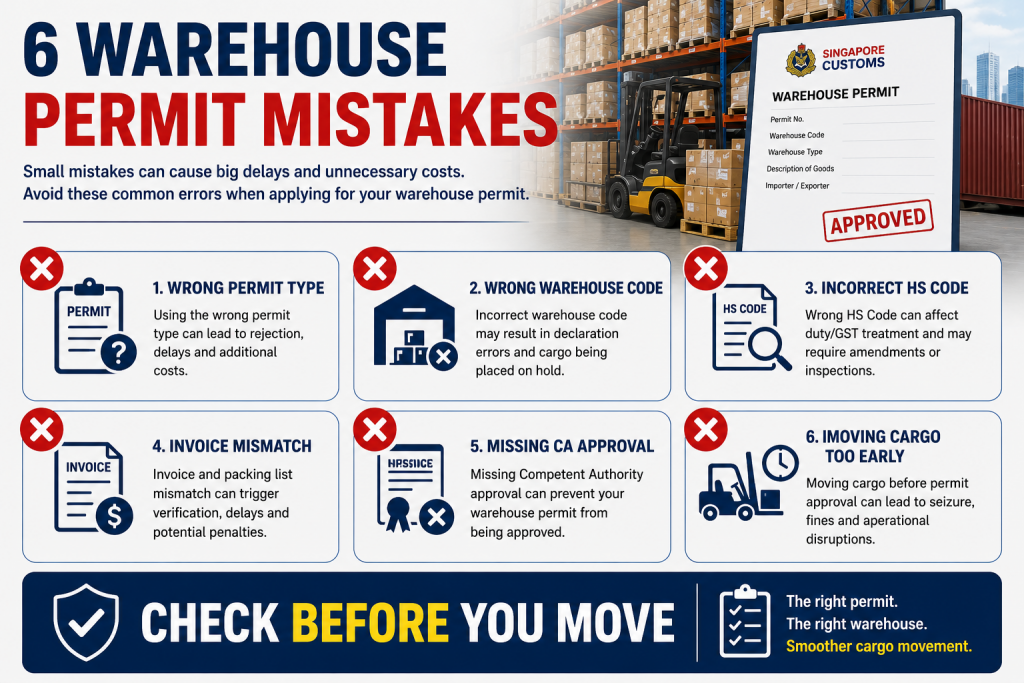
Common Warehouse Permit Mistakes That Can Delay Cargo
❌ 1. Using the Wrong Permit Type
An ordinary import declaration should not automatically be used simply because goods are entering Singapore.
The intended movement must be established first.
❌ 2. Wrong Warehouse Information
Incorrect premises details can cause discrepancies between the physical cargo movement and the Customs declaration.
❌ 3. Wrong HS Code
Incorrect classification may affect whether the goods are treated as dutiable, controlled or subject to additional requirements.
❌ 4. Invoice and Packing List Do Not Match
Quantities, values, weights and goods descriptions should be consistent across supporting documents.
❌ 5. Moving Cargo Before Checking Permit Requirements
Permit requirements should be established before cargo movement, not after the truck is already waiting.
❌ 6. Ignoring Permit Conditions
Approval does not mean there is nothing else to do. Businesses and their logistics partners should review and comply with any conditions stated on the approved permit.
Licensed Warehouse Goods vs Ordinary Local Imports
This distinction is especially important for businesses new to Singapore. If goods are imported directly for local consumption, applicable duty and GST are generally accounted for through the appropriate import declaration.
But if eligible goods are entering an approved warehouse arrangement, duty and/or GST can remain suspended until the relevant taxable event occurs. That means the permit is not merely paperwork. It helps establish the Customs status of the cargo. A mistake can therefore affect both clearance and tax treatment.
What Happens When Goods Leave the Warehouse?
This depends on what happens next.
Goods sold or released locally – Applicable duty and/or GST may become payable when the goods enter Singapore’s Customs territory for local use or consumption.
Goods exported overseas – The appropriate outward Customs declaration is required.
Goods transferred to another licensed premises – The appropriate warehouse movement declaration must be used.
This is why businesses should not view warehouse permits individually. Think of them as a chain: Arrival → Warehouse Entry → Storage → Transfer/Release → Export or Local Consumption
Every movement should make sense when compared with the previous one.
Who Is Responsible for the Permit Declaration?
Businesses can appoint an authorised Declaring Agent to submit Customs permit applications through TradeNet on their behalf. This is particularly useful when warehouse movements become frequent or involve different shipment types. The declarant needs to understand more than what is written on the invoice. They need to establish the actual movement.
At Declarators, our permit declaration team handles air, sea and road declarations and works with importers, exporters, freight forwarders and logistics companies across different industries.
Why Use Declarators for Warehouse Permit Declarations?
Warehouse movements can involve several parties: Importer → Freight Forwarder → Transporter → Warehouse → Declaring Agent → Singapore Customs
When information is passed through multiple parties, one incorrect detail can affect the entire movement. Declarators helps businesses simplify this process through experienced permit declaration support.
Certified Declarants
Our declarants have passed the Singapore Customs competency requirements and are experienced in handling different permit scenarios.
Different Transport Modes
We handle declarations involving air, sea and road shipments.
Permit Declaration Expertise
Warehouse permits are part of a much wider Customs workflow. Our team also handles import, export, transhipment, temporary import/export, dutiable, strategic goods and other permit declarations.
Direct Coordination
Where required, we can liaise with relevant parties to clarify information needed for declaration.
One-Stop Logistics Support
Declarators also provides services including:
- Certificate of Origin applications
- Carnet applications
- Local courier/despatch
- On-board courier/hand-carry
- Manpower deployment
This can be useful when the Customs declaration is only one part of a larger logistics requirement.
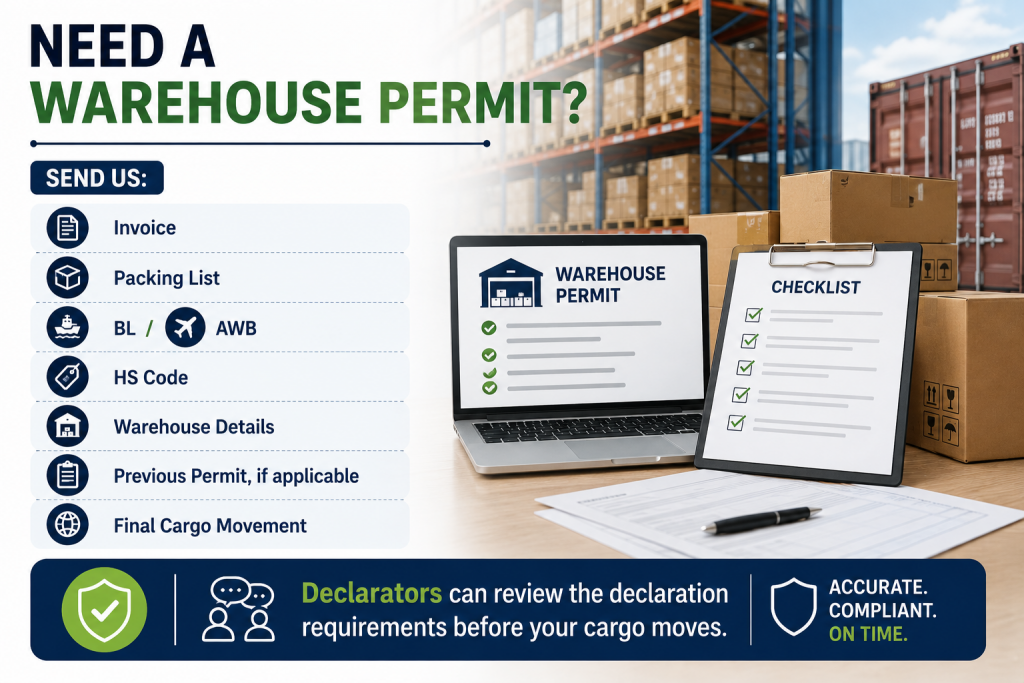
Before Sending Us Your Warehouse Permit Request
For faster assessment, send us:
✓ Commercial Invoice
✓ Packing List
✓ Bill of Lading / Air Waybill
✓ HS Code, if available
✓ Current cargo location
✓ Destination warehouse details
✓ Previous permit number, where applicable
✓ Intended movement after storage
✓ Relevant licences or approvals for controlled goods
If you are unsure which permit is required, tell us the actual cargo movement rather than guessing the permit type. For example:
“Cargo is arriving by sea from Japan, currently in the FTZ and needs to move into our Zero-GST Warehouse before being re-exported.”
That gives the declarant far more useful information than simply saying:
“Please apply warehouse permit.”
Frequently Asked Questions
What is a bonded warehouse permit in Singapore?
The term commonly refers to Customs declarations used when goods are moved into, between or out of approved warehouse premises where duty and/or GST may remain suspended. The exact permit depends on the goods and movement.
What is an APS permit in Singapore?
APS stands for Approved Premises/Schemes. It is an In-Non-Payment declaration category used for qualifying movements involving approved Customs premises or schemes, including certain movements into Licensed and Zero-GST Warehouses.
What is the difference between a Licensed Warehouse and a Zero-GST Warehouse?
Licensed Warehouses are primarily used for dutiable goods, while Zero-GST Warehouses are used for imported non-dutiable goods. The applicable duty and/or GST remains suspended while qualifying goods remain under the respective scheme.
Do I need to pay GST when goods enter a Zero-GST Warehouse?
Under the Zero-GST Warehouse Scheme, GST on qualifying imported non-dutiable goods is suspended while the goods remain in the licensed premises. GST generally becomes payable when the goods are removed for local use or consumption.
Do goods leaving a bonded warehouse require another permit?
Depending on the movement, yes. Goods released locally, exported overseas or transferred between approved premises may require the relevant Customs declaration.
Can a declaring agent apply for warehouse permits?
Yes. Businesses can appoint an authorised Declaring Agent to submit the relevant Customs permit declarations through TradeNet.
Can Declarators handle warehouse permit declarations?
Yes. Declarators provides Customs permit declaration services covering different shipment and permit types across air, sea and road movements. Our team can review the shipment information and determine the declaration requirements based on the actual cargo movement.
Need to Move Goods Into or Out of a Licensed Warehouse?
Warehouse permit declarations are easier when the cargo movement is clear before the goods start moving. Instead of waiting until the transporter is at the warehouse or cargo is approaching its clearance deadline, send the documents to our team for review.
Send us your:
Invoice + Packing List + BL/AWB + Warehouse Details + Shipment Movement
Our team can review the information required for the appropriate Customs permit declaration.
📞 Call us: +65 6385 2155
📧 Email: group@declarators.com.sg
🌐 Visit: declarators.com.sg
Declarators – Your Trusted Declaring Agent in Singapore.