
Your cargo has arrived in Singapore.
The forwarder tells you:
“We need the Customs permit before we can clear the cargo.”
If this is your first commercial shipment, you may immediately wonder: What permit? Where do I get it? And can my goods still be released today? This is where a Cargo Clearance Permit (CCP) comes into the picture.
In Singapore, import, export and transhipment declarations are submitted electronically through TradeNet, Singapore’s national single window for trade declarations. But obtaining an approved permit is only part of the process. The goods, HS code, Customs value, supporting documents, licences, permit conditions and actual cargo movement all need to match.
At Declarators, we handle permit declarations for businesses ranging from companies making their first commercial shipment to experienced importers, exporters, freight forwarders and logistics companies. One thing we often see is that businesses only start thinking about Customs clearance when their cargo has already arrived.
By then, a missing licence, incorrect HS code or incomplete invoice can become an urgent problem. This guide explains what a Cargo Clearance Permit is, when you need one, how the Singapore cargo clearance process works, what documents you should prepare and what commonly causes cargo to be delayed.
Cargo Clearance Permit Singapore: Quick Answer
A Cargo Clearance Permit (CCP) is the approved Customs permit generated through Singapore’s TradeNet system for the import, export or transhipment of goods. The permit records details about the goods and movement and may need to be presented together with supporting documents during cargo clearance, depending on the permit conditions and type of shipment.
For most commercial imports, an appropriate Customs import permit must be obtained through TradeNet. Exports and transshipments also have their respective declaration requirements.
Key Takeaways
- Customs permit applications are submitted electronically through TradeNet.
- The correct permit depends on whether goods are being imported, exported, re-exported or transhipped.
- An approved permit does not automatically mean no further action is required.
- Always read the permit conditions.
- Controlled goods may require approval from another Competent Authority.
- HS codes, Customs values, quantities and shipment information must be accurate.
- Air, sea and land cargo can have different checkpoint clearance requirements.
- Some cargo must be physically presented together with the permit and supporting documents.
- Incorrect information can result in rejection, amendment or cargo delays.
- A Declaring Agent can submit permit applications on behalf of an importer or exporter.
What Is a Cargo Clearance Permit in Singapore?
A Cargo Clearance Permit is essentially the approved Customs permit associated with a trade declaration made through TradeNet. Singapore Customs uses TradeNet to process permit applications for goods moving:
INTO Singapore
→ Imports
OUT of Singapore
→ Exports
THROUGH Singapore
→ Transhipments
The information declared allows Singapore Customs and, where relevant, other government agencies to assess the movement of the goods. A permit can contain information such as:
- importer;
- exporter;
- consignee;
- declarant;
- HS code;
- product description;
- quantity;
- Customs value;
- country of origin;
- port of loading;
- place of receipt;
- place of release;
- transport details;
- licences and approvals; and
- duty and GST information.
Once approved, the Cargo Clearance Permit will also contain permit conditions. These conditions are important because they tell you what must happen when the cargo is cleared. Do not simply see the word APPROVED and assume the job is finished.
Is a Cargo Clearance Permit the Same as an Import Permit?
This terminology can be confusing. Businesses often use terms such as:
- Cargo Clearance Permit;
- Customs permit;
- import permit;
- export permit;
- TradeNet permit; and
- CCP.
They may be talking about closely related documents, but the actual declaration type depends on the cargo movement. For example:
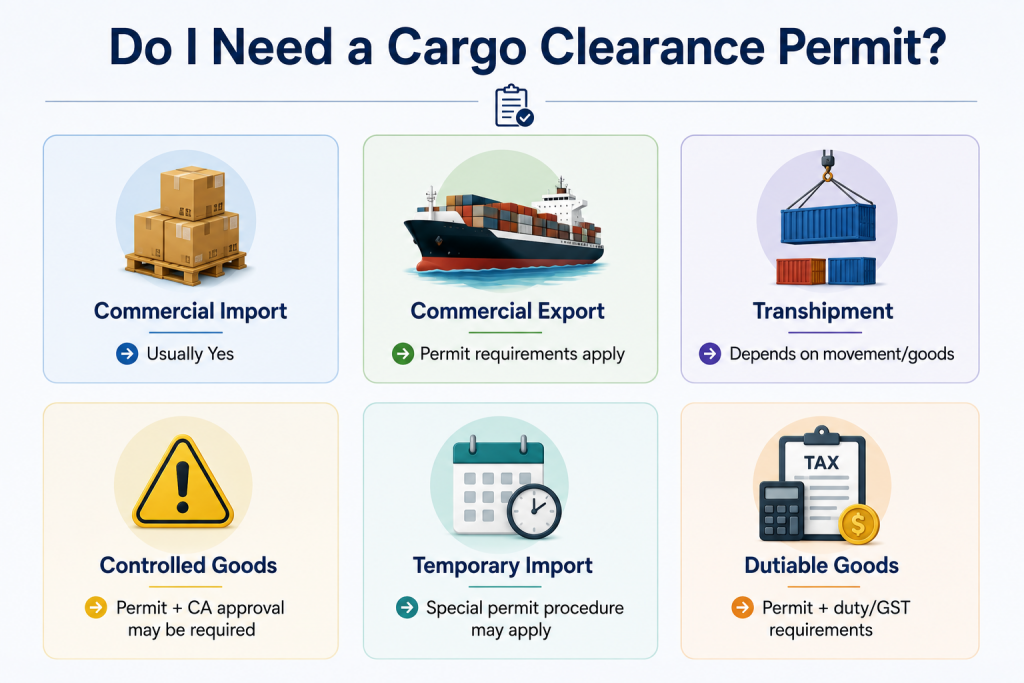
- Importing Goods for Local Use – An appropriate import permit is generally required.
- Exporting Goods from Singapore – An appropriate export permit may be required.
- Moving Goods Through Singapore – A transhipment permit may be required depending on the movement.
- Temporarily Importing Goods – A different non-payment or temporary-consignment procedure may apply.
So when someone tells you:
“Please obtain a CCP.”
the next question should be: What exactly is the cargo movement? That determines the declaration procedure.
How Does Cargo Clearance Work in Singapore?
The process becomes much easier to understand when broken into stages.
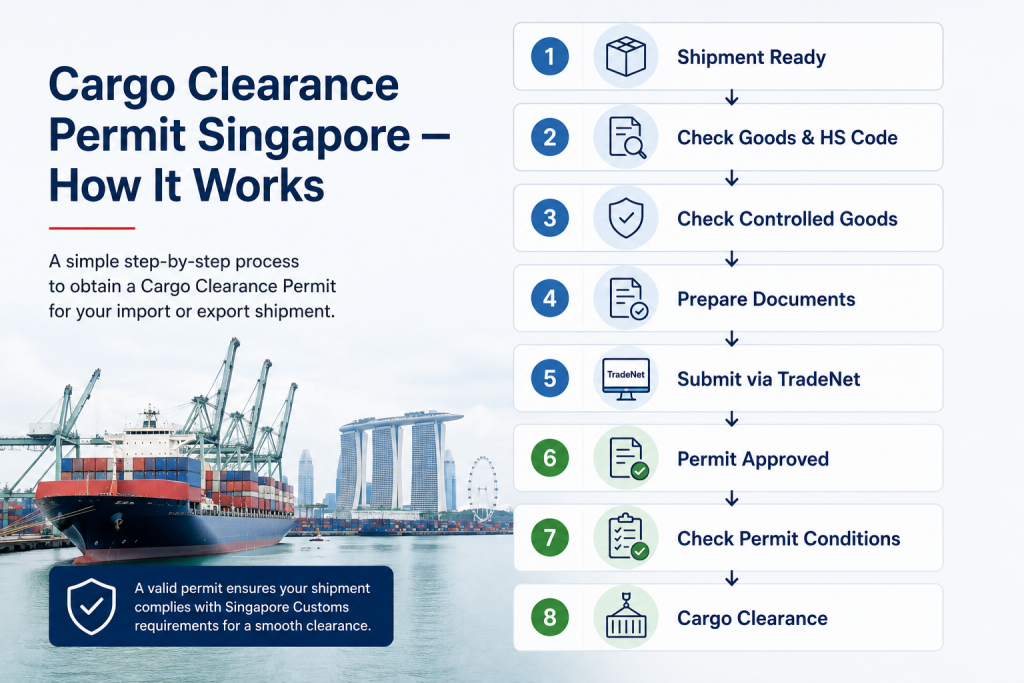
Step 1: Determine the Cargo Movement
Before anything is declared, establish: Is this an import, export, re-export, transhipment or temporary movement? This sounds basic, but it determines the permit procedure. For example, goods entering Singapore for local sale should not be declared the same way as goods simply passing through Singapore.
Step 2: Identify the Goods Correctly
Your declaring agent needs to understand what the product actually is. Avoid descriptions such as:
“Parts”
“Accessories”
“Samples”
“Equipment”
Those descriptions may not provide enough information. A better description might be:
“Stainless steel pump housing”
or
“Lithium-ion rechargeable battery pack”
The actual description should reflect the real product.
Step 3: Determine the HS Code
The Harmonised System (HS) code classifies goods for Customs purposes. The HS code can affect:
- whether goods are controlled;
- applicable duty;
- CA requirements;
- permits;
- product codes; and
- trade statistics.
This is why choosing an HS code simply because it “looks close enough” is risky.
Step 4: Check Whether the Goods Are Controlled
Once the HS code and product are known, check whether a Competent Authority regulates the goods. If additional approval is required, obtain it before or as part of the relevant TradeNet process. This should ideally happen before the shipment arrives. Finding out that a licence is required after the cargo reaches Singapore can mean unnecessary storage and clearance delays.
Step 5: Prepare the Supporting Documents
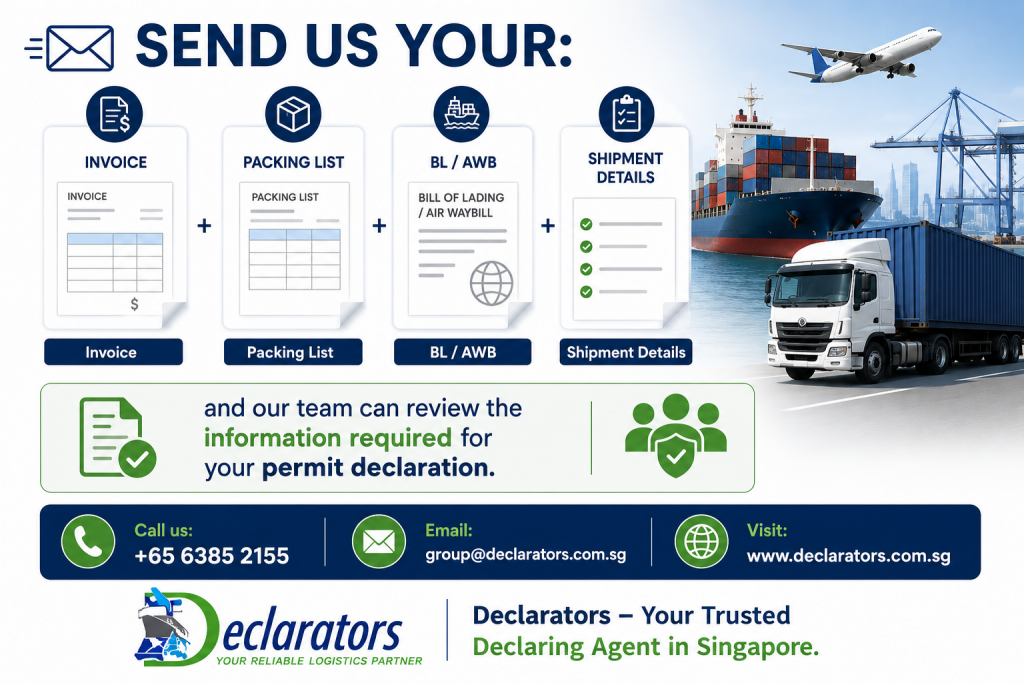
Your declaring agent will generally need shipment information supported by commercial and transport documents. Common documents include:
- commercial invoice;
- packing list;
- Bill of Lading;
- Air Waybill;
- arrival information;
- shipping instructions; and
- relevant licences or approvals.
Depending on the shipment, additional information may be required.
Step 6: Submit the Permit Through TradeNet
Singapore’s trade declarations are submitted electronically through TradeNet. A business can either:
Appoint a Declaring Agent
or
Register as a Declaring Agent and submit its own declarations (For many companies that do not have dedicated Customs teams, appointing a Declaring Agent is the simpler approach.)
Step 7: Receive the Permit Decision
A submitted declaration is not automatically an approved declaration. TradeNet applications can have statuses such as:
APPROVED – The permit has been approved and a permit number is issued.
PENDING – The application is still being processed.
REJECTED – Something needs to be corrected or additional requirements need to be satisfied.
A common mistake is assuming:
“We submitted the permit, so the cargo can move.”
No. Submission is not approval.
- Wait for the approved permit and review its conditions.
Step 8: Check the Permit Conditions
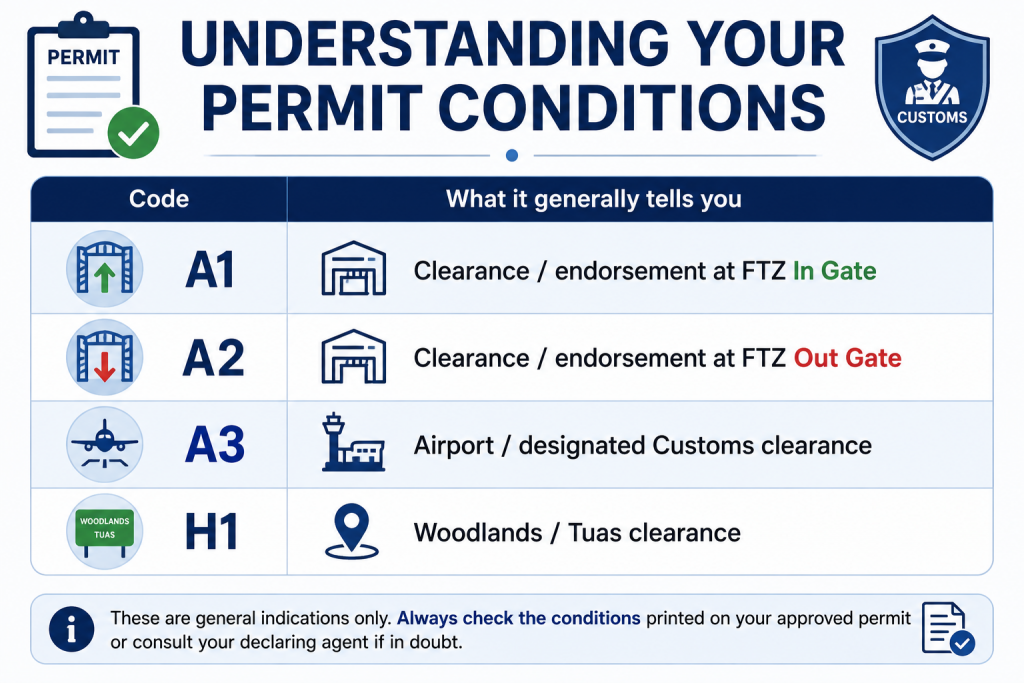
This step is frequently overlooked. Your approved Cargo Clearance Permit can contain condition codes telling you what needs to happen during clearance. Some important examples include:
- A1 – Goods and relevant documents may need to be produced for Customs clearance or endorsement at a Free Trade Zone In Gate.
- A2 – Goods and relevant documents may need to be produced for Customs clearance or endorsement at a Free Trade Zone Out Gate, subject to the applicable clearance direction.
- A3 – Goods may need to be produced with the permit and supporting documents for Customs endorsement at an airport checkpoint or designated Customs office.
- H1 – Goods may need to be produced with the permit and supporting documents for clearance at Woodlands or Tuas Checkpoint.
This is why reading the approved permit matters.
What Documents Are Needed for Cargo Clearance?re
This is where the answer depends heavily on how your goods are moving.
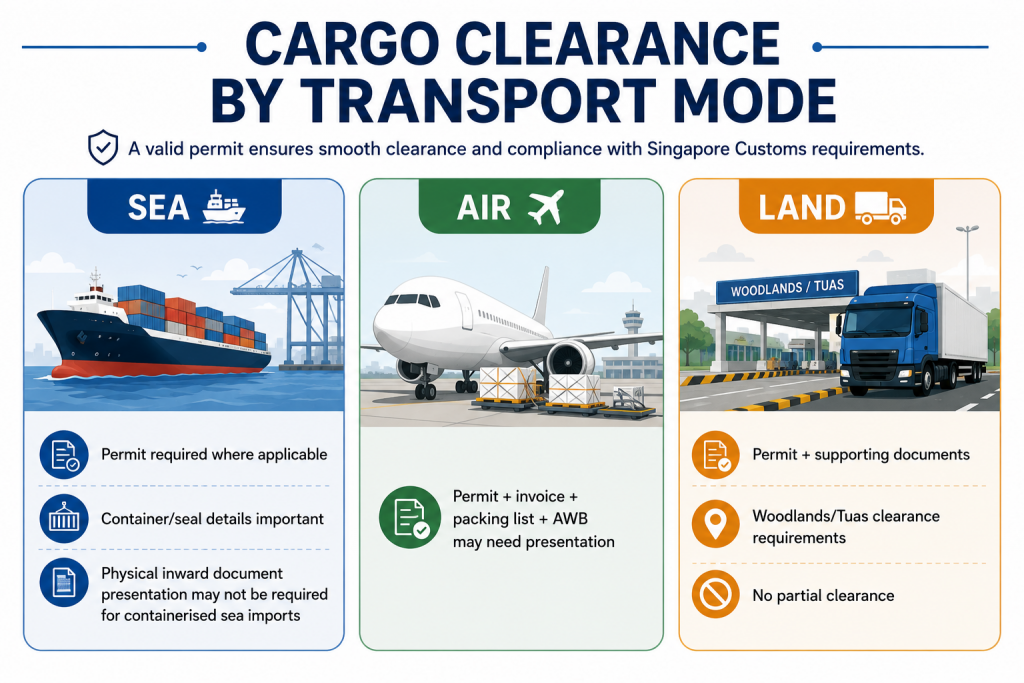
Containerised Cargo Arriving by Sea
Singapore Customs currently states that for containerised imports arriving by sea, the Customs permit and supporting documents do not generally need to be physically presented at the inward checkpoint for clearance. However, the permit still needs to be obtained and its requirements complied with. Container and shipper seal numbers must also be correctly declared when applying for the permit.
Containerised Cargo Arriving by Air or Land
Where the permit conditions require verification and clearance, documents can include:
- Customs permit;
- commercial invoice;
- packing list; and
- Air Waybill for air cargo.
The documents should correspond with the actual shipment.
Conventional Cargo and Hand-Carried Goods
Singapore Customs requires conventional cargo and hand-carried goods to be presented with:
- the goods;
- printed Customs permit; and
- supporting documents such as invoice, packing list and BL/AWB.
Sea vs Air vs Land Cargo Clearance
This distinction is something many generic Customs guides miss.
🚢 Sea Freight
Containerised sea cargo often moves through highly automated port and FTZ processes. The permit is still important, but physical document presentation at the inward checkpoint is not always required in the same way as other modes.
✈️ Air Freight
Air cargo may require presentation of:
- permit;
- invoice;
- packing list;
- AWB; and
- applicable regulatory approvals,
depending on permit conditions.
🚚 Land Freight
Cargo crossing through Woodlands or Tuas needs particular attention. Where H1 clearance applies, the permit and supporting documentation need to be available for Customs clearance. Another important point:
Partial clearance is not allowed at Woodlands and Tuas Checkpoints. (Businesses planning land movements should therefore coordinate quantities carefully.)
What Information Should You Give Your Declaring Agent?
If you want your permit processed smoothly, avoid sending your declarant:
“Please do permit. Cargo arriving tomorrow.”
That creates unnecessary back-and-forth. Instead, provide a complete instruction set.
Cargo Clearance Permit Checklist
- Importer / exporter UEN
- Commercial invoice
- Packing list
- BL or AWB
- Goods description
- HS code if known
- Country of origin
- Quantity
- Gross / net weight where applicable
- Customs value
- Freight and insurance information where relevant
- Port / airport information
- Vessel / flight information
- Arrival or departure date
- Container number where applicable
- Shipper seal number where applicable
- CA licence / approval where applicable
- Purpose of import/export
- Place of receipt / release
- Any previous permit information where relevant
The exact requirements depend on the shipment, but complete information makes the declaration process much smoother.
What Commonly Delays Cargo Clearance in Singapore?
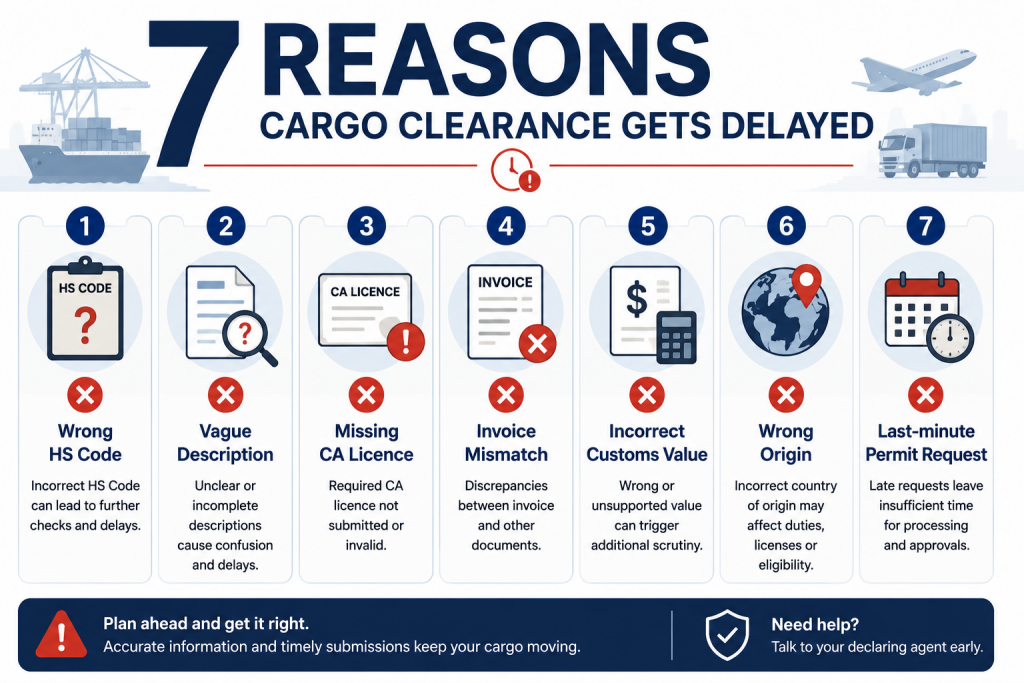
An approved Customs process depends heavily on the quality of the information provided. Here are some of the issues we see businesses struggle with.
1. Wrong HS Code
Incorrect classification can trigger the wrong CA requirement or duty treatment.
2. Vague Goods Description
“Machine parts” may not be enough.
What machine?
What type of part?
What material?
What does it do?
The clearer the information provided to the declarant, the better.
3. Missing Competent Authority Approval
This can be particularly disruptive. Cargo arrives. Permit application is submitted. Then everyone discovers that another government agency’s approval is required. Now the shipment waits. Check controlled-goods requirements early.
4. Invoice and Packing List Do Not Match
Invoice:
1,000 pieces
Packing list:
900 pieces
Which one is correct? The declaring agent should not have to guess. Resolve the discrepancy before declaration.
5. Incorrect Customs Value
Customs value affects GST and potentially duty. Do not automatically assume that the supplier’s invoice amount is the only number relevant to Customs valuation.
6. Wrong Country of Origin
Country of origin and country of export are not always the same.
Goods shipped from one country may have been manufactured in another.
7. Waiting Until Cargo Arrives
This is probably the most avoidable problem. If you know the shipment is coming, prepare early. There is no advantage in waiting until:
“Cargo already landed. Need permit NOW.”
Sometimes the permit can be completed quickly. Sometimes the shipment has an issue that cannot be solved in five minutes.
What Happens If My Cargo Arrives Without a Permit?
Don’t assume the cargo can simply be released and the permit completed later. For imports requiring a Customs permit, the appropriate approved permit needs to be obtained before release according to the applicable procedure. Cargo may remain with the port, airport, terminal, warehouse or handling agent while the required clearance is arranged. That can potentially result in additional:
- storage;
- handling;
- demurrage;
- detention; or
- operational costs,
Depending on the circumstances and service providers involved. This is why we always encourage customers to prepare the declaration before the shipment becomes urgent.
Can Cargo Be Inspected by Singapore Customs?
Yes.
An approved permit does not mean Customs has waived its right to inspect the cargo. Singapore Customs or the relevant Competent Authority may require:
- document verification;
- physical inspection;
- scanning;
- sealing;
- supervision; or
- additional supporting information,
Depending on the shipment. If inspection is required, make sure the goods and documents correspond with what was declared.
Can I Clear Only Part of My Shipment?
In some situations, partial clearance may be possible. Singapore Customs states that where partial clearance is allowed, the same permit should be presented for endorsement each time until the entire shipment has been cleared. However:
Partial clearance is not allowed at Woodlands and Tuas Checkpoints.
This is particularly important for businesses moving goods by truck between Singapore and Malaysia. If you have ten pallets declared but intend to move only five today and five tomorrow, don’t assume the same arrangement that works elsewhere will apply at the land checkpoints. Ask before moving the cargo.
What If the Permit Contains a Mistake?
This is where your Cargo Clearance Permit process connects directly to permit amendment. Suppose the permit has already been approved but you realise:
- quantity is wrong;
- value changed;
- vessel changed;
- origin is incorrect; or
- another declaration detail needs correction.
Do not ignore the discrepancy. If the permit is still valid and has not been used for cargo clearance, certain information may be amendable through TradeNet. If the field cannot be amended, cancellation and a new permit may be necessary. Once the permit has been used for clearance, your options become more limited.
Do I Need a Declaring Agent for Cargo Clearance?
Businesses have two broad options.
Option 1: Handle TradeNet Declarations Internally
To submit declarations yourself, your business needs to meet the relevant requirements for operating as a Declaring Agent and accessing TradeNet. This may make sense for organisations with dedicated Customs and trade-compliance teams handling high declaration volumes.
Option 2: Appoint a Declaring Agent
A registered Declaring Agent can submit Customs permit applications on your behalf. This is often more practical for companies that:
- import or export occasionally;
- do not maintain an internal Customs department;
- need different permit types;
- deal with controlled goods;
- need urgent declarations; or
- prefer to outsource permit administration.
What Does a Declaring Agent Actually Do?
A good declaring agent should do more than copy numbers from an invoice into TradeNet. At Declarators, permit declaration involves understanding the movement behind the paperwork. When a customer approaches us for a Cargo Clearance Permit, the questions we may need answered include:
What are the goods?
Where are they coming from?
Where are they going?
Who is the importer/exporter?
Are they controlled?
What is the HS code?
What is the Customs value?
Where will the cargo be released?
Has a previous permit been declared?
Does another authority’s approval apply?
The permit should reflect the actual shipment. That is ultimately more important than simply submitting the declaration quickly.
How Declarators Helps With Cargo Clearance Permits
Declarators Pte Ltd specialises in Singapore Customs permit declarations and related trade-documentation services. We assist businesses with:
- import permit declarations;
- export permit declarations;
- transhipment permits;
- Cargo Clearance Permits;
- permit amendments;
- permit cancellations;
- controlled-goods declarations;
- Customs documentation;
- Certificate of Origin applications;
- temporary import/export requirements; and
- other permit-related support.
Our role is particularly useful when a customer says:
“I’m not sure what permit I need.”
Instead of expecting the customer to understand every TradeNet declaration type, we can review the shipment information and determine what needs to be considered. For businesses dealing with multiple shipments, this also reduces the administrative burden on internal staff.
The goal is not simply to obtain a permit. The goal is to obtain the correct permit, with accurate information, in time for the actual cargo movement. If you have cargo arriving in or departing from Singapore and are unsure which permit you need, Declarators can assist with reviewing your shipment information and submitting the appropriate TradeNet declaration.