
Your Singapore Customs permit has already been approved.
Then you spot a mistake. Maybe the quantity is wrong. The supplier issued a revised invoice. The vessel changed. The country of origin was entered incorrectly. Or the shipment has been cancelled altogether.
The first thought is usually: “Can I just amend the permit?” Sometimes, yes. But whether a Singapore Customs permit can be amended depends heavily on when the mistake is discovered, whether the permit is still valid, whether the cargo has already cleared, and which information needs to be changed.
At Declarators, this is why we always encourage customers to tell us about shipment changes as soon as possible. A mistake discovered before cargo clearance can be much easier to correct than the same mistake discovered after the goods have already moved.
This guide explains when you can amend a Customs permit in Singapore, when cancellation and a new permit may be necessary, and what businesses should do when an error is discovered too late.
Quick Answer: Can You Amend an Approved Singapore Customs Permit?
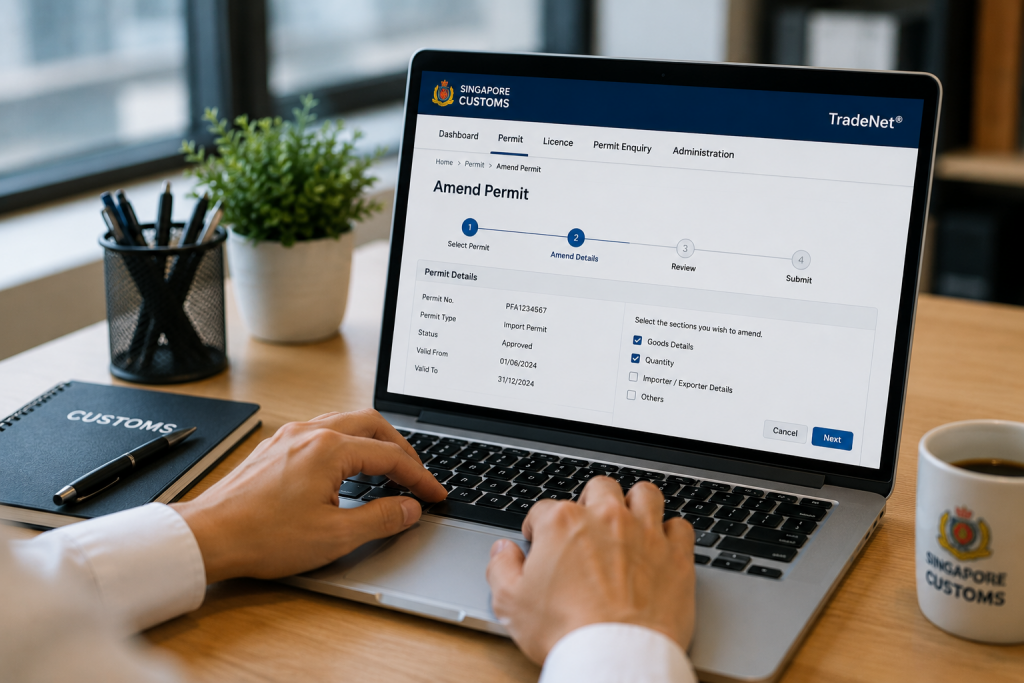
Yes. An approved Singapore Customs permit can generally be amended through TradeNet while it is still valid. However, you cannot amend it if the permit has already been used for cargo clearance, has expired, or the information you need to change is a non-amendable field.
Singapore Customs also states that there is no limit on the number of amendments that can be made to an eligible permit while it remains valid. If incorrect information cannot be amended, the existing permit may need to be cancelled while it is still valid and a new permit submitted.
| Situation | What may be possible? |
|---|---|
| Permit valid + cargo not cleared | ✅ Amendment may be possible |
| Field is non-amendable | ⚠️ Cancellation + new permit may be required |
| Permit expired | ❌ Normal amendment unavailable |
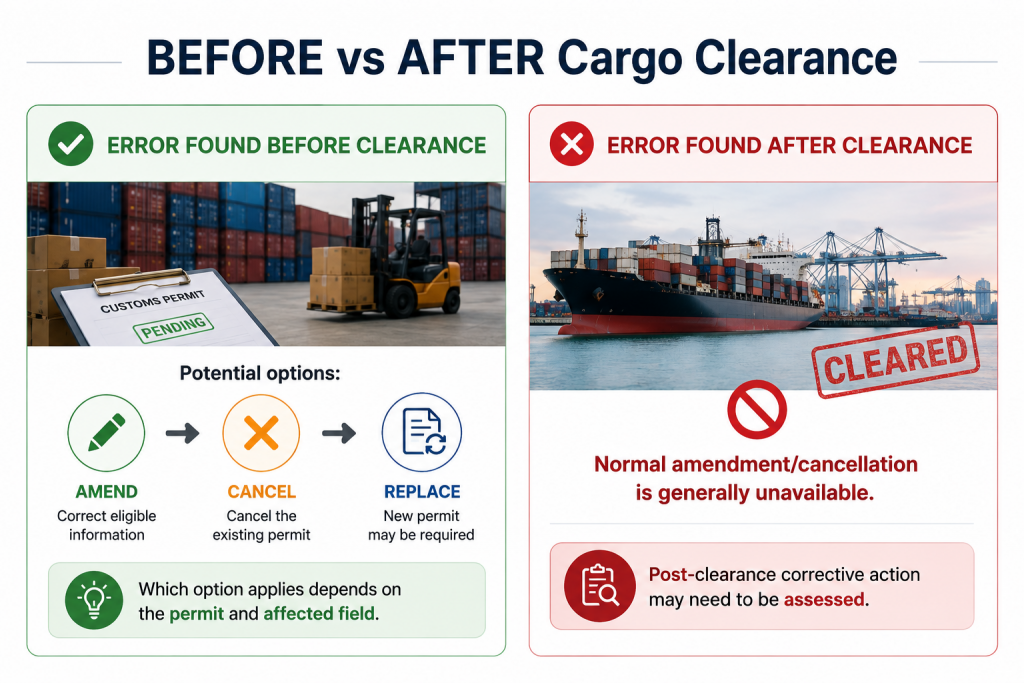
| Cargo already cleared | ❌ Normal amendment/cancellation generally unavailable |
| Shipment cancelled before permit is used | ⚠️ Permit cancellation may be required |
| Error discovered after clearance | ⚠️ Corrective action / Voluntary Disclosure may need to be considered |
Why Do Customs Permit Amendments Happen?
Shipment information changes all the time. A permit may have been completely correct when it was submitted on Monday.
Then on Tuesday:
- the shipping line changes the vessel;
- the supplier revises the invoice;
- the warehouse confirms a different quantity;
- the customer cancels part of the order; or
- someone discovers that information originally provided to the declaring agent was incorrect.
The important thing is not to panic or ignore the discrepancy. Instead, ask: Does the approved permit still accurately reflect the actual shipment? If not, contact your declaring agent before the cargo moves.
When Can You Amend an Approved Singapore Customs Permit?
Singapore Customs allows an approved permit to be amended through TradeNet as long as it remains valid. But there are three important conditions to remember.
1. The Permit Must Still Be Valid – Customs permits have validity periods.
For example, a typical OUT export permit may be valid for the approval date plus nine working days, although shorter periods apply to certain movements involving dutiable goods. Import permit validity also depends on factors such as the permit type, goods and movement involved. Always check the validity shown on your actual permit rather than assuming that every Customs permit has the same validity period.
2. The Permit Must Not Have Been Used for Cargo Clearance – This is where timing becomes very important.
If you discover the error before clearance, an amendment may still be possible. If the permit has already been used for cargo clearance, Singapore Customs generally does not allow the normal amendment process. So don’t wait until after delivery to tell your declaring agent:
“By the way, the invoice was changed.”
Tell them as soon as you know.
3. The Information Must Be Amendable – Not every field in a Customs declaration can be changed electronically.
Singapore Customs maintains a list of fields that are not allowed for electronic amendment through TradeNet. If the incorrect information falls into one of those fields, simply submitting an amendment will not solve the problem. The existing permit may instead need to be cancelled and replaced with a new permit, depending on its status and the circumstances.
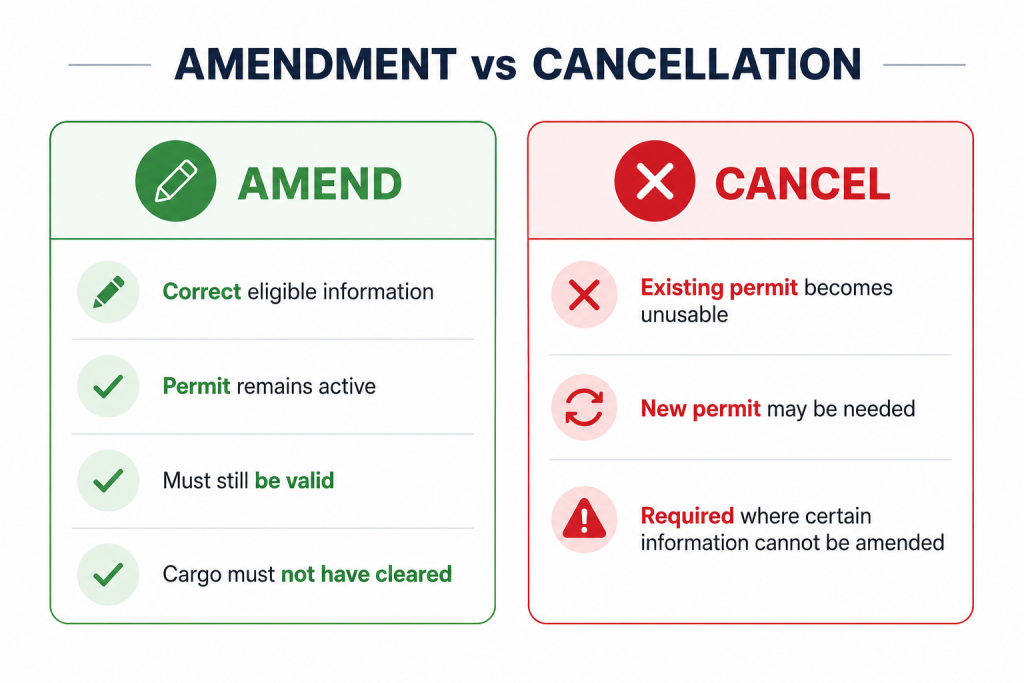
Permit Amendment vs Cancellation: What's the Difference?
The two terms sound similar but serve different purposes.
Permit Amendment
An amendment corrects eligible information while keeping the permit.
Think:
“The permit can still be used, but something needs correcting.”
Permit Cancellation
Cancellation makes the existing permit unusable.
Think:
“This permit should no longer be used.”
If information is incorrect and cannot be amended, Singapore Customs generally requires the existing valid permit to be cancelled and a new permit submitted. Once cancelled, the old permit must not be used for cargo movement.
7 Common Reasons a Customs Permit May Need Correction
This is where things become more practical. Here are some situations businesses frequently encounter.
1. The Quantity Changed
You declared: 1,000 pieces The warehouse later confirms: 920 pieces
Perhaps some goods were damaged, unavailable or removed from the shipment. Don’t assume the original quantity can simply remain because the difference seems small. Tell your declaring agent.
2. The Invoice Value Changed
Suppliers sometimes issue revised invoices after the permit has already been approved. Changes to the declared value deserve particular attention because Customs value can affect the amount of GST or duty payable.
3. Wrong HS Code
An incorrect HS code can affect much more than the description of the goods. It may affect:
- duty;
- controlled-goods requirements;
- Competent Authority approvals;
- CA product codes; and
- trade statistics.
This is why HS classification should be checked before permit submission whenever possible.
4. Vessel or Flight Changed
Shipping schedules change. Containers get rolled. Flights are rescheduled. A shipment originally booked on one vessel may eventually depart on another. When transportation information changes, let your declaring agent determine whether the approved declaration needs updating.
5. Country of Origin Is Wrong
This is particularly important. Country of export and country of origin are not necessarily the same. Goods shipped from China through Singapore do not suddenly become Singapore-origin goods simply because Singapore is the final export location. Origin can affect regulatory requirements, Certificates of Origin, preferential treatment and other compliance considerations.
6. Importer or Exporter Details Are Wrong
Company name and UEN information are fundamental parts of a declaration. If the wrong company has been declared, contact your declaring agent immediately rather than assuming the name can simply be changed later.
7. The Shipment Is Cancelled
Sometimes there isn’t technically a “mistake” at all. The shipment simply isn’t happening anymore. If an approved permit will no longer be used, don’t automatically leave it untouched. Depending on the permit and situation, it may need to be cancelled.
What Happens If the Permit Has Already Been Used?
This is one of the most valuable questions to answer because it represents a completely different search intent: “I found a Customs permit error after clearance. What do I do?” Singapore Customs states that amendment or cancellation is generally not available once an import permit has been used for cargo clearance. Depending on the error, businesses may need to consider another corrective process. One possibility is Singapore Customs’ Voluntary Disclosure Programme (VDP).
The programme allows traders to voluntarily disclose qualifying errors or omissions. Importantly, Singapore Customs states that a disclosure must generally be complete and made before Customs has initiated a check, audit or investigation relating to the matter. So if you discover a genuine declaration error after clearance, ignoring it is not a strategy. Raise it promptly and establish the appropriate corrective action.
What If the Wrong Value Resulted in Too Much or Too Little GST?
This deserves its own section because somebody searching for a permit amendment may actually have a GST problem. Suppose the permit was based on an incorrect Customs value.
If Too Little GST or Duty Was Accounted For
Depending on the circumstances, additional payment may need to be made through the appropriate Customs procedure.
If Too Much Was Paid
A refund application may potentially be available depending on the situation. TradeNet allows Declaring Agents to submit not only permit declarations, but also amendment, cancellation and refund applications.
Can You Amend an Expired Customs Permit?
Generally, no.
Singapore Customs states that an expired permit cannot be amended through the normal TradeNet amendment process. This is why permit validity should be checked whenever a shipment is postponed.
If you already know the shipment will move later than planned, don’t simply wait for the permit to expire. Depending on the permit, a validity extension may be available before expiry.
Amendment vs Validity Extension
These are not the same thing.
Amendment → Changes information. Extension → Changes how long an eligible permit remains usable.
For example: Your shipment information is correct.
But the vessel has been delayed and the permit will expire before the goods move. The issue may therefore involve the permit validity period, not simply correcting incorrect information. This distinction is another reason to tell your declaring agent what actually happened rather than just asking:
“Can you amend my permit?”
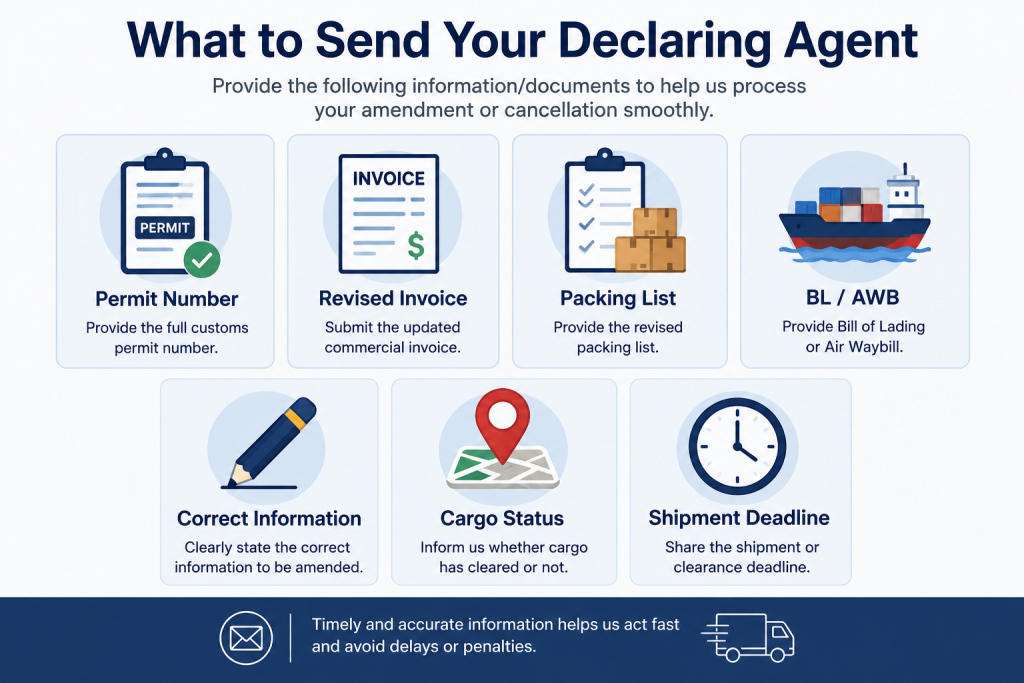
What Should You Send Your Declaring Agent?
Want the problem solved faster? Don’t send:
“Hi, permit wrong. Please amend urgently.”
Send this instead. Permit Correction Checklist
- Permit number / URN
- What information is currently shown
- What the correct information should be
- Revised invoice or packing list
- Updated BL/AWB where applicable
- Current cargo location
- Whether cargo has already cleared
- When the shipment is moving
The more complete the information, the easier it is for the declarant to understand what needs to be corrected.
How to Avoid Permit Amendments in the First Place
Not every amendment is preventable. Vessels change. Customers change orders. Warehouses adjust quantities. But declaration errors caused by incorrect instructions often are. Before sending permit instructions, check these five areas:
1. WHO?
- Importer, exporter and consignee.
2. WHAT?
- Goods description, HS code and quantity.
3. HOW MUCH?
- Invoice value, currency, freight and insurance where relevant.
4. WHERE?
- Country of origin, place of receipt and place of release.
5. HOW?
- Transport mode, vessel/flight and supporting licences where applicable.
This five-question check is much easier for operational staff to remember than a 30-item compliance list.
Found an Error on Your Customs Permit? Don't Wait.
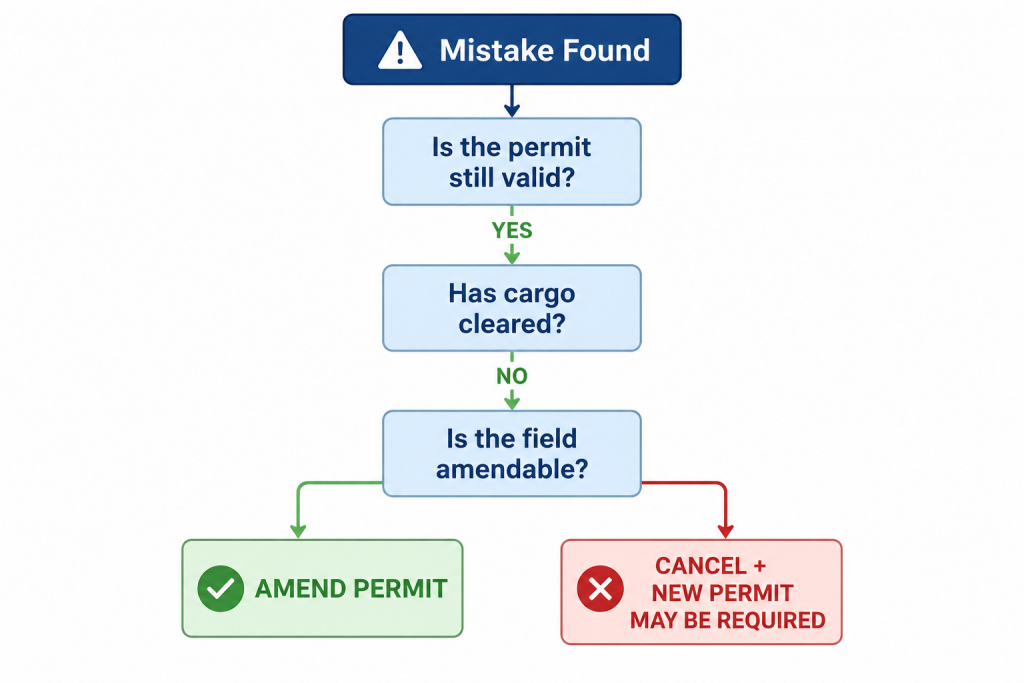
Mistakes and last-minute shipment changes happen. What matters is when you discover the problem and how quickly you act. Remember these three questions:
Is the permit still valid?
Has the cargo already cleared?
Is the incorrect field amendable?
Those answers will largely determine what happens next. If you notice that an approved Singapore Customs permit contains incorrect information, contact your declaring agent before the cargo moves whenever possible.
At Declarators, we can help assess whether the appropriate action is an amendment, cancellation, replacement declaration, validity extension or another corrective process.
Need Help With a Customs Permit Amendment?
Have your permit number and revised supporting documents ready, and contact Declarators as soon as you notice the discrepancy
📞 Call us: +65 6385 2155
📧 Email: group@declarators.com.sg
🌐 Visit: www.declarators.com.sg
Declarators – Your Trusted Declaring Agent in Singapore.