
If your business exports goods from Singapore, there is an important change to Singapore Customs’ Certificate of Origin process that you should be aware of.
From 1 August 2026, Ordinary Certificate of Origin (OCO) applications must be submitted electronically through an Authorised Organisation (AO). Manual submissions will no longer be accepted for new applications.
For businesses that regularly export products, this is more than just an administrative change. Your OCO application process, supporting documents and internal workflow may all need to be reviewed to ensure your shipments are not affected.
At Declarators Pte Ltd, we understand that customs requirements can sometimes be difficult to keep up with, especially when your team is already managing export permits, shipping arrangements, invoices and delivery schedules.
In this guide, we explain what the new digital OCO requirement means, why businesses should prepare, what to look out for and how a declaring agent can support your customs documentation process.
What Is an OCO?
An Ordinary Certificate of Origin (OCO) is a trade document used to identify the origin of goods.
An ordinary Certificate of Origin is also known as a non-preferential Certificate of Origin. It may be required for commercial reasons, depending on the requirements of your overseas buyer, importer or destination country.
For example, your overseas customer may request a Certificate of Origin before accepting a shipment or completing its import procedures.
It is important to understand that an OCO is different from a Preferential Certificate of Origin (PCO).
A preferential Certificate of Origin is generally used where goods qualify for preferential tariff treatment under a relevant Free Trade Agreement or preferential arrangement. An ordinary Certificate of Origin, on the other hand, is a non-preferential origin document.
If your company regularly exports from Singapore, understanding which type of Certificate of Origin your customer requires is an important part of your export documentation process.
What Is Changing for OCO Applications in Singapore?
The major change is the move from manual OCO applications to a fully electronic application process.
Singapore Customs issued a circular in May 2026 announcing the transition to full electronic submission of Ordinary Certificate of Origin applications by 1 August 2026.
This means that businesses should no longer rely on the previous manual submission process for new OCO applications after the implementation date.
The change is part of Singapore’s broader move towards digitalising trade and customs processes.
For businesses, this means it is important to understand:
- How your OCO applications will be submitted
- Which Authorised Organisation you will work with
- What supporting documents are required
- Who within your company will manage the application
- How your team will keep track of applications and approved documents
- Whether your existing internal procedures need to be updated
If your company has previously depended on physical paperwork or manual processes, now is a good time to review your workflow.

Is There a Grace Period?
This is one of the most important points for businesses to take note of.
There is no grace period after 1 August 2026.
For exporters, this means waiting until the last minute is not a good strategy. If you have an urgent shipment coming up and suddenly discover that your staff are unfamiliar with the new electronic application process, it could create unnecessary administrative pressure. A better approach is to make sure your team understands the process before the next OCO is needed.
Why Is Singapore Moving Towards Digital OCO Applications?
The move towards electronic OCO applications is part of a wider digitalisation of Singapore’s trade environment. Singapore Customs already provides various digital platforms and electronic services for businesses involved in import and export activities. Digital processes can offer several practical advantages.
Less paperwork – Electronic applications reduce reliance on physical documents and manual handling.
Easier tracking – Businesses can have better visibility over the progress of their applications instead of relying entirely on physical documents or manual follow-ups.
Better document management – Digital records can make it easier for businesses to organise and retrieve previous applications and supporting documentation.
More efficient workflows – For companies handling multiple shipments, having a standard electronic process can reduce repetitive administrative work.
The move towards digitalisation therefore does not simply mean replacing paper with a computer. It gives businesses an opportunity to review and improve the way they manage their overall export documentation process.
Which Organisations Can Issue an OCO?
Businesses should also be aware of the organisations authorised to issue ordinary Certificates of Origin in Singapore.
According to Singapore Customs, ordinary Certificates of Origin are issued by Singapore Customs or one of the following five Authorised Organisations:
- Singapore Chinese Chamber of Commerce & Industry (SCCCI)
- Singapore Indian Chamber of Commerce & Industry (SICCI)
- Singapore International Chamber of Commerce (SICC)
- Singapore Malay Chamber of Commerce & Industry (SMCCI)
- Singapore Manufacturing Federation (SMF)
These Authorised Organisations issue ordinary Certificates of Origin for qualifying goods, including locally manufactured or processed goods and certain goods re-exported from Singapore.
Businesses should check the relevant requirements and application procedures of their chosen organisation before submitting an application.
What Should Your Business Do Now?
If your company regularly requires an OCO, preparation does not need to be complicated.
However, it is important not to assume that your existing process will automatically work under the new system. Here are some practical steps businesses can take.
1. Review your current OCO process
Look at how your company currently prepares and submits Certificates of Origin.
Identify which parts of the process are still manual and determine what needs to change.
2. Identify your Authorised Organisation
Make sure your team knows which AO it will be working with and understands its electronic application process.
3. Check your supporting documents
Make sure your invoices, product descriptions and other supporting information are accurate and consistent.
Incorrect or incomplete documentation can cause unnecessary delays.
4. Assign responsibility internally
Someone in your organisation should be responsible for preparing and checking OCO applications.
If several employees handle export documentation, make sure everyone understands the new process.
5. Test the process
Do not wait until an urgent export shipment is ready before using the new system.
Familiarising your team with the electronic process in advance can help avoid last-minute problems.
6. Update your internal procedures
If your company’s SOPs still refer to manual OCO applications, update them. This is particularly important if several employees are involved in preparing export documents.
What Documents Should You Check Before Applying?
While the exact requirements may depend on the application and circumstances, businesses should make sure their supporting documentation is properly prepared. Common information that may need to be checked includes:
- Exporter’s company details
- Consignee or buyer information
- Product descriptions
- Quantity of goods
- Invoice information
- Country of origin information
- Manufacturing or processing details, where applicable
- Relevant supporting documents
The most important point is consistency.
For example, if the product description on your invoice differs significantly from the information used in your Certificate of Origin application, it may result in questions or the need for clarification.
Singapore Customs’ guidance also highlights the importance of complete and accurate supporting documents for Certificate of Origin applications.
A good document-checking process before submission can therefore save time later.
Digital Does Not Mean Less Compliance
One common misconception about digitalisation is that electronic applications make the compliance requirements easier.
The process may become more convenient, but businesses are still responsible for providing accurate information.
Digitalisation changes how information is submitted and managed. It does not remove the underlying responsibility to ensure that your declarations and supporting documents are correct.
Singapore Customs has previously taken enforcement action in cases involving false statements in Certificate of Origin applications. This highlights why businesses should take origin documentation seriously and ensure that information submitted to the authorities is accurate.
For businesses involved in international trade, good record-keeping and proper documentation should remain an important part of the export process.
How Does This Affect SMEs?
For large companies with dedicated trade compliance departments, implementing a new electronic process may be relatively straightforward.
For SMEs, however, customs documentation is often handled by a small operations team where one person may be responsible for multiple tasks.
This is where preparation becomes particularly important.
If your staff are already handling:
- Export permits
- Shipping documents
- Commercial invoices
- Packing lists
- Freight arrangements
- Customer requirements
- Customs declarations
Adding another digital process without proper preparation can create additional administrative pressure. Businesses should therefore consider whether it makes sense to handle every part of the process internally or engage a professional declaring agent to assist with customs-related documentation.

Can a Declaring Agent Help?
Yes.
A Declaring Agent (DA) is an entity that makes applications for permits, certificates, licences or other approvals on behalf of a Declaring Entity through a Declarant.
For businesses that do not have dedicated customs personnel, working with an experienced declaring agent can make the customs process easier to manage.
Instead of having your sales or operations staff spend time trying to keep up with every customs procedure, you can have a dedicated party assist with the relevant declaration and documentation processes.
This can be especially useful for businesses with frequent shipments or tight export schedules.
Of course, businesses should still maintain accurate commercial and supporting documents and provide the necessary information to their appointed agent.
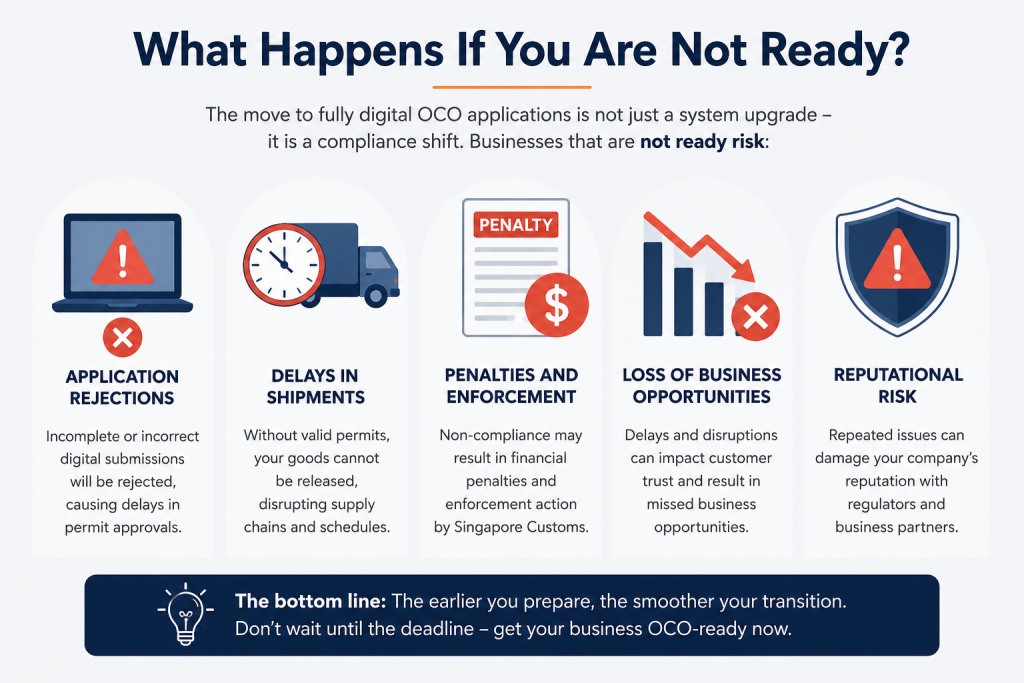
What Happens If You Are Not Ready?
The biggest risk is not the digital system itself. The bigger concern is being unprepared when you need an OCO urgently. Imagine your goods are ready to leave Singapore and your overseas customer suddenly requests a Certificate of Origin.
If your team has never used the electronic application system, does not know which organisation to approach or has incomplete supporting documents, valuable time may be spent trying to resolve the issue.
For exporters working with tight delivery schedules, even small administrative delays can become inconvenient. Preparing in advance is therefore much easier than trying to fix the process when a shipment is already waiting.
How Declarators Can Help Your Business
At Declarators Pte Ltd, we understand that customs documentation is only one part of running an export business. Your priority is getting your goods to your customers on time. Our role is to help make the customs and declaration side of the process as straightforward as possible.
As an experienced declaring agent in Singapore, we support businesses with customs-related documentation and declaration requirements.
Whether you are an established exporter or an SME that is starting to handle more international shipments, having the right customs support can reduce administrative pressure and help your team stay focused on day-to-day operations.
We also understand that every business has different shipment volumes, products and documentation requirements.
Instead of taking a one-size-fits-all approach, it is important to understand your company’s actual process and identify where customs support can make the biggest difference.
Keeping up with changes in Singapore Customs requirements can be challenging, especially when your business is already managing customers, suppliers, shipments and delivery schedules.
At Declarators Pte Ltd, we help businesses manage their customs declaration and documentation requirements in Singapore.
If you are unsure about the new OCO application requirements, need assistance with customs documentation or want to review your current declaration process, speak to our team. Let us help you keep your shipments moving while you focus on running your business.
Declarators Pte Ltd – Your Trusted Declaring Agent in Singapore.
📞 Call us: +65 6385 2155
📧 Email: group@declarators.com.sg
🌐 Website: www.declarators.com.sg