
Your overseas customer sends you an email:
“Please provide Certificate of Origin.”
It sounds straightforward. But then the questions start.
- Which Certificate of Origin?
- OCO or PCO?
- Can my goods claim Singapore origin?
- Do I need a Manufacturing Cost Statement?
- Can I apply if I am only the exporter and not the manufacturer?
And perhaps most importantly: Will the Certificate of Origin actually give my customer lower import duty?
For Singapore exporters, a Certificate of Origin (CO or COO) can be an important part of international shipping documentation. But applying for one should not simply be treated as filling in another form. The origin you declare must be accurate and supportable.
At Declarators, Certificate of Origin applications are handled by a dedicated operations team. One issue we regularly encounter is that businesses know they need a “CO”, but are not always sure which type of CO their overseas customer actually requires.
This guide explains the process in practical terms.
Certificate of Origin Singapore: Quick Answer
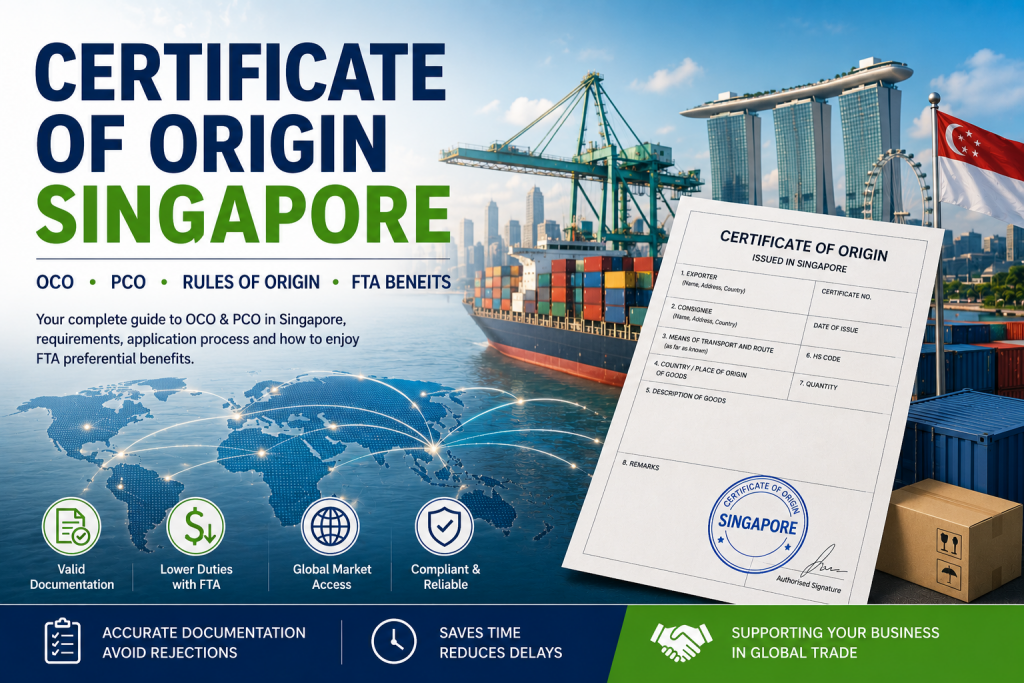
A Certificate of Origin (CO or COO) is an international trade document that certifies the country where goods originate. In Singapore, businesses may require an Ordinary Certificate of Origin (OCO) for non-preferential purposes or a Preferential Certificate of Origin (PCO) when eligible goods are exported under an applicable Free Trade Agreement.
The important distinction is that shipping goods from Singapore does not automatically make them Singapore-origin goods. The goods must satisfy the applicable Rules of Origin.
Key Takeaways
- There are preferential and non-preferential Certificates of Origin.
- An OCO generally certifies origin without providing FTA tariff preference.
- A PCO may allow an overseas importer to claim reduced or zero tariffs under an applicable FTA.
- Goods exported from Singapore are not automatically Singapore-originating.
- Locally manufactured goods may require manufacturer registration and supporting origin documentation.
- A Manufacturing Cost Statement (MCS) may be required for certain preferential applications.
- Your invoice, packing list, HS code and origin information should be consistent.
- Different FTAs can have different Rules of Origin.
- From 1 August 2026, OCO applications moved to full electronic submission.
- Origin should be checked before promising preferential tariff benefits to your overseas buyer.
What Is a Certificate of Origin?
A Certificate of Origin is a document used in international trade to establish the origin of goods. In simple terms, it answers:
“Where were these goods actually produced or manufactured?”
That information can be important to:
- overseas Customs authorities;
- importers;
- banks;
- distributors;
- government agencies;
- tendering organisations; and
- other parties involved in an international transaction.
But origin is not necessarily the same as: Where the seller is located.
And it is not necessarily: Where the shipment departed from.
A Singapore company can sell goods manufactured in China, Thailand, Malaysia or elsewhere. Likewise, goods can arrive in Singapore, be stored in a warehouse and later re-exported without becoming Singapore-originating goods. That distinction is fundamental to Certificate of Origin applications.
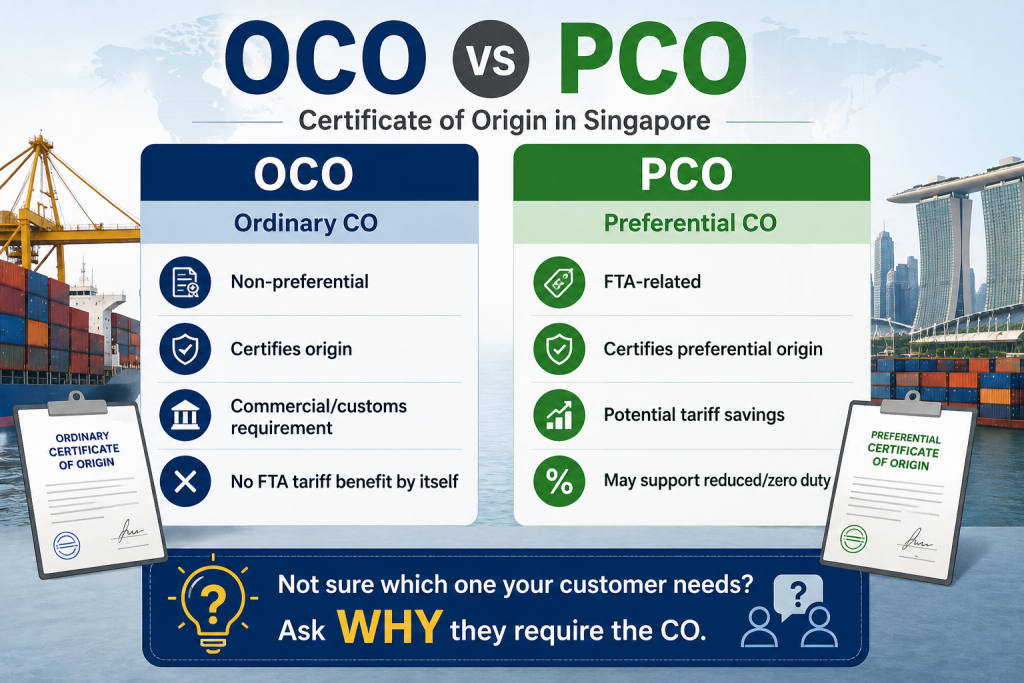
OCO vs PCO: What's the Difference?
This is probably the most important thing for a first-time applicant to understand. There are two broad categories.
Ordinary Certificate of Origin (OCO)
An Ordinary Certificate of Origin is a non-preferential Certificate of Origin. Its purpose is generally to certify the origin of the goods rather than provide preferential tariff treatment under an FTA. An OCO may be requested because of:
- importing-country requirements;
- buyer requirements;
- banking requirements;
- letters of credit;
- tender requirements; or
- other commercial reasons.
Preferential Certificate of Origin (PCO)
A Preferential Certificate of Origin relates to an applicable trade agreement. If the goods satisfy the agreement’s Rules of Origin, the overseas importer may potentially receive reduced or zero import tariffs. But this is the crucial part:
A product does not qualify for preferential treatment merely because it was exported from Singapore.
It must satisfy the origin criteria under the specific FTA being used. Singapore Customs also warns that qualification under one FTA does not automatically mean a product qualifies under another.
Does My Customer Actually Need an OCO or PCO?
Here’s a simple way to start.
Customer says: “We need proof of where the goods originate.”
→ An OCO may be appropriate.
Customer says: “We need the Certificate of Origin for our bank / Letter of Credit.”
→ Check the documentary requirements carefully; an OCO may be required.
Customer says: “We need the CO to reduce our import duty.”
→ Stop and check the applicable FTA and preferential origin requirements.
A PCO or another preferential origin mechanism may be needed. Don’t automatically apply for an OCO simply because the customer used the words “Certificate of Origin.” Clarifying the purpose first can save time and money.
Can My Goods Claim Singapore Origin?
This is where Certificate of Origin applications become more technical.
Singapore Customs’ current non-preferential origin rules state that goods can qualify as Singapore-originating if they are wholly obtained in Singapore or undergo qualifying substantial transformation here. For applicable non-preferential cases, substantial transformation can involve criteria including:
- Minimum 25% local content, based on the ex-factory price;
- Change in Tariff Classification at the six-digit HS level; or
- Chemical reaction for applicable products under HS Chapters 27–40.
However, the exact origin analysis depends on the goods and the origin regime being used.
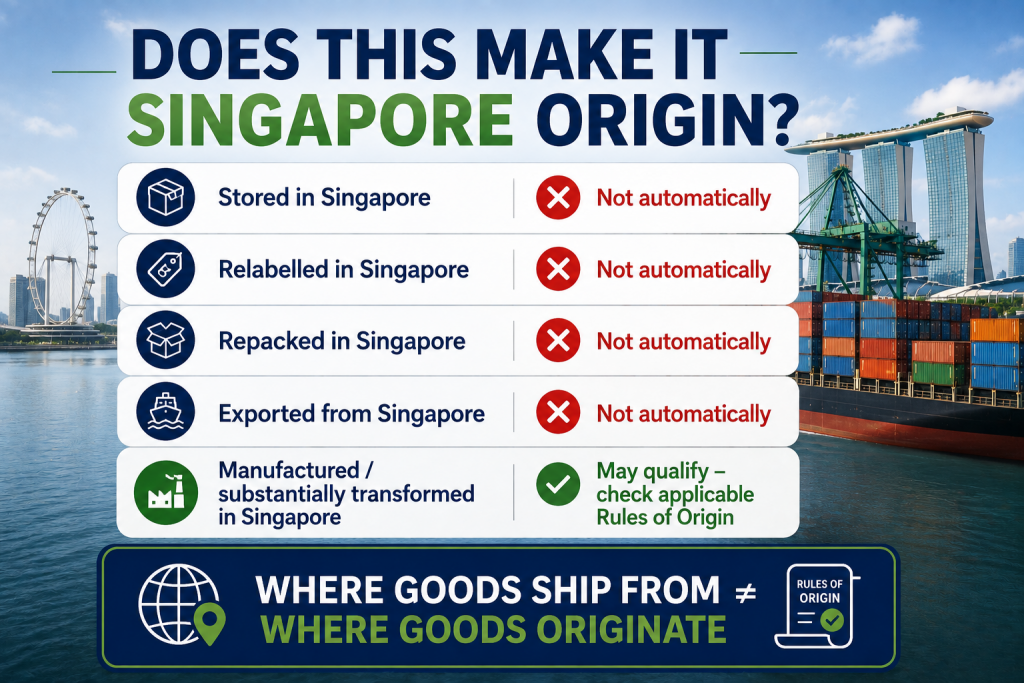
What Does NOT Automatically Make a Product Singapore Origin?
This is an important section because it’s where many misconceptions occur. Imagine finished goods are manufactured overseas. They arrive in Singapore. Your company then:
- stores them;
- repacks them;
- changes the cartons;
- adds labels; and
- exports them to another country.
Can you simply declare: Country of Origin: Singapore? Not necessarily.
Singapore Customs specifically states that goods undergoing only minimal processing do not qualify as Singapore-originating under its non-preferential origin criteria. Activities such as basic preservation, simple packing or similar minor operations should therefore not be assumed to confer Singapore origin.
Remember: Country of Export ≠ Country of Origin
What Are Rules of Origin?
Rules of Origin (ROO) are the rules used to determine the economic nationality of a product. They answer the question:
“Has enough production taken place in this country for the product to originate here?”
This becomes particularly important for PCO applications. Different FTAs can apply different criteria. Depending on the agreement and product, origin requirements can involve concepts such as:
- wholly obtained;
- regional/local value content;
- change in tariff classification;
- specific manufacturing processes;
- accumulation; or
- product-specific rules.
That means a product qualifying under one trade agreement does not automatically qualify under every FTA.
What Documents Are Needed for a Certificate of Origin?
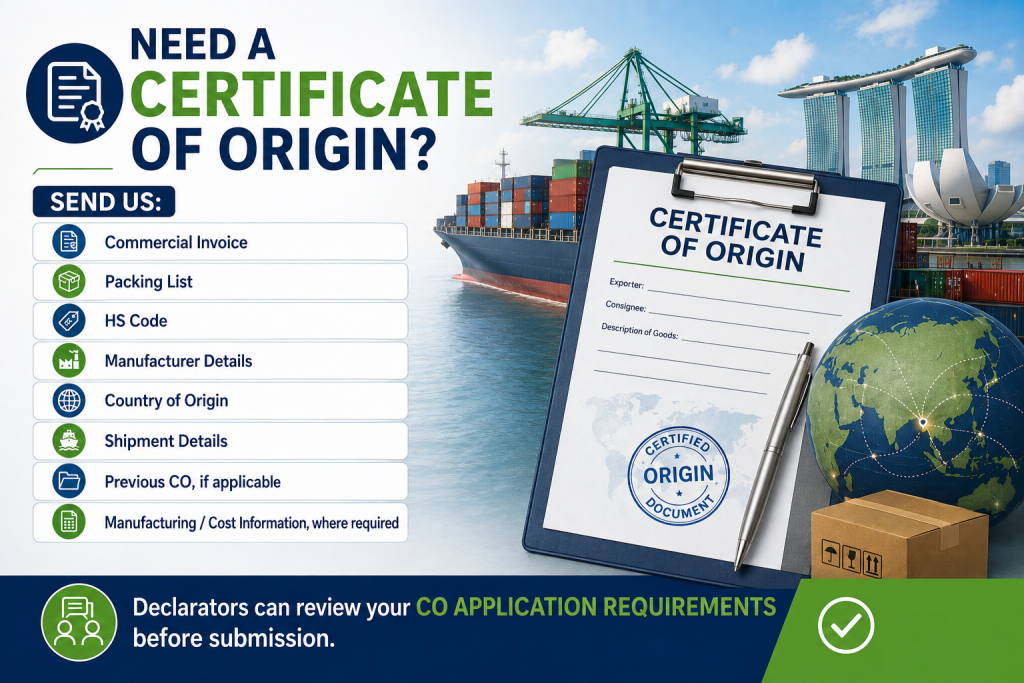
The exact documents depend on the type of CO, product and origin claim. However, businesses should generally prepare accurate shipment information such as:
📄 Commercial Invoice – Check:
- exporter;
- buyer;
- invoice number;
- invoice date;
- goods description;
- quantity;
- currency; and
- value.
📦 Packing List – The packing list should correspond with the invoice and shipment.
🏷️ HS Code – The HS code can be important for determining both product classification and applicable Rules of Origin.
🏭 Manufacturer Information – Where Singapore manufacturing origin is being claimed, information about the actual manufacturer and manufacturing process may be needed.
🌏 Origin Information – You should be able to explain why the stated country of origin is correct.
🧾 Production / Cost Information – For certain preferential applications, production information and a Manufacturing Cost Statement may be required.
What Is a Manufacturing Cost Statement?
The Manufacturing Cost Statement (MCS) is particularly relevant to certain preferential Certificate of Origin applications for locally manufactured goods. It provides information used to support the origin assessment. Depending on the applicable FTA and circumstances, supporting information can include:
- raw materials;
- origin of materials;
- production costs;
- manufacturing processes;
- local content; and
- product classification.
Singapore Customs’ current PCO guidance states that where an MCS is required, it should be submitted for verification before the PCO application. For complete submissions, the stated MCS processing time is generally around seven working days. This is why you should not wait until your customer says:
“Need CO tomorrow.”
If your product has never gone through the necessary origin assessment, there may be prerequisite work to complete first.
What If I Am the Exporter but NOT the Manufacturer?
This is another valuable search query to target. You can be an exporter without manufacturing the goods yourself.
For a preferential CO involving Singapore-origin goods, however, you still need appropriate origin information from the manufacturer. Singapore Customs’ current guidance for exporters that are not the manufacturer says they should ensure that the Singapore manufacturer is appropriately registered and that the relevant MCS remains valid where required. The exporter then uses the verified information to apply for the PCO through TradeNet. In practice, this means your manufacturer may need to cooperate.
You cannot simply invent:
- local content;
- raw-material origin;
- manufacturing costs; or
- production information.
How to Apply for a Certificate of Origin in Singapore
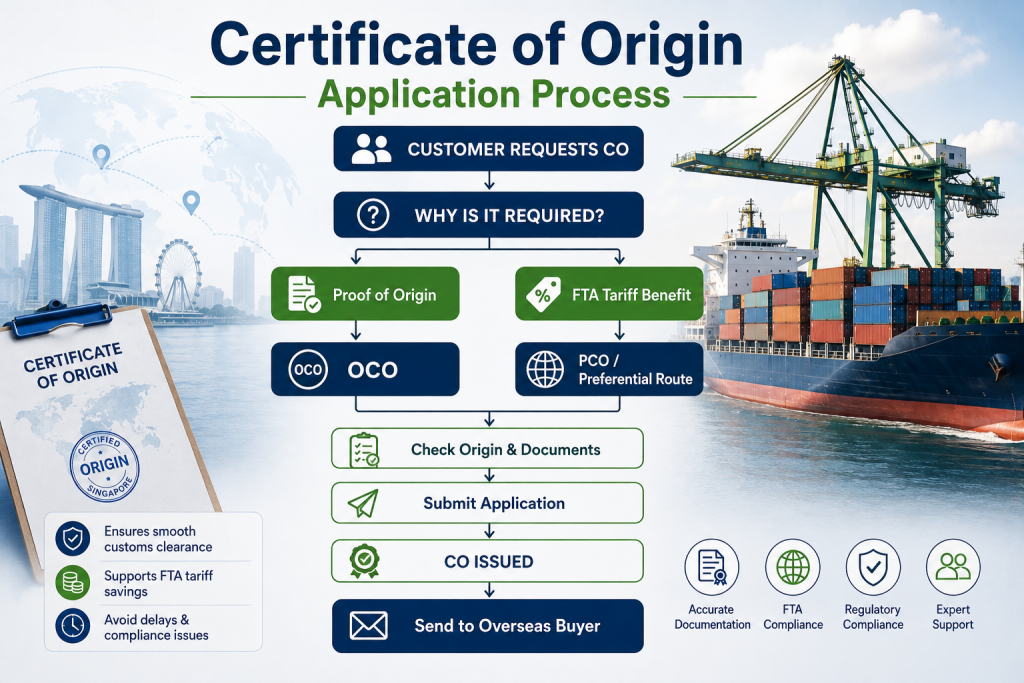
The process depends on the type of CO, but the practical workflow looks like this:
Step 1 — Ask Why the Customer Needs the CO
Determine whether the purpose is:
Origin proof
or
Preferential tariff treatment.
This helps establish whether you should be looking at OCO or PCO requirements.
Step 2 — Identify the Actual Origin
Don’t start with:
“We’re a Singapore company, so put Singapore.”
Start with:
“Where and how were these goods produced?”
Step 3 — Determine the HS Code
Correct classification can be important for establishing the applicable origin rule.
Step 4 — Check the Applicable FTA, If Any
For preferential treatment, identify:
- destination country;
- relevant FTA;
- product-specific rule; and
- required certification mechanism.
Step 5 — Prepare Supporting Documents
Make sure your commercial and origin information is consistent.
Step 6 — Complete Prerequisites
For locally manufactured goods, this may include manufacturer/product registration and MCS verification where applicable.
Step 7 — Submit the CO Application
The appropriate application route depends on the certificate.
Step 8 — Check the Issued Certificate
Before sending the CO overseas, verify:
- exporter;
- consignee;
- invoice;
- description;
- quantity;
- HS code;
- origin; and
- other shipment details.
Electronic OCO Applications: What Changed in 2026?
There is also an important recent change exporters should know about. From 1 August 2026, new Ordinary Certificate of Origin applications moved to full electronic submission through the relevant Authorised Organisation’s platform.
So this is no longer an upcoming requirement. It is already in effect. But digitisation does not change the underlying responsibility. You still need to make sure:
- origin is correct;
- supporting information is available;
- documents are consistent; and
- the correct CO is being requested.
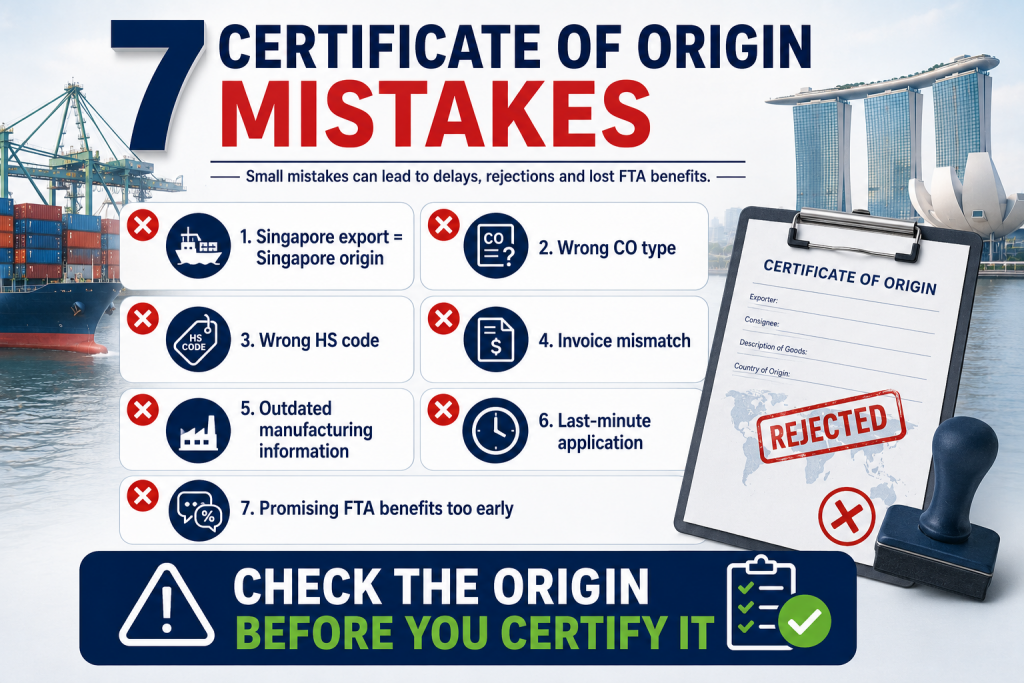
7 Certificate of Origin Mistakes to Avoid
❌ 1. Assuming Singapore Export = Singapore Origin
Probably the most important mistake to avoid.
Where the cargo departs from does not automatically determine where the goods originate.
❌ 2. Applying for OCO When the Customer Needs FTA Benefits
Ask the customer why they need the certificate.
❌ 3. Using the Wrong HS Code
The HS code can affect the applicable Rules of Origin.
❌ 4. Invoice and CO Descriptions Don’t Match
Your trade documents should tell a consistent story.
❌ 5. Manufacturing Information Is Outdated
Products change.
Suppliers change.
Raw materials change.
Production processes change.
Don’t assume last year’s origin assessment remains correct forever.
❌ 6. Waiting Until Shipment Day
CO applications can involve more than simply submitting shipment details.
Origin verification or prerequisite documentation may take time.
❌ 7. Promising Your Customer Zero Duty Before Checking
This can create a difficult commercial situation.
A sales team tells the customer:
“Don’t worry, Singapore FTA. Zero duty.”
Then the operations team discovers the product does not satisfy the relevant origin rule.
Check eligibility before promising tariff savings.
Can a Certificate of Origin Save My Customer Money?
Potentially—if preferential treatment applies.
Suppose your overseas customer normally pays import duty on your product. If:
- Singapore has an applicable FTA with the destination;
- your product falls within the agreement;
- the goods satisfy the relevant Rules of Origin; and
- the applicable origin certification requirements are met,
The importer may be able to claim a lower preferential tariff. That can reduce the landed cost of your product. For exporters, this can also become a commercial advantage. Instead of competing only on your selling price, your product may become more attractive because of the tariff treatment available to the buyer. But eligibility should always be verified rather than assumed.
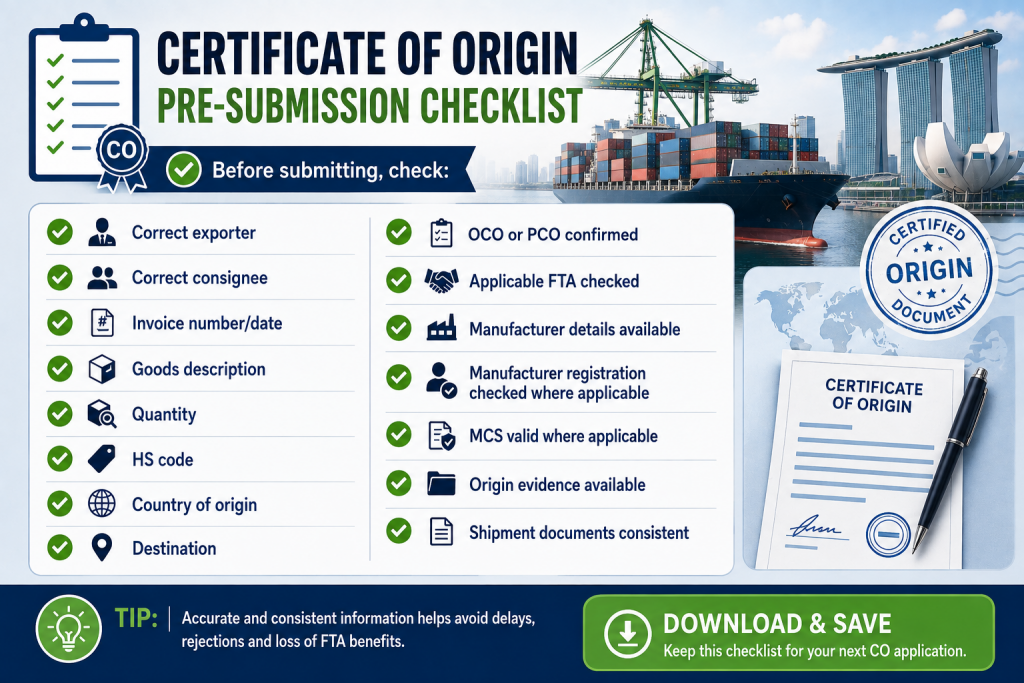
How Declarators Helps With Certificate of Origin Applications
At Declarators Pte Ltd, Certificate of Origin work is one of our specialist trade-documentation services, supported by a dedicated CO operations team. Rather than treating every application the same, we first need to understand:
- What are the goods?
- Where were they manufactured?
- Where are they being exported?
- Why does the customer require a CO?
- Is preferential treatment being claimed?
- Is the manufacturer registered where required?
- Is supporting origin documentation available?
From there, we can help identify the relevant application requirements and review the documentation before submission. This is especially useful where the exporter has received a vague request from an overseas customer such as:
“Please send Form D / CO urgently.”
Before simply applying, it is worth establishing whether that document is actually appropriate for the shipment.
Need a Certificate of Origin? Check Before Your Cargo Moves
The most important part of a Certificate of Origin application isn’t the certificate itself. It is establishing that the origin stated on that certificate is correct. Before applying, ask:
Where were the goods actually manufactured?
Why does my customer need the CO?
Is an OCO or preferential route required?
Does an FTA apply?
Do the goods satisfy its Rules of Origin?
Are my supporting documents ready?
A little checking before shipment can prevent rejected applications, Customs questions and disappointed overseas customers later.
Need Help With a Certificate of Origin Application?
Send Declarators your:
📄 Invoice + 📦 Packing List + 🏷️ HS Code + 🏭 Manufacturer Information + 🌏 Destination + Shipment Details
Our team can review the application requirements and advise what supporting information may be required before submission.
Declarators Pte Ltd
The Customs Specialist
Tel: +65 6385 2155
Email: group@declarators.com.sg