
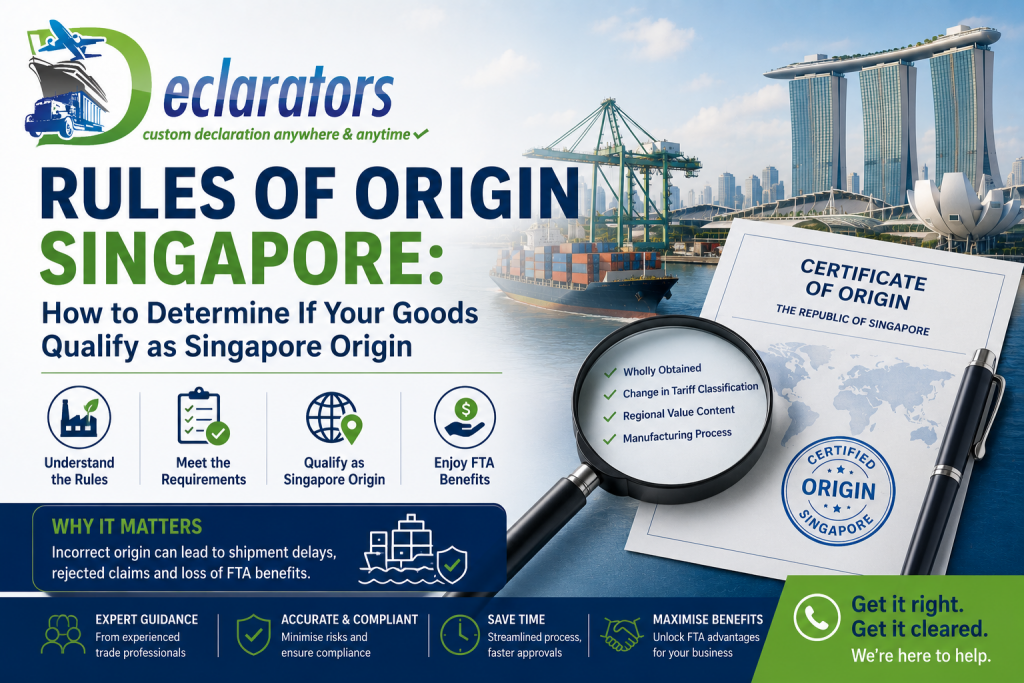
Determining the correct country of origin is an important part of international trade compliance.
For Singapore importers, exporters and manufacturers, origin can affect Customs declarations, Certificates of Origin, Free Trade Agreement benefits, preferential tariff treatment and supporting trade documentation.
However, one of the most common misconceptions is that goods automatically become Singapore-originating simply because they are exported from Singapore. This is not the case.
A product’s country of export and country of origin may be different. Goods manufactured overseas can be imported into Singapore, stored, repacked and subsequently re-exported without becoming Singapore-originating.
The correct origin depends on where the goods were produced and whether they satisfy the applicable Rules of Origin (ROO). This guide explains how Rules of Origin work in Singapore, including substantial transformation, local content, changes in tariff classification, preferential and non-preferential origin, and the documentation businesses should maintain to support their origin declarations.
Rules of Origin Singapore: Quick Answer
Rules of Origin are the criteria used to determine the country or region in which goods originate. Goods may qualify as Singapore-originating if they are wholly obtained in Singapore or undergo sufficient manufacturing or processing in Singapore to meet the applicable origin requirements. Preferential origin claims must satisfy the specific Rules of Origin under the relevant Free Trade Agreement.
Key Points for Businesses
- Exporting goods from Singapore does not automatically make them Singapore-originating.
- Country of origin and country of export are separate concepts.
- Singapore non-preferential origin may be established through wholly obtained status or qualifying substantial transformation.
- Certain manufactured goods may qualify through local-content or tariff-classification criteria.
- Simple repacking, relabelling or storage generally does not establish Singapore origin.
- Preferential Rules of Origin differ between Free Trade Agreements.
- Correct HS classification is often important when assessing origin.
- Businesses should retain sufficient documentation to substantiate the origin declared.
- Origin should be confirmed before applying for a Certificate of Origin or claiming preferential tariff treatment.
What Are Rules of Origin?
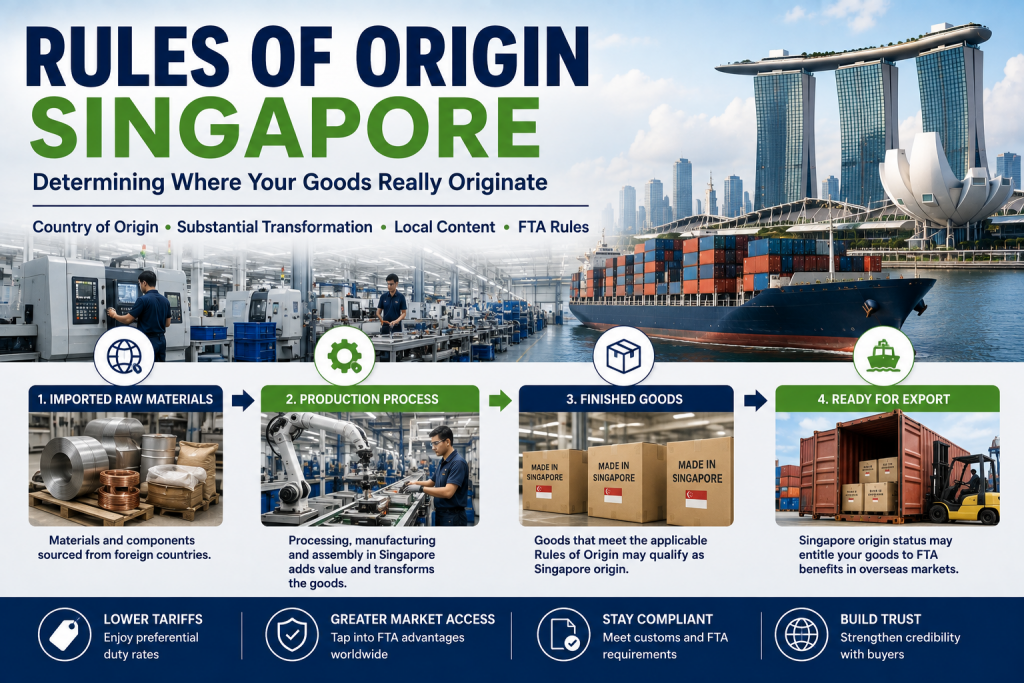
Rules of Origin are the criteria used to determine the economic nationality of goods. In international trade, a product may involve materials, components and manufacturing activities from several countries.
For example, a finished product may include:
- components manufactured in China;
- raw materials sourced from Malaysia;
- electronic parts from Japan;
- packaging produced in Singapore; and
- final manufacturing carried out in Singapore.
In such cases, the origin cannot be determined solely by looking at the country from which the product is shipped.
Instead, the relevant Rules of Origin must be applied. The purpose is to establish where the goods were either:
- wholly obtained; or
- sufficiently manufactured or transformed into their final form.
This distinction is particularly important when businesses declare origin information to Customs or apply for a Certificate of Origin.
Country of Origin vs Country of Export
Country of Origin vs Country of Export
The country of origin and country of export should not be treated as interchangeable.
Country of Origin
The country where the goods are considered to originate based on the applicable origin rules.
Country of Export
The country from which the goods are physically exported.
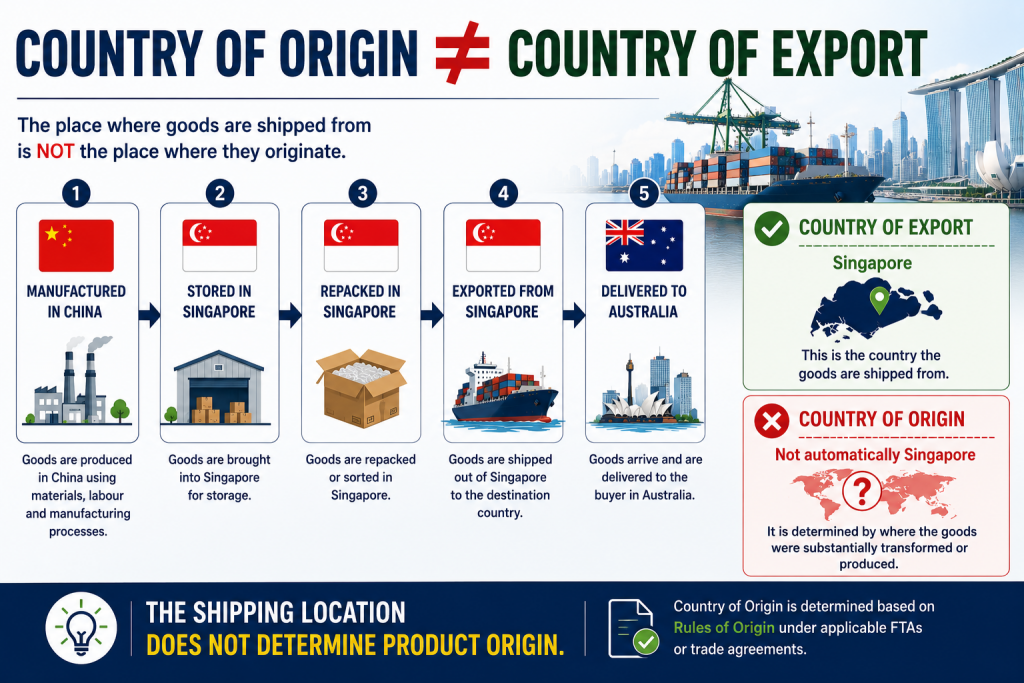
Consider the following example:
A Singapore trading company imports fully manufactured industrial equipment from China.
The equipment is stored in Singapore before being sold to an Australian customer.
The shipment therefore moves:
China → Singapore → Australia
In this scenario:
Exporter: Singapore company
Country of Export: Singapore
Country of Origin: Potentially China, depending on the actual manufacturing circumstances
The fact that the goods were stored or re-exported from Singapore does not automatically change their origin.
When Can Goods Qualify as Singapore Origin?
For non-preferential purposes, goods may generally qualify as Singapore-originating if they are either:
Wholly Obtained in Singapore
or
Substantially Transformed in Singapore
Substantial transformation means that sufficient manufacturing or processing has taken place in Singapore to satisfy the applicable origin criteria. Depending on the circumstances, this may involve criteria such as:
- minimum local content;
- change in tariff classification; or
- specific processing requirements.
The applicable test should always be determined based on the product and the origin regime being used.
What Does “Wholly Obtained” Mean?
Wholly obtained goods are generally products that originate entirely within one country without incorporating imported materials in the manner commonly seen in manufactured products. Depending on the applicable origin framework, examples may include certain:
- agricultural products;
- minerals;
- natural resources;
- animals and animal products;
- fishery products; and
- other goods obtained entirely within the relevant territory.
For many Singapore manufacturers, however, the more relevant issue is substantial transformation, because imported materials and components are commonly used during production.
What Is Substantial Transformation?
Substantial transformation refers to manufacturing or processing that is significant enough for the resulting product to acquire its originating character. It is therefore not sufficient simply to ask:
“Did something happen to the goods in Singapore?”
The more appropriate question is:
“Was the processing undertaken in Singapore sufficient to meet the applicable Rules of Origin?”
For non-preferential Singapore origin, relevant tests may include local-content requirements, changes in tariff classification and specified production processes.
Understanding the 25% Local-Content Criterion
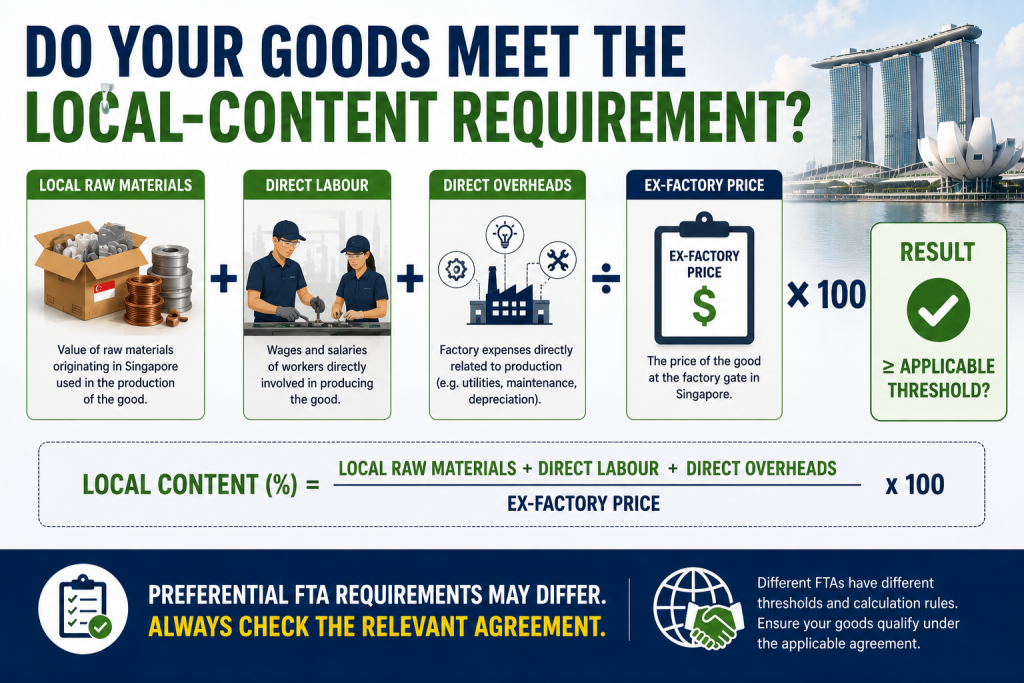
One criterion that may apply under Singapore’s non-preferential origin framework is a minimum level of local content. In simplified terms, the calculation considers eligible Singapore costs in relation to the finished product’s ex-factory price.
A simplified illustration is:
Local Raw Materials + Direct Labour + Direct Overheads ÷ Ex-Factory Price × 100
Where the applicable local-content threshold is met, the goods may satisfy the relevant non-preferential origin criterion.
Example
Assume: Ex-factory price: $100 Qualifying Singapore content: $30 The local-content percentage would be: $30 ÷ $100 × 100 = 30%
This exceeds a 25% threshold. However, businesses should be careful not to apply this test automatically to preferential origin claims.
Free Trade Agreements can impose different Rules of Origin.
What Is a Change in Tariff Classification?
Another commonly used origin concept is Change in Tariff Classification (CTC). This compares the HS classification of the non-originating materials with the HS classification of the finished product.
Where the manufacturing process results in the required change in tariff classification, the product may satisfy the applicable origin rule.
Depending on the rule, this may involve a:
- Change in Chapter;
- Change in Tariff Heading; or
- Change in Tariff Subheading.
This makes correct HS classification particularly important. An incorrect HS code may affect both:
- the Customs declaration; and
- the origin determination.
Does Repacking or Relabelling in Singapore Change Origin?
Generally, simple operations such as repacking or relabelling should not be assumed to change the origin of overseas-manufactured goods. Consider the following situation: Finished goods are manufactured overseas. They are imported into Singapore and then:
- inspected;
- repacked;
- relabelled;
- placed into new cartons; and
- exported to another country.
The exporter may be a Singapore company. The invoice may be issued from Singapore. The shipment may depart from Singapore. However, those activities alone generally do not mean the goods have undergone sufficient transformation to qualify as Singapore-originating.
Practical Example 1: Overseas Goods Repacked in Singapore
A Singapore distributor imports 1,000 units of finished consumer products manufactured overseas. After arrival, the company:
- removes the original cartons;
- places the products into new packaging;
- attaches its own branding; and
- exports the products to another market.
There has been no significant manufacturing process. In this situation, the goods should not automatically be treated as Singapore-originating simply because packaging activities were performed locally. This is an important distinction for businesses operating regional distribution or re-export hubs in Singapore.
Practical Example 2: Imported Components Manufactured Into a New Product
Consider a different scenario. A Singapore manufacturer imports various components and raw materials.
Within its Singapore factory, the company carries out a substantial production process that results in a new finished product. The finished product may:
- have a different commercial identity;
- have a different HS classification;
- contain qualifying Singapore content; or
- satisfy another applicable origin criterion.
The business should then assess whether the final product meets the relevant Rules of Origin.
This is significantly different from simple repacking or relabelling.
Practical Example 3: Exporting Under a Free Trade Agreement
A Singapore manufacturer exports finished products to a country with which Singapore has an applicable Free Trade Agreement.
The overseas customer requests preferential origin documentation so that it can claim a reduced tariff. The exporter must now consider the Rules of Origin under that specific agreement.
The product may need to meet a rule involving:
- Regional Value Content;
- Change in Tariff Heading;
- Change in Tariff Subheading;
- wholly obtained status;
- specific manufacturing processes; or
- a combination of conditions.
Qualifying as Singapore origin for one purpose does not automatically mean that the product qualifies for preferential treatment under every FTA.
Preferential vs Non-Preferential Rules of Origin
This is an important distinction for exporters.
Non-Preferential Origin
Non-preferential origin is generally used where no FTA tariff preference is being claimed.
It may be relevant to:
- Ordinary Certificates of Origin;
- Customs declarations;
- commercial documentation;
- origin marking; and
- other trade requirements.
Preferential Origin
Preferential origin applies when an importer wishes to claim reduced or zero tariffs under an applicable Free Trade Agreement or preferential arrangement. In this case, the product must satisfy the specific Rules of Origin under that agreement.
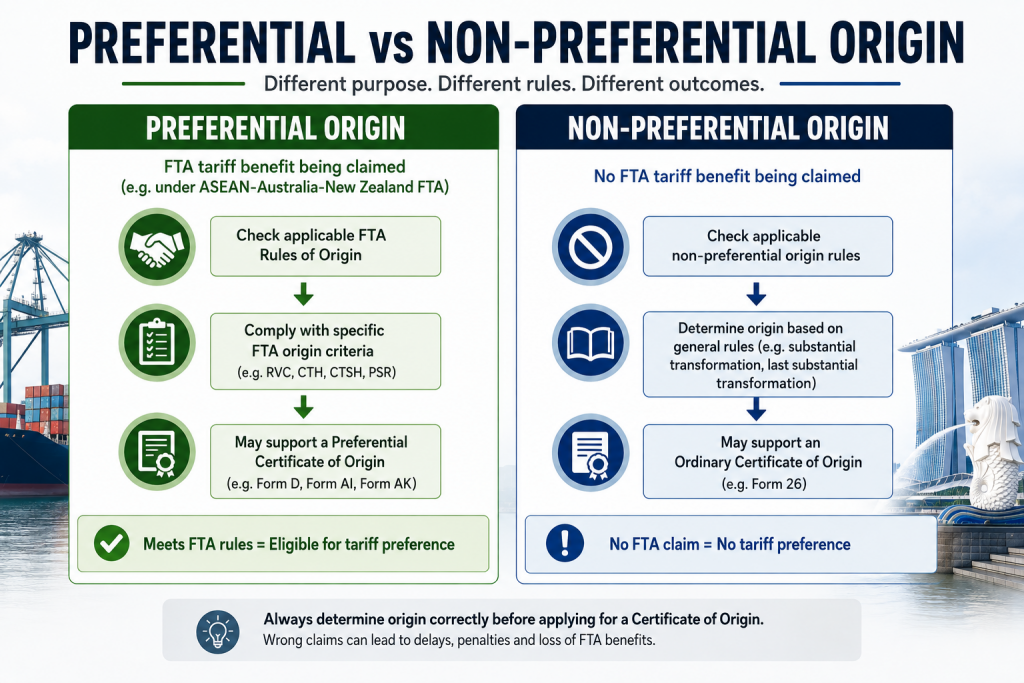
PREFERENTIAL ORIGIN
FTA tariff preference being claimed
↓
Identify applicable FTA
↓
Check Product Specific Rule
↓
Confirm qualification
↓
Issue / apply for relevant preferential proof of origin
Bottom banner: Different trade agreements may apply different origin tests.
Why Rules of Origin Can Differ Between FTAs
Singapore has an extensive network of Free Trade Agreements.
However, businesses should not assume that all agreements use the same origin rules. A product may qualify under one agreement and fail under another.
Differences can arise in:
- Regional Value Content thresholds;
- Product Specific Rules;
- tariff-classification requirements;
- accumulation provisions;
- certification procedures; and
- documentary requirements.
A practical approach is:
Destination Country
↓
Applicable FTA
↓
Correct HS Code
↓
Product Specific Rule
↓
Origin Assessment
↓
Origin Documentation
This should ideally be done before the exporter promises preferential tariff treatment to the overseas customer.
What Is a Product Specific Rule?
A Product Specific Rule, or PSR, identifies the origin requirement applicable to a specific product under a particular trade agreement. The product’s HS code is normally used to locate the relevant rule.
A PSR may require, for example:
RVC – Regional Value Content.
CTH – Change in Tariff Heading.
CTSH – Change in Tariff Subheading.
Specific Process
- A prescribed manufacturing or production activity.
- Some agreements may also provide alternative rules.
- Businesses should therefore avoid applying a generic origin test without first checking the correct agreement and product classification.
How Rules of Origin Affect Certificate of Origin Applications
A Certificate of Origin is the document certifying origin. Rules of Origin are the criteria used to establish whether that origin is correct.
In practical terms:
Rules of Origin
↓
Determine whether goods qualify
↓
Supporting Documentation
↓
Supports the origin assessment
↓
Certificate / Origin Declaration
↓
Provided to the customer or importing authority
This means an application should not begin by simply deciding what country should appear on the certificate. The origin should first be established from the facts and supporting records.
What Documents Should Exporters Keep?
Origin declarations should be supported by proper records. Depending on the goods and transaction, businesses may need to maintain:
- commercial invoices;
- supplier invoices;
- Bills of Materials;
- raw-material records;
- HS classifications;
- supplier origin declarations;
- manufacturing-flow information;
- production records;
- costing records;
- previous Certificates of Origin;
- Manufacturing Cost Statements; and
- relevant FTA documentation.
Good recordkeeping becomes particularly important if the origin of the goods is later reviewed or questioned.
7 Common Rules of Origin Mistakes
- Assuming Singapore Export Means Singapore Origin – This is one of the most common misconceptions. The country from which goods are exported does not automatically determine their origin.
- Treating Repacking as Manufacturing – Simple repacking should not automatically be considered sufficient transformation.
- Using an Incorrect HS Code – HS classification can directly affect the applicable origin rule.
- Using the Same Origin Rule for Every FTA – Different agreements may impose different product-specific requirements.
- Relying on Outdated Supplier Information – Manufacturing arrangements and supply chains can change. Origin information should therefore be reviewed periodically.
- Declaring Origin Without Supporting Evidence – Origin should be based on verifiable information rather than assumption.
- Waiting Until the Customer Requests a Certificate of Origin – Origin verification can take time. If an overseas customer requires preferential documentation urgently, discovering an origin issue at the last minute can delay the transaction.
Rules of Origin Pre-Assessment Checklist Before determining origin, consider:
- What is the finished product?
- What is its HS code?
- Where is it manufactured?
- What imported materials are used?
- What Singapore materials are used?
- What manufacturing process takes place locally?
- Does the product undergo substantial transformation?
- Is non-preferential or preferential origin being assessed?
- If preferential, which FTA applies?
- What Product Specific Rule applies?
- Are costing and manufacturing records available?
- Can the declared origin be supported if questioned?
How Declarators Can Assist
Rules of Origin can become complex when a product involves several countries, multiple suppliers, imported materials or preferential tariff claims. At Declarators Pte Ltd, origin considerations frequently arise in connection with:
- Certificate of Origin applications;
- Preferential Certificates of Origin;
- FTA documentation;
- Customs permit declarations;
- HS classification; and
- supporting trade documentation.
Before an origin-related application is prepared, it is useful to establish:
What are the goods?
Where were they manufactured?
What processing occurred in Singapore?
What is the HS classification?
Where are the goods being exported?
Is preferential treatment being claimed?
What supporting records are available?
Understanding these facts first helps reduce avoidable inconsistencies later in the application process.
Before Declaring Singapore Origin, Verify the Basis
Country of origin should never be determined solely from:
- the exporter address;
- the warehouse location;
- the shipping port; or
- the country from which the invoice was issued.
Instead, businesses should look at the actual manufacturing circumstances. Ask:
Where were the goods produced?
What materials were used?
What manufacturing took place in Singapore?
Was there sufficient transformation?
What is the correct HS classification?
Is preferential tariff treatment being claimed?
Which Free Trade Agreement applies?
What origin rule does that agreement require?
The objective is not simply to produce a Certificate of Origin but to ensure the origin stated in the declaration or certificate can be properly supported.
Need Assistance With Certificate of Origin Documentation?
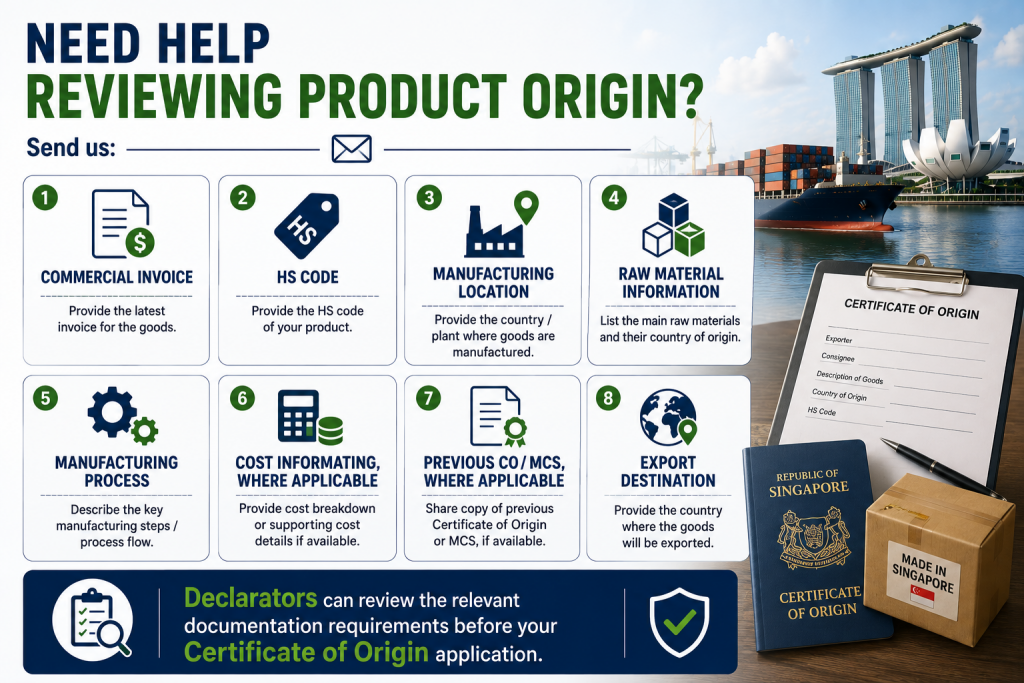
Provide Declarators with:
Commercial Invoice + HS Code + Manufacturing Information + Country of Origin Information + Export Destination + Previous CO/MCS, where applicable
And our team can review the relevant documentation requirements before submission.
Declarators Pte Ltd
The Customs Specialist
Tel: +65 6385 2155
Email: group@declarators.com.sg