
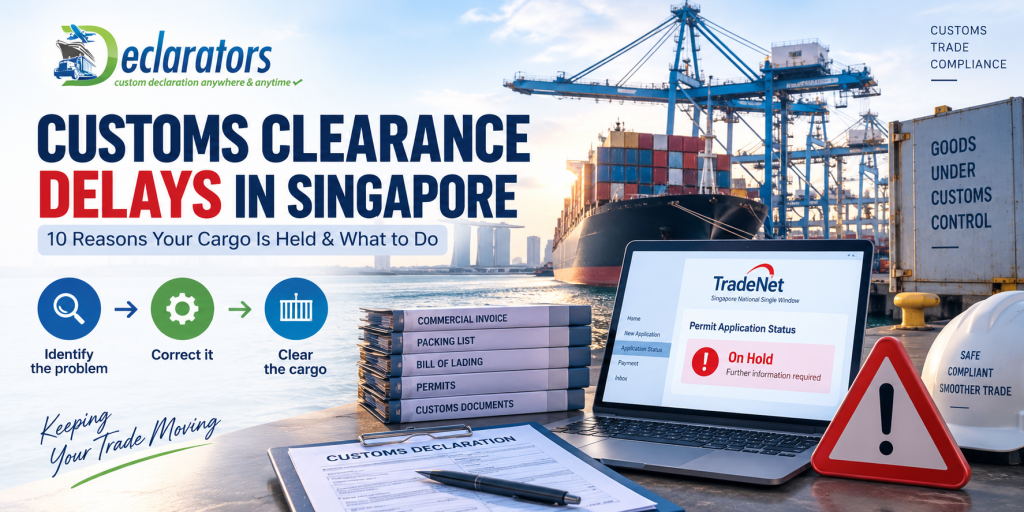
Your shipment has arrived in Singapore. The vessel has berthed or the aircraft has landed. Your customer is waiting for the goods.
Then you receive a message from your freight forwarder:
“Cargo cannot be cleared yet.”
Sometimes the problem is straightforward. The Customs permit has not been approved.
In other cases, there may be a mismatch between the permit and commercial documents, an incorrect HS code, missing Competent Authority approval or a condition on the permit that still needs to be fulfilled. The important point is that “Customs clearance delayed” does not describe one specific problem.
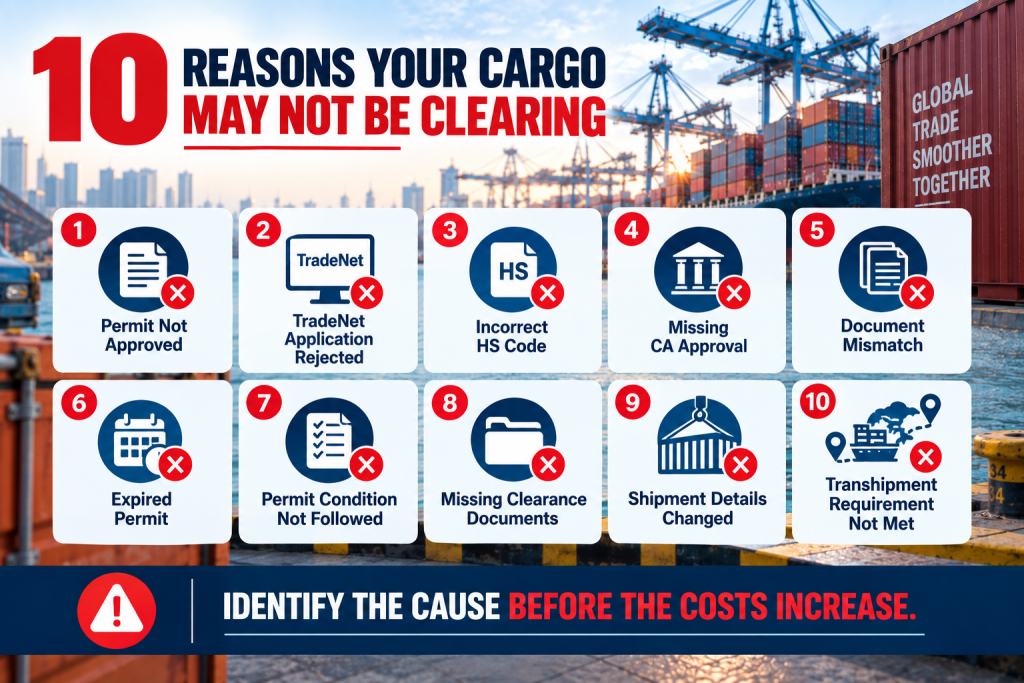
You first need to identify what is preventing the cargo from moving. This guide covers 10 common reasons cargo clearance may be delayed in Singapore and what importers, exporters and logistics teams should check before the problem becomes more expensive.
Different transport modes also have different clearance requirements. Singapore Customs’ current guidance states, for example, that containerised imports by sea generally do not require permit/supporting-document presentation at the inward checkpoint, while air and land imports may require the permit, invoice, packing list and transport document to be presented for verification.
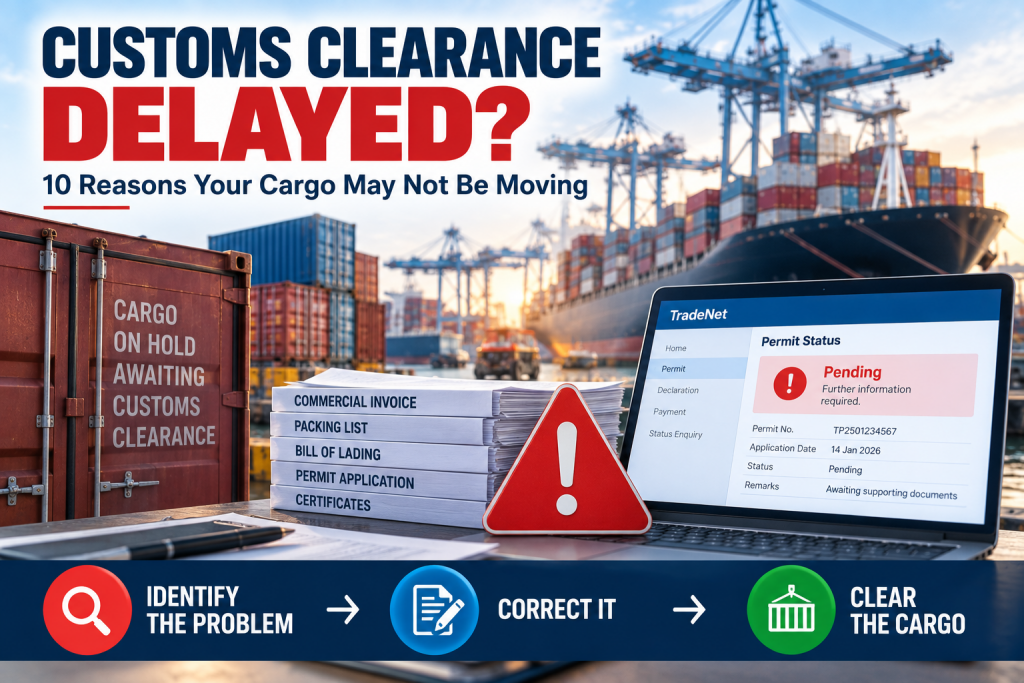
1. The Customs Permit Has Not Been Approved
This is one of the first things to check. A TradeNet application being submitted does not mean the Customs permit has been approved. The application may still be:
- Pending
- Rejected
or showing an error. For import permits, Singapore Customs currently distinguishes between DCS Error, where an application is incomplete or contains an error, and CA/SC Reject, where the application does not meet Singapore Customs or Competent Authority requirements. If your cargo is waiting, confirm the actual permit status.
Do not rely on:
“The permit was submitted already.”
Ask instead:
“Has the permit been approved?”
2. The TradeNet Application Was Rejected
A rejected permit can stop the clearance process before it even starts. The reason may involve:
- incomplete declaration information;
- incorrect permit data;
- missing regulatory approval;
- incorrect product information; or
- another Customs or Competent Authority requirement.
Singapore Customs states that after the relevant error or omission is corrected, a new permit application must be submitted and a new Unique Reference Number is issued. Repeatedly resubmitting the same declaration without understanding the error usually does not solve the problem.
3. The HS Code May Be Incorrect
The HS code affects much more than a Customs statistic. It can determine:
- whether goods are dutiable;
- whether another authority regulates the goods;
- CA product-code requirements;
- declaration requirements; and
- applicable controls.
Imagine the invoice simply says: “Electronic equipment.” If the actual goods are regulated telecommunications equipment, the classification may trigger additional requirements.
Using an incorrect HS code may therefore create a chain reaction:
Wrong HS Code
↓
Wrong Regulatory Assessment
↓
Missing Approval
↓
Permit Problem
↓
Cargo Delay
This is why HS classification should be checked before the cargo becomes urgent.
4. The Goods Are Controlled but the Required Approval Is Missing
Some products are regulated by a Competent Authority. Depending on the goods, this may involve areas such as:
- food;
- health products;
- plants;
- animals;
- telecommunications equipment;
- chemicals;
- strategic goods; or
- other regulated products.
A Customs permit does not automatically replace a licence or approval required by another authority.
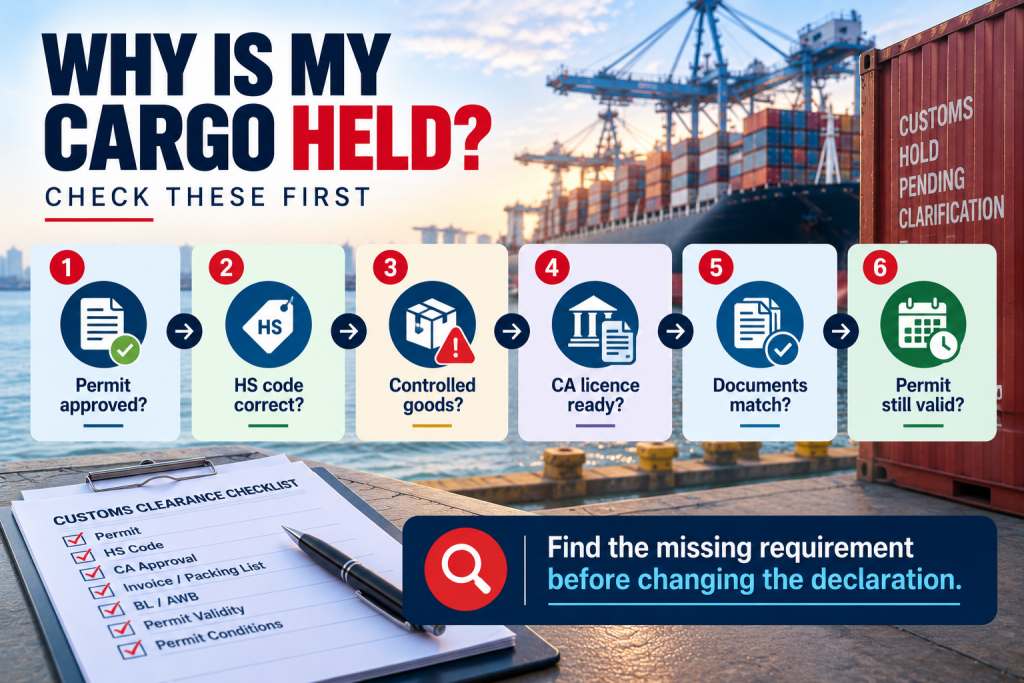
If the regulatory requirement is only discovered after cargo arrives, clearance can become much more difficult operationally. The better workflow is:
Identify Goods
↓
Confirm HS Code
↓
Check Controlled Status
↓
Obtain Licence / Approval
↓
Submit TradeNet Declaration
↓
Arrange Cargo Clearance
5. Your Invoice, Packing List and Permit Do Not Match
Customs declarations should reflect the actual commercial shipment. Suppose your documents show:
Commercial Invoice – 500 pieces
Packing List – 500 pieces
Customs Permit – 5,000 pieces
That discrepancy should be addressed. Other common inconsistencies can involve:
- description;
- weight;
- quantity;
- currency;
- invoice value;
- origin;
- consignee;
- transport information.
A simple way to reduce problems is to perform a four-way check:
INVOICE
↕
PACKING LIST
↕
BL / AWB
↕
CUSTOMS PERMIT
The information should tell the same story.
6. The Customs Permit Has Expired
This problem often occurs when the shipment is delayed. For example:
The permit is approved on Monday.
The vessel rolls.
The shipment moves later than expected.
Nobody checks the permit again.
Singapore Customs states that permit validity depends on the permit type and transaction. For common import permits, current published validity periods can be approval date plus nine working days, although some circumstances have different validity requirements.
If the permit cannot be used within its validity period, businesses should review whether it can be extended before it expires. Do not assume:
Approved once = valid forever.
7. A Permit Condition Requires Cargo or Documents to Be Presented
This is one reason an approved permit may still require action. Singapore Customs publishes condition codes such as:
A1 — goods and documents are to be produced at an FTZ In Gate.
A3 — goods and documents are to be produced at an airport checkpoint or designated Customs location.
H1 — goods and documents are to be produced for clearance at Woodlands or Tuas Checkpoint.
This means operations staff should not simply look at the word: APPROVED and assume the process is finished.
Read the conditions printed on the permit.
8. The Clearance Documents Are Missing
Depending on the shipment and mode of transport, Customs clearance can require supporting documents such as:
- commercial invoice;
- packing list;
- Customs permit;
- BL;
- AWB;
- consignment note; or
- other supporting documentation.
For containerized imports by air or land, Singapore Customs states that the Customs permit, invoice, packing list and AWB or consignment note must be presented for verification and clearance at the checkpoint.
Conventional cargo and hand-carried goods require the goods, printed permit and supporting documents to be presented at the inward checkpoint.
The lesson is simple: Don’t send the truck first and search for the documents afterwards.
9. The Cargo Movement Is Different From What Was Declared
Shipment plans change. The final cargo movement may no longer be what was originally declared.
Examples include:
- different vessel;
- different flight;
- different quantity;
- different container;
- change in destination;
- changed warehouse movement;
- shipment split;
- cargo rolled to a later sailing.
When information changes, the existing permit should be reviewed. Depending on the field and permit status, the appropriate action may involve:
- amendment;
- cancellation;
- replacement permit; or
- another declaration process.
10. Inter-Gateway or Transhipment Requirements Were Not Followed
This is a useful section because many general Customs articles ignore it. Singapore handles huge volumes of transhipment cargo. Some movements involve cargo entering through one checkpoint and leaving through another.
For relevant inter-gateway transhipments, Singapore Customs requires the cargo to be presented with the approved permit and supporting documents at both the entry and exit checkpoints. Where permit condition AX applies, goods released from the first checkpoint must generally be produced at the second checkpoint within 24 hours. Failure to comply can result in investigation and penalties.
So sometimes the problem is not:
“Do we have a permit?”
It is:
“Are we following the movement conditions attached to that permit?”
My Cargo Is Already in Singapore — What Should I Do?
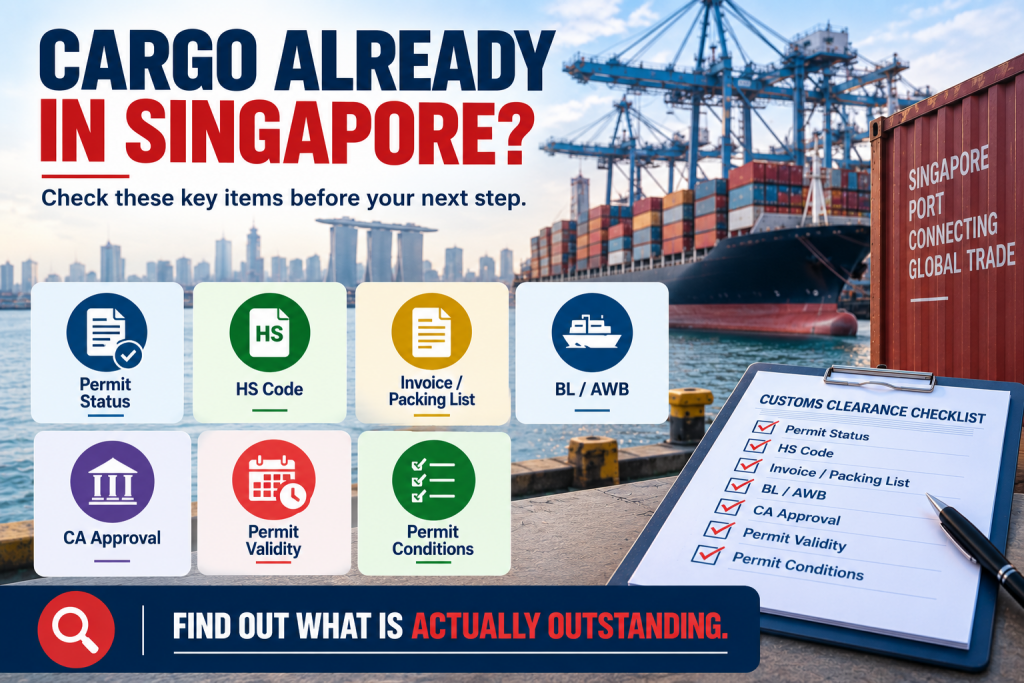
This is the section I want high on the page because it targets customers who need help now. Start with five checks.
- Check the permit status – Is it approved, pending or rejected?
- Read the permit conditions – Does the cargo need to be presented somewhere?
- Compare the documents – Does the permit match the invoice, packing list and BL/AWB?
- Check controlled-goods requirements – Is another government authority involved?
- Identify exactly what the freight forwarder or warehouse is waiting for
Don’t settle for:
“Customs problem.”
Ask:
“What specifically is outstanding?”
That answer can save a lot of unnecessary back-and-forth.
Can Singapore Customs Physically Inspect My Cargo?
Yes. An approved Customs permit does not mean a shipment can never be checked. If cargo is selected for verification or inspection, make sure the shipment can be supported by the information declared. That includes:
- correct goods;
- correct quantities;
- supporting commercial documents;
- licences where required; and
- appropriate permit information.
This is one reason accurate declarations matter even after the permit has been approved.
Does “Held at Customs” Always Mean Singapore Customs Is Holding the Goods?
No. This is a very useful distinction to include because customers regularly use the phrase “held by Customs” for any clearance delay. The cargo may actually be waiting with:
- the port;
- airline;
- ground-handling agent;
- freight forwarder;
- warehouse;
- courier; or
- another operator
While a Customs or regulatory requirement is being resolved. For personal postal and courier parcels, Singapore Customs itself notes that it does not manage parcel tracking or delivery; parcels may instead be held by the relevant postal/courier process for reasons including dutiable goods, controlled goods, prohibited goods or missing invoice information.
For commercial cargo, ask your logistics provider precisely where the cargo is and what requirement remains outstanding.
How Long Does Customs Clearance Take in Singapore?
There isn’t one universal Customs-clearance time. A straightforward shipment with:
Correct documents + correct permit + no additional regulatory issues
may move efficiently.
A shipment involving:
permit rejection + controlled goods + missing licence
may take much longer.
Instead of asking:
“How many hours does Singapore Customs clearance take?”
a more useful question is:
“Is anything outstanding for this shipment?”
The duration largely depends on whether every required piece is already in place.
How to Prevent Customs Clearance Delays Before Shipment
The best time to solve a clearance problem is before it happens. Before cargo departs, make sure you know:
What are the goods?
What is the HS code?
Are they controlled?
Who is the importer/exporter?
What is the actual origin?
What is the Customs value?
What permit is required?
What supporting documents are available?
When will the cargo move?
Then, after the permit is approved: Read it.
Check its validity and conditions before handing it to operations.
Add Your Heading Text Here
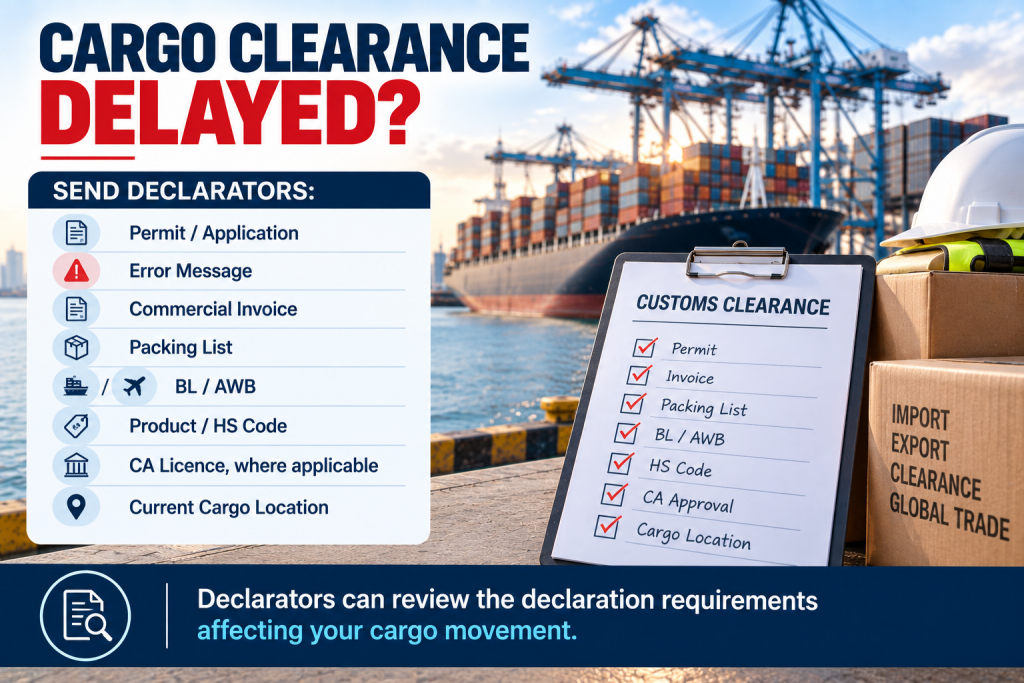
If your shipment is delayed, send your declaring agent:
📑 TradeNet permit/application
⚠️ Error or rejection message, if any
📄 Commercial invoice
📦 Packing list
🚢 BL / AWB
🏷️ Product description / HS code
🏛️ CA licence or approval, if applicable
📍 Current cargo location
🚚 Planned cargo movement
This is more useful than simply sending:
“Please check why cannot clear.”
How Declarators Can Assist
At Declarators Pte Ltd, we handle Customs permit declarations for businesses importing, exporting and transhipping goods through Singapore. When a customer tells us:
“Cargo cannot clear.”
the first objective is to determine why. Depending on the shipment, this may involve reviewing:
- TradeNet permit status;
- declaration information;
- HS classification;
- Customs value;
- country of origin;
- quantity;
- shipment details;
- permit validity;
- permit conditions;
- controlled-goods requirements; and
- supporting documents.
Where declaration changes are required, the appropriate permit amendment, cancellation or replacement process can then be assessed based on the permit status and actual cargo movement. The goal is not simply to make another submission. It is to identify the actual clearance problem and address the relevant declaration requirement.
Need Help With a Customs Clearance Issue?
Send Declarators your: Permit/Application + Invoice + Packing List + BL/AWB + Product Details + Error Message + CA Approval, where applicable and our team can review the relevant Customs declaration requirements affecting the shipment.
📞 Call us: +65 6385 2155
📧 Email: group@declarators.com.sg
🌐 Visit: www.declarators.com.sg
Declarators – Your Trusted Declaring Agent in Singapore.