
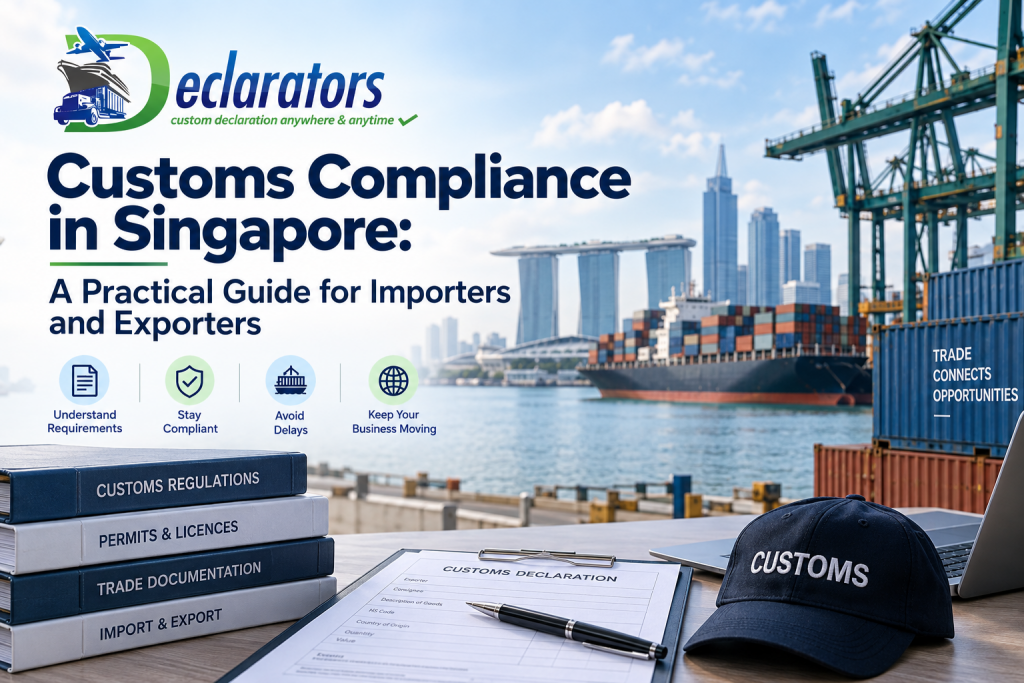
Customs compliance in Singapore means ensuring that import, export and transhipment declarations accurately reflect the actual goods and transaction, that the correct permits and regulatory approvals are obtained, and that supporting trade records are retained for the required period.
Compliance does not stop when the permit is approved. Singapore Customs can conduct post-clearance audits after goods have already been released. These audits can examine commercial systems, processes, financial and non-financial records, physical stock and previous Customs declarations.
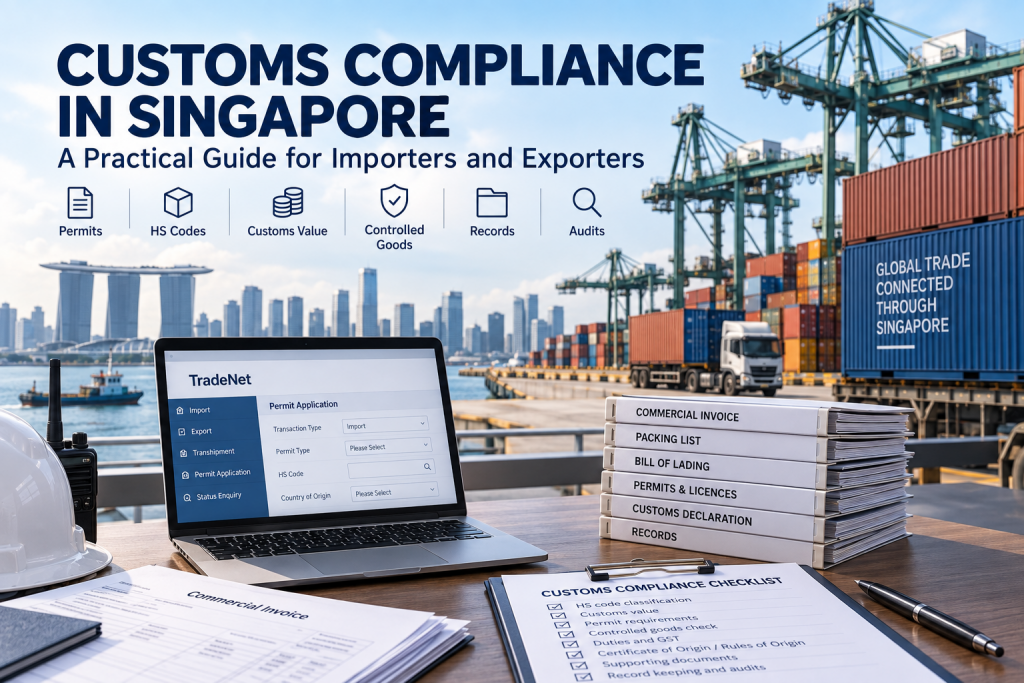
Key Compliance Areas
- Correct TradeNet permit
- Accurate HS classification
- Correct Customs value
- Correct country of origin
- Accurate quantities and shipment details
- Controlled-goods approvals
- Duty and GST treatment
- Permit conditions and validity
- Record retention
- Correction of declaration errors
- Internal compliance checks
- Readiness for Customs audits
1. Start With the Correct Customs Permit
One of the foundations of Customs compliance is selecting the correct declaration for the actual cargo movement. A shipment may involve:
- import;
- export;
- re-export;
- transhipment;
- temporary import/export;
- warehouse movement; or
- another specialised Customs procedure.
These should not simply be treated as interchangeable. Before a TradeNet declaration is prepared, the business should establish:
What are the goods?
Where are they coming from?
Where are they going?
What will happen to them after arrival?
Choosing the wrong declaration procedure can result in rejection, amendment or additional corrective work.
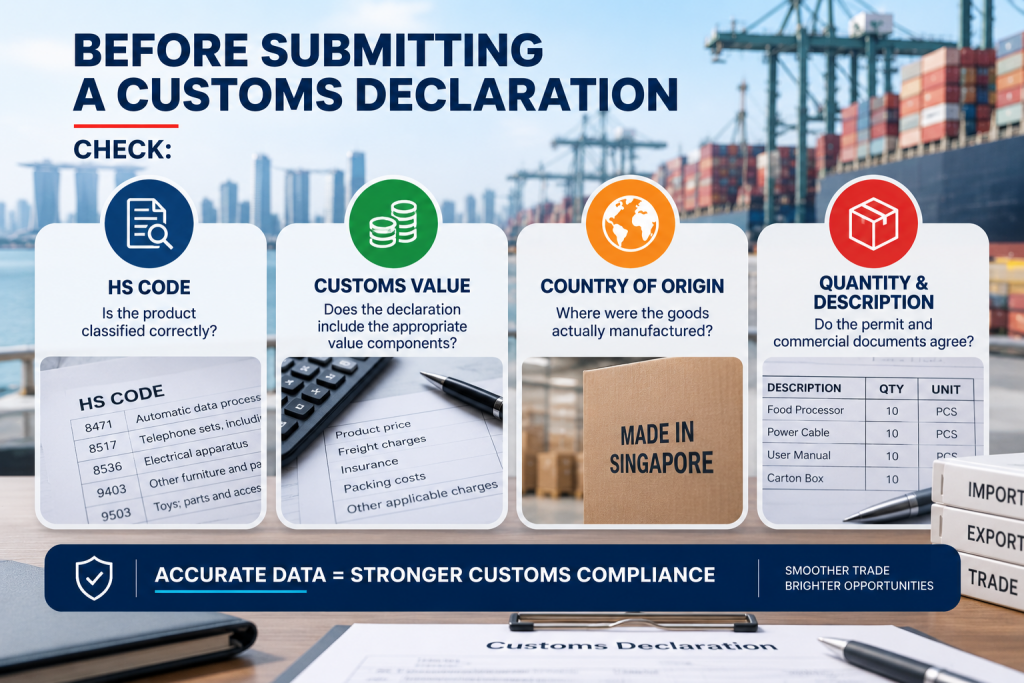
2. Use the Correct HS Code
The Harmonised System (HS) code is one of the most important pieces of information in a Customs declaration. It can affect:
- duty;
- controlled-goods requirements;
- Competent Authority product codes;
- Rules of Origin;
- product restrictions; and
- trade statistics.
This is why businesses should not automatically reuse an HS code just because it was declared for an earlier shipment.
- Products change.
- Specifications change.
- Suppliers change.
- And sometimes an old classification was wrong to begin with.
A good compliance process includes maintaining a product master list containing:
- product description;
- HS code;
- supporting classification notes;
- regulatory status; and
- date last reviewed.
3. Make Sure Your Customs Value Is Correct
Another major compliance area is Customs valuation. The amount shown on the commercial invoice does not always represent the complete Customs value required for declaration. Depending on the transaction, relevant factors can include:
- invoice price;
- freight;
- insurance;
- assists;
- royalties;
- commissions;
- discounts; and
- other valuation adjustments.
A small difference can become significant when the same valuation method is applied across hundreds of shipments.
For example: If freight is consistently omitted from the appropriate Customs value calculation, the company may not simply have one incorrect permit. It may have a repeated historical declaration issue.
4. Country of Origin Must Reflect the Actual Goodsext Here
One common misconception is:
“The goods are shipped from Singapore, so the origin is Singapore.”
That is not necessarily correct. Country of origin generally depends on where the goods were obtained or sufficiently manufactured, not merely where the shipment departed. This becomes particularly important when dealing with:
- Certificates of Origin;
- preferential tariff claims;
- Free Trade Agreements;
- permit declarations; and
- origin markings.
If finished products are manufactured overseas, stored in Singapore and re-exported, the origin does not automatically become Singapore.
5. Check Whether the Goods Are Controlled
Some products cannot simply be declared based on normal commercial documents. They may be regulated by a Competent Authority (CA). Depending on the goods, this can involve authorities responsible for:
- food;
- health products;
- telecommunications equipment;
- chemicals;
- animals;
- plants;
- hazardous materials; or
- other regulated products.
A TradeNet permit does not automatically replace the required licence. Businesses should determine controlled-goods requirements before cargo arrives. Waiting until the shipment reaches Singapore to discover that a licence or product code is required can lead to unnecessary clearance delays.
6. Make Sure Your Documents Tell the Same Story
A strong Customs file should be consistent. Compare:
Commercial Invoice
↕
Packing List
↕
BL / AWB
↕
TradeNet Permit
↕
Licence / Certificate where applicable
They should broadly describe the same transaction. For example:
Invoice – 1,000 units
Packing List – 1,000 units
Permit -100 units
This should be investigated. Likewise, if the invoice describes: Industrial pump, but the permit says: Electronic accessories. There is clearly a problem. Many compliance issues start as simple document inconsistencies.
7. Read Your Permit Conditions
Receiving an approved permit does not mean the permit should immediately be filed away. Approved Customs permits can contain conditions relating to:
- cargo presentation;
- checkpoint clearance;
- supporting documents;
- validity;
- movement restrictions; and
- other procedural requirements.
Operations staff should therefore receive the latest approved permit and understand any condition that affects cargo movement. A company can have a perfectly approved declaration and still create an operational problem by failing to follow the conditions printed on it
8. Monitor Permit Validity
TradeNet permits do not remain valid indefinitely. The exact validity depends on the declaration and cargo movement. If a shipment is delayed, businesses should check permit validity early. Do not wait until the truck, vessel or cargo is ready to move before discovering that the permit has expired. Where applicable, a permit extension should be considered before expiry.
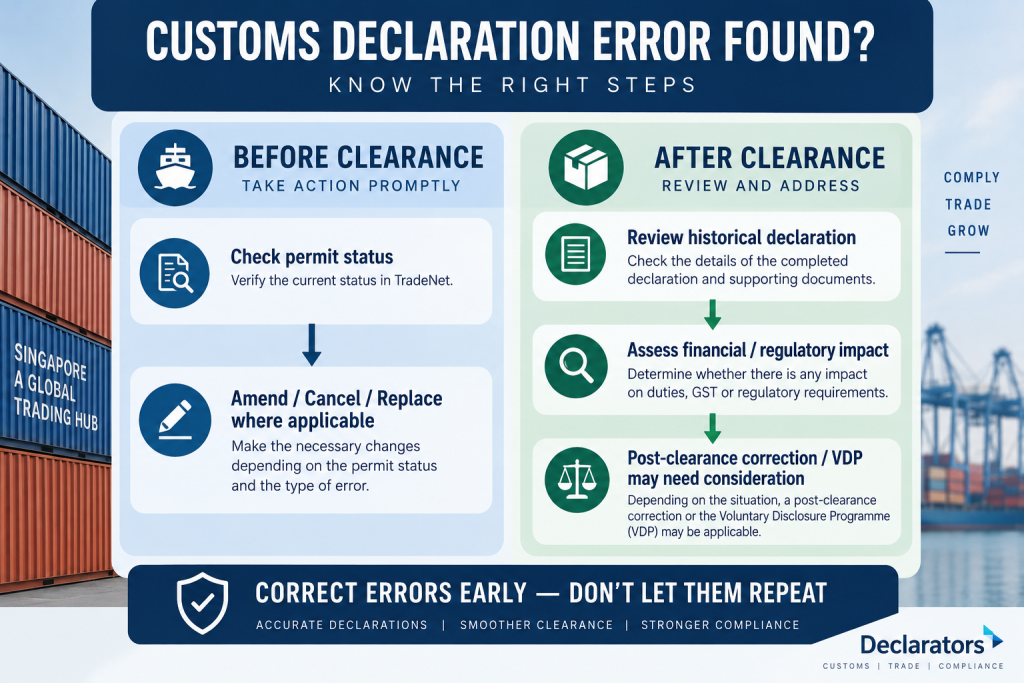
9. Correct Errors Promptly
Customs compliance does not mean that a company will never make a mistake. The important issue is what happens after an error is discovered.
Before cargo clearance – An eligible permit may sometimes be amended.
Non-amendable error – Cancellation and a new permit may be required.
Error discovered after clearance – The company may need to consider a post-clearance corrective process, including Singapore Customs’ Voluntary Disclosure Programme, depending on the circumstances.
Do not simply:
“Fix the next shipment.”
That does not necessarily correct the historical declaration.
10. Keep Customs Records for at Least Five Years
Document retention is not simply an administrative preference. Singapore Customs states that both traders and their Declaring Agents must retain documents relating to the purchase, import, sale or export of goods for at least five years from the date the permit is approved.
Records can include:
- commercial invoices;
- packing lists;
- Bills of Lading;
- Air Waybills;
- Certificates of Origin;
- insurance certificates;
- books of accounts;
- terms-of-trade documents; and
- other records relating to the movement or sale of the goods.
This is important because Singapore Customs may request supporting documents later. A business should be able to locate:
Permit → Invoice → Packing List → BL/AWB → Supporting Approval
without having to search multiple employees’ inboxes.
11. Be Prepared for a Post-Clearance Audit
Customs compliance continues after the goods are released.
Singapore Customs conducts post-clearance audits to assess whether traders have complied with Customs requirements.
An audit can review:
- Customs declarations;
- commercial systems;
- financial records;
- non-financial records;
- internal processes;
- stock; and
- previous import/export transactions.
An audit can take place at the trader’s premises or at Singapore Customs’ premises and may focus on selected transactions or a defined period. The best time to prepare for an audit is before you receive an audit notice.
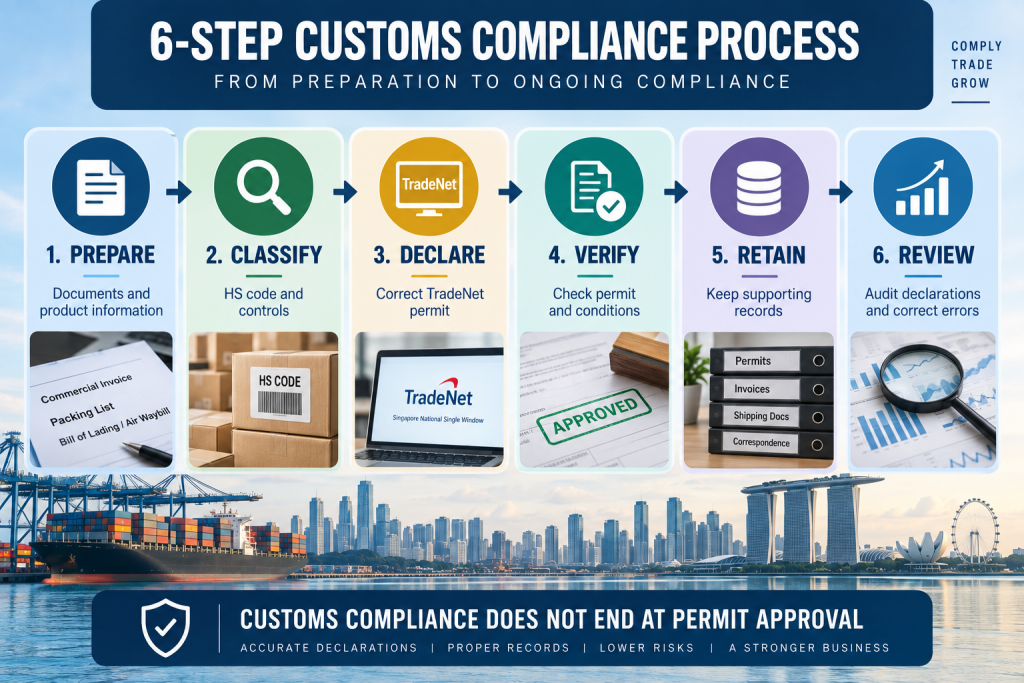
12. Build a Simple Internal Customs Compliance Process
Customs compliance does not need to involve an enormous manual. For many SMEs, a basic process is already a major improvement.
Before Declaration
Check:
- importer/exporter;
- goods;
- HS code;
- origin;
- value;
- quantity;
- controlled-goods requirements.
Before Cargo Movement
Check:
- permit approved;
- permit valid;
- conditions reviewed;
- supporting approvals available;
- shipment information unchanged.
After Shipment
Check:
- final documents match declaration;
- any changes were properly addressed;
- records stored centrally;
- recurring errors documented.
This creates a simple:
PREPARE → DECLARE → VERIFY → MOVE → RETAIN → REVIEW
workflow.
7 Customs Compliance Mistakes Businesses Should Avoid
- Copying Old Permit Information Without Reviewing It – Past declarations are useful references, but not proof that current information is correct.
- Relying Entirely on Supplier HS Codes – The importer/exporter should ensure the classification is appropriate for the actual goods.
- Confusing Country of Export With Country of Origin – They can be different.
- Waiting Until Cargo Arrival to Check Controlled Goods – Regulatory approval may take time.
- Ignoring Small Declaration Differences – A small repeated error can become a larger historical compliance issue.
- Failing to Retain Supporting Records – Singapore Customs requires relevant trade documentation to be retained for at least five years.
- Assuming the Declaring Agent Is Responsible for Everything – A declaring agent can prepare and submit the permit, but the business still needs to provide accurate commercial and product information. A good relationship between importer/exporter and declarant is therefore a shared compliance process.
Customs Compliance Pre-Shipment Checklist
Before cargo moves, check:
- Correct importer/exporter and UEN
- Correct permit type
- Invoice reviewed
- Packing list reviewed
- BL/AWB information checked
- Product description accurate
- HS classification reviewed
- Country of origin confirmed
- Customs value checked
- Quantity and units correct
- Duty/GST treatment reviewed
- Controlled-goods status checked
- CA approvals available where applicable
- TradeNet permit approved
- Permit validity checked
- Permit conditions reviewed
- Supporting documents centrally retained
How Declarators Supports Customs Compliance
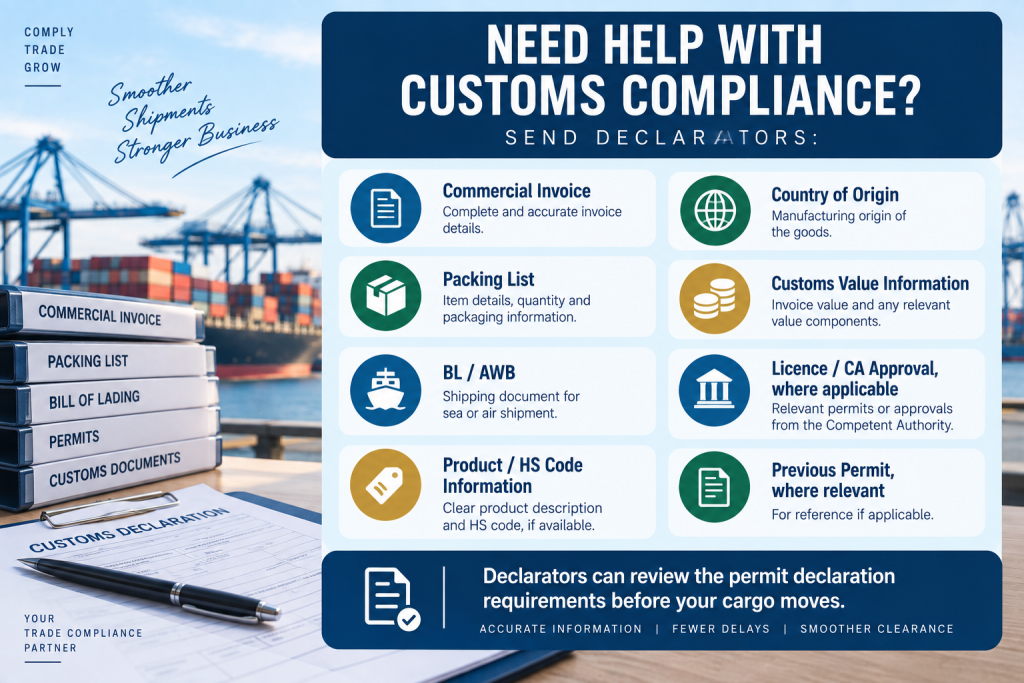
At Declarators Pte Ltd, our work centres on Singapore Customs permit declarations and trade documentation. For us, compliance starts before information is submitted into TradeNet. Depending on the shipment, we may need to review:
- permit procedure;
- importer/exporter details;
- product information;
- HS classification;
- Customs value;
- country of origin;
- quantity;
- transport details;
- controlled-goods requirements; and
- supporting documents.
When shipment information changes after approval, we can also help assess whether the matter involves:
- permit amendment;
- cancellation;
- replacement declaration; or
- another corrective process.
The objective is not simply to obtain permit approval. It is to ensure that the permit is appropriate for the actual cargo movement and supported by accurate information.
Need Assistance With Singapore Customs Permit Declarations?
Provide Declarators with your: Invoice + Packing List + BL/AWB + Product Information + HS Code + Origin + Shipment Details + Regulatory Approval, where applicable and our team can review the relevant permit-declaration requirements before submission.
📞 Call us: +65 6385 2155
📧 Email: group@declarators.com.sg
🌐 Visit: www.declarators.com.sg
Declarators – Your Trusted Declaring Agent in Singapore.