

If your company imports, exports or tranships commercial goods through Singapore, you will probably encounter one term repeatedly:
TradeNet permit.
Your freight forwarder may ask:
“Is the TradeNet permit approved?”
Your warehouse may tell you:
“We need the permit before cargo can move.”
Or your shipment may already be arriving when somebody suddenly realises that no Customs declaration has been submitted. For businesses unfamiliar with Singapore Customs procedures, this can be confusing.
What exactly is a TradeNet permit?
Is it the same as an import permit?
Who submits it?
How long does approval take?
What happens if the application is rejected?
Can an approved permit be amended?
And does an approved TradeNet permit automatically mean your cargo is ready for release? At Declarators Pte Ltd, TradeNet permit declarations form part of our day-to-day Customs declaration work. In practice, obtaining approval is only one part of the process. The permit must also correctly reflect the goods, HS code, Customs value, origin, shipment movement, applicable licences and supporting documentation.
This guide explains how TradeNet permits in Singapore work from the practical perspective of an importer, exporter or logistics operator.
TradeNet Permit Singapore: Quick Answer
A TradeNet permit is a Customs permit obtained through Singapore’s TradeNet system for the import, export or transhipment of goods. Permit applications contain details of the cargo, trader, HS classification, Customs value, origin and movement. Depending on the goods, approval from other Competent Authorities may also be required before the permit can be approved.
Singapore Customs requires the relevant Customs permits to be approved before goods requiring permits are presented for clearance. For controlled goods, the necessary licences and approvals from the relevant Competent Authorities must also be obtained.
Key Takeaways
- TradeNet is Singapore’s electronic trade-declaration system.
- Import, export and transhipment permits are submitted through TradeNet.
- Businesses can submit declarations through an authorised setup or appoint a Declaring Agent to handle them.
- An application is not the same as an approved permit.
- The correct HS code is critical.
- Controlled goods may require another authority’s approval.
- The permit must correspond with the actual shipment.
- Approved permits have validity periods.
- Permit conditions must be checked before cargo movement.
- Some approved permits can be amended or cancelled where the applicable conditions are met.
- Historical declaration errors may require a different corrective process.
- Businesses and Declaring Agents are generally required to retain supporting trade records for five years.
What Is TradeNet?
TradeNet is Singapore’s national electronic platform used for trade declarations Instead of businesses submitting separate paper applications to different authorities for every shipment, relevant trade information is submitted electronically.
TradeNet is used for Customs declarations involving movements such as:
- imports;
- exports;
- transhipments;
- re-exports;
- temporary imports and exports;
- dutiable goods;
- controlled goods; and
- other specialised Customs procedures.
Depending on the goods and movement, information submitted through TradeNet can also be routed to the relevant Competent Authority for approval. This is why a TradeNet declaration should not be thought of as merely:
“Filling in a Customs form online.”
The declaration brings together information about the goods, trader, shipment, taxation and regulatory requirements.
What Is a TradeNet Permit?
A TradeNet permit is the approved declaration generated after the relevant permit application has been processed. Businesses commonly use several terms interchangeably:
- TradeNet permit;
- Customs permit;
- Cargo Clearance Permit;
- import permit;
- export permit;
- transhipment permit; and
- CCP.
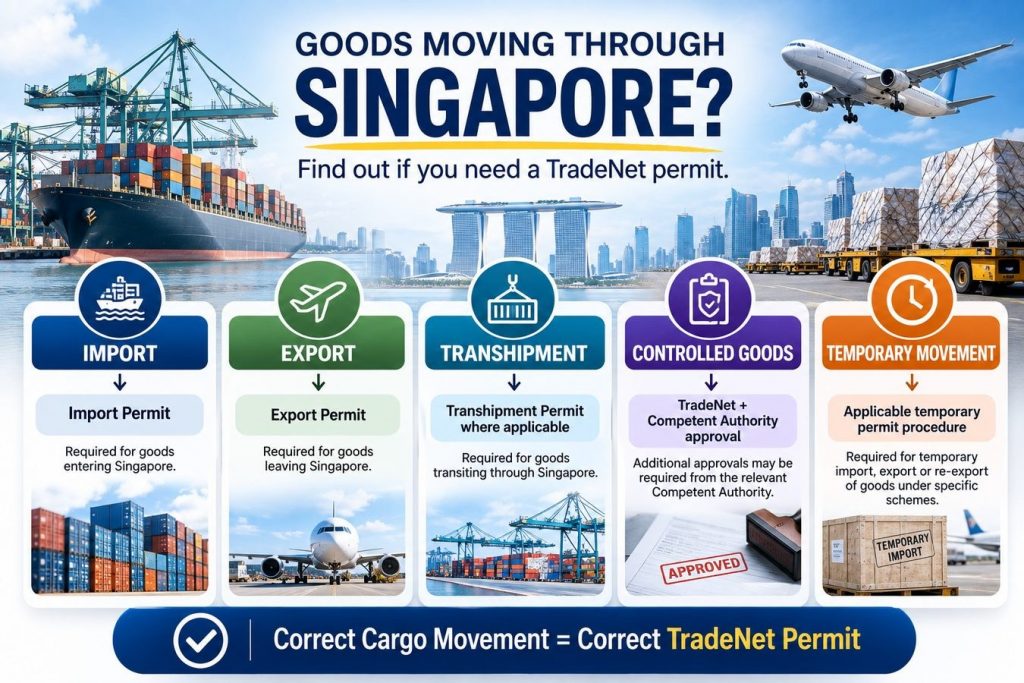
The exact permit type depends on the actual transaction. For example:
Goods entering Singapore for local use
An appropriate import permit is generally required.
Goods leaving Singapore
An appropriate export permit may apply.
Goods moving through Singapore
A transhipment permit may be required.
Goods entering temporarily
A temporary-import procedure may apply.
The question should therefore not simply be:
“Do I need TradeNet?”
A better question is:
“What is the correct TradeNet declaration for this cargo movement?”
Who Can Apply for a TradeNet Permit?
Businesses generally have two practical options.
Option 1: Submit Permit Applications Internally
Companies with the relevant setup, accounts and trained declarants may manage their TradeNet declarations internally. This approach is more common among organisations with:
- dedicated trade-compliance teams;
- high declaration volumes;
- experienced Customs staff; and
- established internal procedures.
Option 2: Appoint a Declaring Agent
Businesses may appoint a Declaring Agent to submit TradeNet declarations on their behalf. Singapore Customs guidance expressly allows businesses to appoint an agent, freight forwarder or TradeNet service provider to submit relevant permit applications rather than submitting applications themselves.
For companies importing or exporting occasionally, outsourcing the permit declaration is often more practical than maintaining an internal declaration function.
When Do You Need a TradeNet Permit?
TradeNet permits can apply to a wide range of commercial cargo movements.
1. Importing Goods Into Singapore
Commercial imports generally need to be accounted for using the appropriate import declaration unless a specific exemption applies. The permit type depends on factors such as:
- whether GST or duty is payable;
- whether goods are stored under a suspension scheme;
- whether they are controlled;
- whether the import is temporary; and
- what happens to the goods after arrival.
2. Exporting Goods From Singapore
Commercial exports may also require an appropriate TradeNet export declaration. The declaration can include information about:
- exporter;
- consignee;
- destination;
- HS code;
- origin;
- quantity;
- value;
- outward transport; and
- cargo movement.
For certain export transactions, permit data may also support Singapore’s international Customs-data exchange arrangements. Current Singapore Customs documentation identifies information such as exporter details, consignee, HS code, quantity, origin, transport mode and TradeNet permit number among data transmitted under the ASEAN Customs Declaration Document arrangement where applicable.
3. Transhipment Through Singapore
Singapore is a major transhipment hub. Goods can arrive by:
- sea;
- air; or
- land,
before continuing to another destination. A TradeNet transhipment permit may be required depending on:
- the goods;
- the transport movement;
- whether cargo changes gateway;
- whether the goods are controlled; and
- the relevant Customs procedure.
This is particularly important for sea-to-air or air-to-sea transhipments, where cargo physically moves between different checkpoints or Free Trade Zones.
4. Controlled Goods
One of the most important functions of TradeNet is coordinating declarations involving goods regulated by another government agency. Examples may include certain:
- food products;
- telecommunications equipment;
- pharmaceuticals;
- chemicals;
- plants;
- animals;
- hazardous goods;
- vehicles; and
- strategic or security-sensitive goods.
The TradeNet permit does not replace the applicable licence. If another Competent Authority regulates the goods, that approval may need to be obtained before the overall declaration can be approved. Singapore Customs requires the necessary CA licences and permits to be approved before controlled goods are imported, exported or transhipped.
What Information Is Required for a TradeNet Permit?
A permit application can involve significantly more information than many first-time importers expect. Depending on the permit, the declaring agent may need information relating to:
Trader Details
- importer UEN;
- exporter UEN;
- consignee;
- declaring agent.
Product Details
- goods description;
- HS code;
- quantity;
- unit of measurement;
- country of origin.
Commercial Details
- invoice number;
- invoice date;
- currency;
- Customs value;
- freight;
- insurance.
Transport Details
- Bill of Lading;
- Air Waybill;
- vessel;
- flight;
- container;
- transport mode;
- port of loading/discharge.
Cargo-Movement Details
- place of receipt;
- place of release;
- arrival/departure date;
- permit procedure.
Regulatory Information
- CA licence;
- product code;
- supporting approvals;
- previous permit number where applicable.
The exact requirements depend on the transaction.
Documents to Send Your Declaring Agent
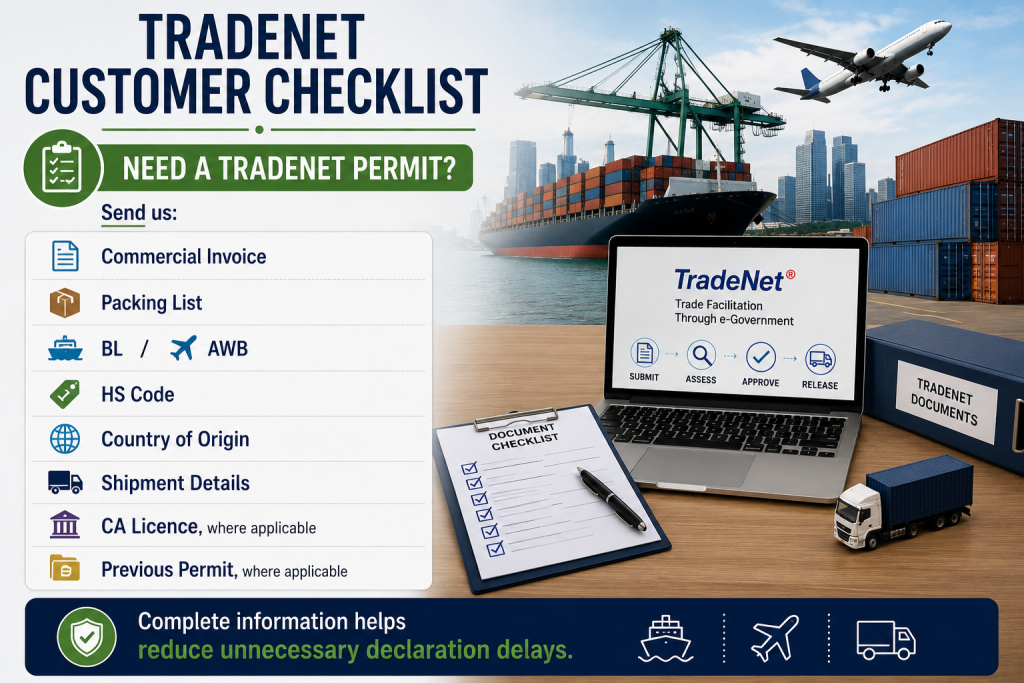
If you want a smoother TradeNet application, send complete information from the start. A practical document set may include:
Commercial Invoice
Check:
- seller;
- buyer;
- product;
- value;
- quantity;
- currency.
Packing List
Ensure quantities and packaging correspond with the invoice.
Bill of Lading or Air Waybill
Used to support transport and shipment information.
HS Code
If known, provide it. If uncertain, don’t simply guess.
Product Description
Provide enough detail for the goods to be understood.
Country of Origin
Don’t confuse this with the country of export.
Regulatory Approval
Where controlled goods are involved, provide the relevant licence or registration information.
How Does the TradeNet Permit Process Work?
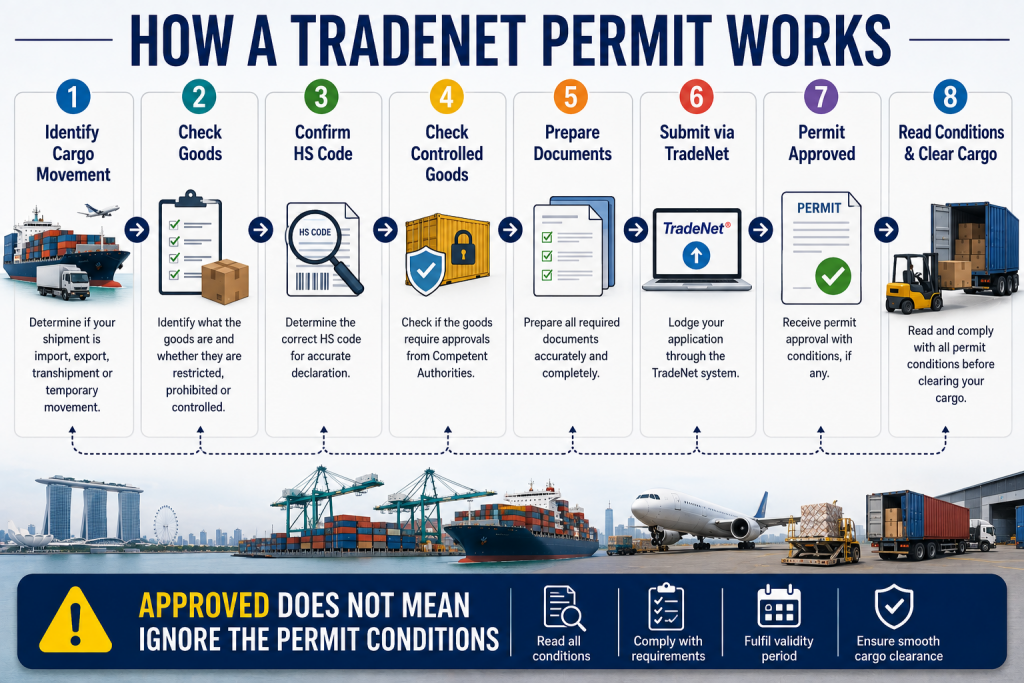
From a customer’s perspective, the workflow can be broken into eight stages.
Step 1 — Identify the Cargo Movement
First determine whether the transaction is:
- import;
- export;
- re-export;
- transhipment;
- temporary import/export; or
- another Customs procedure.
This determines the starting point for the declaration.
Step 2 — Review the Goods
The goods need to be properly understood. For example:
Poor description:Parts
Better:Stainless steel centrifugal pump impeller
An accurate description helps with classification and regulatory checks.
Step 3 — Determine the HS Code
The Harmonised System code is one of the most important pieces of Customs declaration information.
It can affect:
- Customs duty;
- Competent Authority controls;
- product codes;
- import/export restrictions;
- Rules of Origin;
- statistics; and
- other declaration requirements.
An incorrect HS code can cause permit rejection or incorrect regulatory treatment. For certain regulated goods, agencies explicitly require HS quantities and product-code quantities to be consistent; otherwise TradeNet may automatically reject the application.
Step 4 — Check Controlled-Goods Requirements
Before declaration, establish whether another government authority regulates the product.
If the goods require:
- licence;
- registration;
- approval; or
- product code,
obtain the necessary information early.
Waiting until cargo arrives can create avoidable storage and clearance costs.
Step 5 — Prepare the Declaration
Your declarant enters the relevant shipment information into TradeNet.
This can include:
WHO
Importer, exporter, consignee.
WHAT
Goods and HS classification.
WHERE
Origin, receipt, release, destination.
HOW MUCH
Quantity and value.
HOW
Air, sea or land movement.
Step 6 — Submit Through TradeNet
Once submitted, the declaration is processed electronically. Depending on the goods, processing may involve:
- Singapore Customs;
- another Competent Authority; or
- multiple regulatory checks.
Some controlled-goods applications require supporting documents to be uploaded with the TradeNet declaration. For example, current SPF guidance for certain regulated goods requires documents such as invoices, packing lists, BL/AWB and relevant licences to support TradeNet applications.
Step 7 – Receive the Permit Outcome
This is where an important distinction needs to be made:
SUBMITTED ≠ APPROVED
A permit application may be:
Approved
The Customs permit has been issued.
Pending / Processing
The declaration is still under assessment.
Queried
Additional information may be needed.
Rejected
The declaration must be corrected or another requirement satisfied. Operational teams should therefore wait for the appropriate approved permit rather than assuming cargo can move immediately after submission.
Step 8 — Read the Permit Conditions
An approved permit can still contain important clearance instructions. Singapore Customs expressly requires businesses to read and comply with the permit conditions because requirements vary between permit types. Examples include producing cargo at checkpoints and completing onward clearance within prescribed periods. This is one of the biggest practical mistakes businesses make:
Seeing “APPROVED” and not reading anything else.
Always review the conditions.
How Long Does TradeNet Permit Approval Take?
This is one of the most common questions customers ask. Unfortunately, there is no single approval time applicable to every TradeNet permit. Processing depends on factors such as:
- permit type;
- goods;
- accuracy of declaration;
- controlled-goods status;
- Competent Authority;
- supporting documents;
- queries; and
- whether further clarification is needed.
Some straightforward declarations can be processed electronically very quickly. Others require manual regulatory review. For example, current guidance for certain controlled explosives recommends submission at least five working days before the cargo movement, with the regulator stating that such declarations are generally processed within that timeframe and cannot simply be fast-tracked on request. The practical lesson is:
Do not assume every TradeNet permit is instant.
Prepare before the cargo becomes urgent.
Why Does a TradeNet Permit Get Rejected?
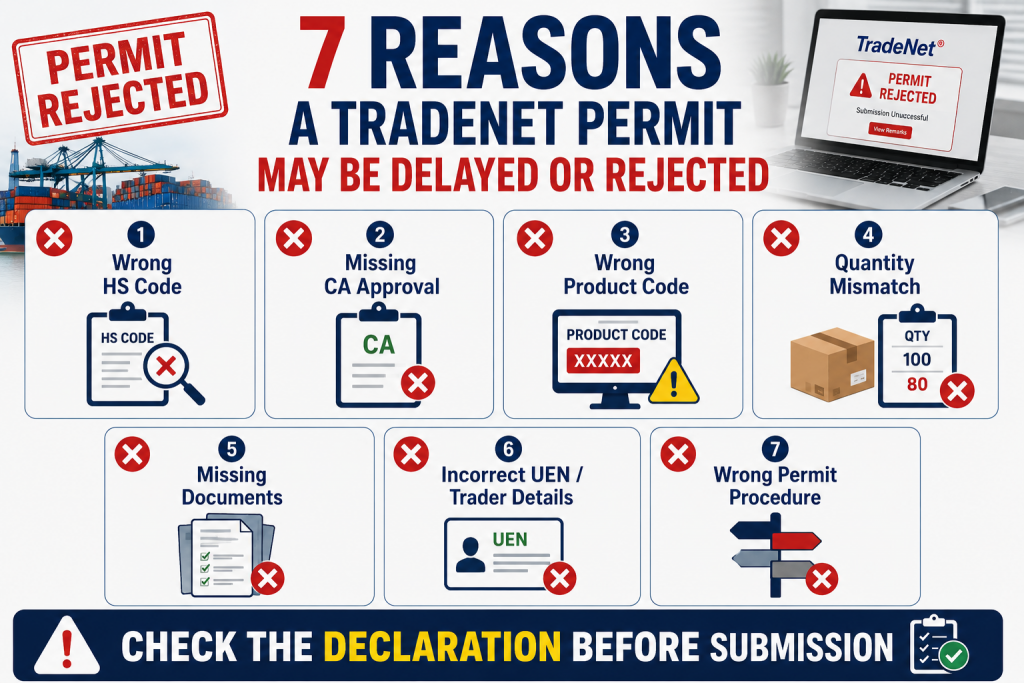
Permit rejection can happen for many reasons. Some of the most common practical issues include:
- Incorrect HS Code – The classification may not correspond with the goods.
- Missing Competent Authority Approval – A regulated product requires another authority’s approval.
- Incorrect Product Code – HS code and CA product information may not correspond.
- Quantity Mismatch – Declared HS quantity and regulated-product quantity may not tally.
- Incomplete Supporting Documents – Invoice, packing list, licence or transport information may be missing.
- Incorrect Trader Information – The wrong UEN or entity may have been used.
- Wrong Permit Procedure – The declaration type may not reflect the actual cargo movement.
What Should You Do If Your TradeNet Permit Is Rejected?
First:
Don’t keep resubmitting the exact same declaration.
Find out why it was rejected. Your declaring agent should review:
- rejection message;
- affected field;
- HS code;
- product code;
- CA requirement;
- supporting documents;
- permit procedure; and
- shipment information.
Sometimes the solution is straightforward. For example:
Missing licence number → Provide the correct approval. Other situations require more work.
For example:
Product appears controlled under another authority → Establish the correct regulatory requirements before reapplying. This is why the exact rejection message matters.
What Does “Approved TradeNet Permit” Actually Mean?
Approval means the declaration has been accepted for the stated permit process.
It does not necessarily mean:
- Customs will never inspect the goods;
- no checkpoint presentation is required;
- the cargo can move at any time;
- the permit remains valid forever; or
- there are no conditions attached.
You still need to check:
- Permit validity
- Permit conditions
- Goods description
- Quantity
- Customs value
- Origin
- Container / transport information
- Regulatory approvals
- The permit should correspond to the actual cargo.
How Long Is a TradeNet Permit Valid?
TradeNet permits are issued with validity periods. The exact validity depends on the permit and cargo movement. Singapore Customs requires traders to check the validity shown on their approved permit. If the permit cannot be utilised within that period, the business should consider applying for an extension through TradeNet while it is still eligible, or cancel and reapply where appropriate.
Do not assume:
“The permit was approved last month, so it should still be fine.”
Check the actual permit. Certain specialised permits have their own validity rules. For example, current strategic-goods guidance states that specified TradeNet strategic-goods permits are valid for 22 working days and may be extended while still valid.
What Happens If the Shipment Is Delayed?
- A vessel can roll.
- A flight can change.
- The customer can postpone a shipment.
- If the permit will no longer be used within its validity period, inform your declaring agent before expiry.
- Depending on the permit, an extension may be possible.
- Once the permit expires, your options can change.
- This is why permit validity should be part of shipment planning rather than something checked only at the checkpoint.
Can You Amend an Approved TradeNet Permit?
Certain approved permits can be amended where the applicable criteria are met. However, not every field is amendable and timing matters.
The important questions are:
- Is the permit still valid?
- Has the cargo already been cleared?
- Is the affected field amendable?
If the information cannot be amended, cancellation and a replacement permit may be necessary depending on the circumstances.
Can You Cancel a TradeNet Permit?
Certain unused TradeNet permits can be cancelled where the applicable requirements are met. Reasons may include:
- shipment cancelled;
- wrong permit procedure;
- non-amendable declaration error;
- duplicate permit; or
- permit no longer required.
Once cancelled, that permit should no longer be used for the cargo movement. If the shipment is still proceeding, a replacement declaration may be required.
What If the Error Is Found After Cargo Clearance?
This is very different from an ordinary amendment. Imagine:
- cargo cleared last week;
- customer received the goods;
- your finance department now discovers the Customs value was wrong.
Or:
- the HS code used for the past year appears incorrect.
The ordinary amendment route may no longer be available once the relevant permit has been utilised.
Depending on the circumstances, the error may need to be assessed under Singapore Customs’ Voluntary Disclosure Programme or another corrective process.
TradeNet Permit vs Cargo Clearance Permit: Are They the Same?
This is another strong search-intent section. The terms are often used interchangeably in day-to-day logistics conversations. A Cargo Clearance Permit is the approved permit associated with the relevant Customs declaration and used for cargo-clearance purposes where applicable.
A TradeNet permit generally refers to a permit application submitted and approved through the TradeNet system.
In practical operations, somebody saying:
“Please send me the TradeNet permit.”
May simply be asking for the approved Customs permit needed for that shipment. However, always check the actual permit type and conditions rather than relying solely on informal terminology.
TradeNet Permit vs Import Licence
These are not necessarily the same thing. A TradeNet Customs permit accounts for the cargo movement.
A controlled product may additionally require a licence or approval from a Competent Authority. For example:
TradeNet Permit / Relevant CA Licence
May both be necessary. This explains why a business can provide all of its shipping documents and still be unable to obtain permit approval:
A regulatory prerequisite may still be missing.
What Happens If Cargo Arrives Before the TradeNet Permit Is Ready?
This is a common real-world problem. The cargo arrives. Then the company starts preparing the declaration. Depending on the shipment, goods may remain with the:
- terminal;
- airline handling agent;
- port;
- warehouse;
- freight forwarder; or
- other operator
while the required permit is obtained. That can potentially lead to additional:
- storage;
- handling;
- demurrage; or
- operational costs.
The better approach is to provide permit instructions before arrival wherever possible.
How Early Should You Apply for a TradeNet Permit?
There is no universal rule such as:
“Always apply exactly 24 hours before arrival.”
The appropriate timing depends on the goods and declaration. For ordinary commercial cargo, prepare once reliable shipment documents are available.
- For controlled goods, allow more time because another authority may need to review the application.
- For specialised regulated products, agencies may prescribe significantly longer lead times.
The operational rule we recommend is simple:
Don’t wait until the cargo reaches the checkpoint.
TradeNet Permit Checklist Before Cargo Moves
Before the shipment proceeds, confirm:
- Correct importer/exporter
- Correct UEN
- Commercial invoice reviewed
- Packing list reviewed
- BL/AWB correct
- Product description accurate
- HS code checked
- Quantity correct
- Country of origin correct
- Customs value reviewed
- Freight/insurance included where applicable
- Controlled-goods requirements checked
- CA licence approved where applicable
- Correct permit procedure selected
- TradeNet permit approved
- Permit validity checked
- Permit conditions read
- Operations team has latest permit copy
How Long Should TradeNet Records Be Kept?
Customs compliance does not end when the shipment is delivered. Singapore Customs requires traders and Declaring Agents to maintain transaction records, including supporting documents, for five years. Relevant records may include:
- permits;
- commercial invoices;
- packing lists;
- Bills of Lading;
- Air Waybills;
- licences;
- product information;
- Customs valuation records; and
- other supporting documents.
Proper recordkeeping becomes particularly important during a Customs audit or when a historical declaration error is discovered.
What Are the Most Common TradeNet Permit Mistakes?
From an operational perspective, the mistakes that create the most unnecessary
problems usually fall into a few categories.
Wrong Cargo Information – Quantity, description or shipment details do not match.
Wrong HS Classification – This may affect duties or regulatory controls.
Missing CA Approval – The goods are controlled, but licensing was checked too late.
Incorrect Customs Value – The amount declared does not reflect the applicable valuation requirements.
Wrong Country of Origin – Country of export was mistaken for country of origin.
Using an Expired Permit – The shipment moved later than planned but nobody checked validity.
Not Reading Permit Conditions – Operations receives the approved permit but misses a checkpoint requirement. Most of these problems are easier to correct before cargo movement than afterwards.
Why Use a Declaring Agent for TradeNet Permits?
For companies with experienced Customs teams, managing TradeNet internally may be appropriate. For others, appointing a Declaring Agent can reduce the operational burden. This may be particularly useful for businesses that:
- import occasionally;
- export occasionally;
- handle multiple permit types;
- deal with controlled goods;
- are unfamiliar with HS classification;
- need temporary permits;
- operate under warehouse or suspension schemes;
- require permit amendments;
- need urgent cargo clearance; or
- do not maintain dedicated Customs personnel.
A declaring agent should do more than simply enter information. A proper declaration depends on understanding the cargo movement and reviewing the supporting documents.
How Declarators Helps With TradeNet Permit Declarations
At Declarators Pte Ltd, TradeNet permit declaration is one of our core services. We assist with permit requirements involving:
- imports;
- exports;
- transhipments;
- re-exports;
- Cargo Clearance Permits;
- temporary movements;
- controlled goods;
- permit amendments;
- permit cancellations;
- Customs valuation information;
- warehouse movements; and
- other Customs declaration procedures.
Our work generally begins with a simple question:
What exactly is happening to the cargo?
From there, the relevant information can be reviewed:
- What are the goods?
- Who is importing/exporting?
- Where are they coming from?
- Where are they going?
- What is the HS code?
- Are they controlled?
- What is the Customs value?
- What documents are available?
- When is the cargo moving?
The objective is not merely to obtain the word “APPROVED” on a permit. The objective is to make sure the approved permit corresponds with the actual shipment and its Customs requirements.
Need a TradeNet Permit? Prepare Before the Cargo Moves
- A permit that is approved but inaccurate can still create problems.
- A permit that is accurate but expired cannot simply be assumed to remain usable.
- A permit application that has merely been submitted should not be treated as approved.
The most reliable TradeNet workflow is therefore:
Prepare → Check → Declare → Approve → Verify → Move
Send Declarators your: 📄 Invoice + 📦 Packing List + 🚢 BL/AWB + 🏷️ HS Code + 🌏 Origin + Shipment Details + CA Licence, where applicable and our team can review the relevant permit-declaration requirements before your cargo moves.
Declarators Pte Ltd
The Customs Specialist
Tel: +65 6385 2155
Email: group@declarators.com.sg